
The Night the Seven Sisters Host Mars and Uranus
Just before dawn on July 5, two planets rise side by side between the Pleiades and the Hyades. One is red and restless, the other almost invisible. The gap between them is larger than your eye can ever measure, and that has something to say about the choices you make today.
The Night the Seven Sisters Host Mars and Uranus
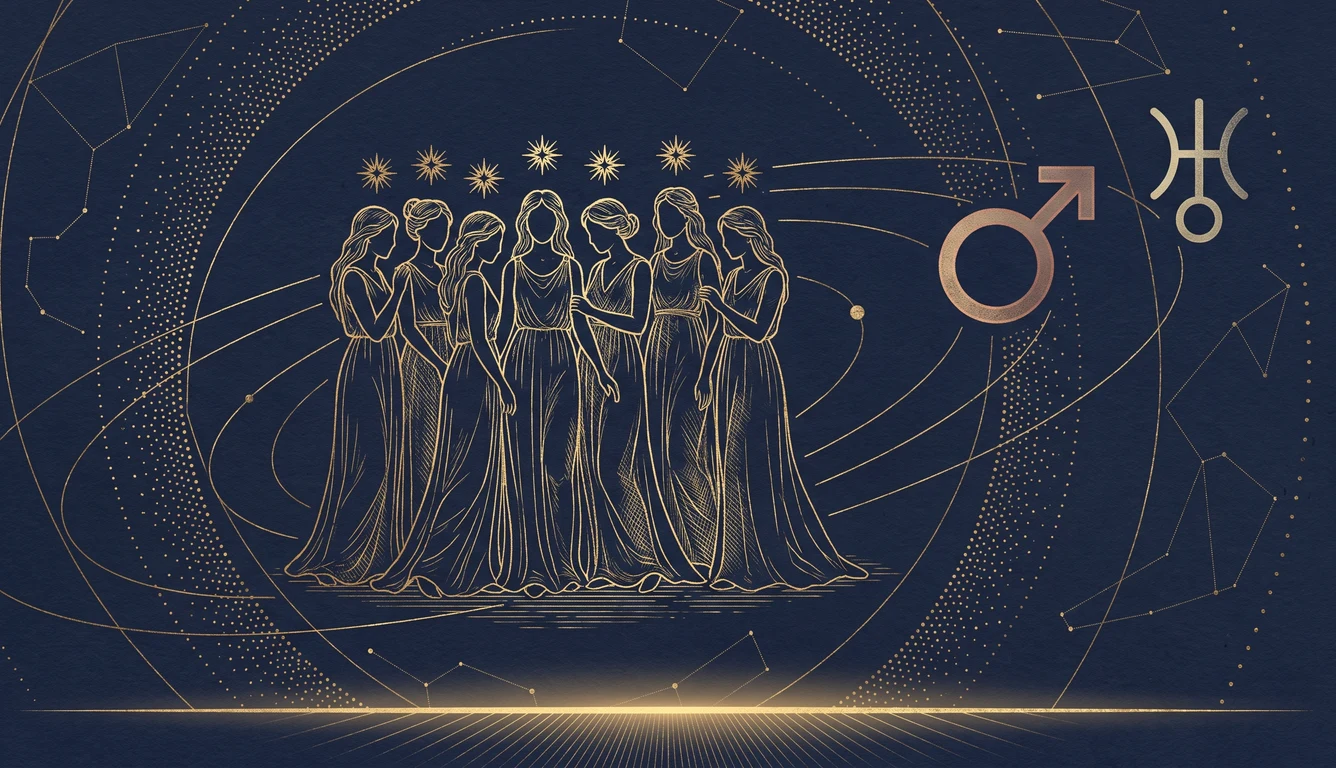
Picture someone looking east about an hour before sunrise in early July. Not in the dark of full night, but in that thin blue that comes before the sun. Away from the city, maybe at the edge of a field, maybe on a hilltop. The sky is still deep, but a faint light is beginning low in the east. A little above it sits a small knot of stars. Crowded, tiny, hazy. At first a smudge, then, as the eye settles, a handful of separate points. This is a cluster the Greeks called the Pleiades, the Seven Sisters, one of the oldest patterns humans have named.
And this morning, right beside the Pleiades, there are two visitors. One is red, easy to catch. The other is so faint you would miss it if you didn't know it was there. The red one is Mars, planet of drive and the forward move. The dim point near the limit of vision is Uranus, planet of the sudden and unexpected. On the night of July 5, these two pass side by side, threading between the sky's two oldest star nurseries, the Pleiades and the Hyades.
The trick of the sky
Let's be honest first, because what you see is not what is actually there.
Mars and Uranus are said to be in "conjunction." It sounds like two bodies meeting, touching. In truth there is an unthinkable distance between them. The light reaching us from Mars has traveled about fifteen minutes. The light from Uranus has traveled for hours, because Uranus is far, far beyond Mars. So the gap between these two points that seem to sit shoulder to shoulder is larger than your eye could ever grasp.
Why do they look side by side, then? Because the sky reads to us like a flat ceiling. There is no depth up there, only direction. When two bodies fall along the same line, we can't see the gulf between them, and they seem to overlap. Like a candle in the foreground lining up with a mountain behind it in a photo. That is all a conjunction is: appearing in the same direction, not meeting. What looks close is actually far.
Hold on to that, because the whole story of this morning turns on that single illusion.
The same thing is true of the Pleiades. That crowded little knot is made of stars that look glued together to your eye. But the Pleiades are a real community, and a close-knit family at that. These stars were born from the same cloud of gas, more or less at the same time. Young, hot, blue stars, about four hundred forty light-years away, still traveling together like siblings. Most people count six or seven with the naked eye. There are actually hundreds up there; the eye catches only the brightest. What looks like a small smudge is a whole family. Close, tight, one thing. It isn't.
The seven sisters and the hunter behind them
When a person looks at a cluster of stars, they can't leave it blank; they build a story around it at once. The Greeks gave this little cluster one of the best.
To them, these seven lights were the seven daughters of Atlas. The seven sisters. Children of the titan who carries the sky on his shoulders. The hunter Orion saw them one day and set off after them. The sisters fled for years, the hunter chased for years. In the end Zeus took pity, turned them first into doves and then into stars, and lifted them into the sky. But Orion is up there too. Even now, a little behind the Pleiades, the same hunter still moves after the same sisters. A chase that never ends, always one step behind.
There is also the "lost sister." Seven are named, but most people count only six with the naked eye. Ancient peoples noticed this and told stories of a sister who vanished. In some she hid from shame, in others she loved a mortal and dimmed. Where the seventh went is a small mystery that has puzzled skywatchers for thousands of years. So the truth of the cluster slips past us again, this time by leaving us one short.
When the Pleiades rise
For readers in this part of the world, the Pleiades are more than a Greek myth. In Anatolia, this cluster wasn't just a story; it was a calendar.
For centuries here, the seasons were read from the stars. The old folk calendar split the year in two: the days of Hızır and the days of Kasım. One of the markers of that split was this cluster, known in Turkish as Ülker. It appears in the sky at the start of November and fades into the daylight after May. Its rising carried a message: the start of the cold, of the harvest, of the season's work. Sayings that begin with "when the Pleiades rise" were really announcing that the door of a season had opened.
For sailors it meant something else. Old seamen called it the "sail-opening star." They would not put out to sea before it appeared, because its position spoke of the weather, the storms, of safe passage. Notice this, because the whole relationship the old world had with the sky was built on exactly this: waiting. They saw the star, but did not act at once. They waited for the right sign. To sow the seed, to sail, to set out, they waited for the sky's clock to show the right hour. The sky was not an order to them, it was a timing. The one who waited, not the one who rushed, was the one who came out ahead.
The speed of the spark
Now back to the planets, because two of them came calling this morning. And here is the strange part: they whisper the exact opposite of the patience the old world learned.
Mars is the urge to move. The wish to do a thing, the drive to push on it, a short-fused anger. Uranus is the sudden and unexpected, the one that breaks the rule, cracks the usual, throws you in another direction all at once. When these two come together, the energy runs on edge and impatient. It flares like a spark.
In a stretch like this, the urge to act rises in you. You want to do something you've put off for ages, cut a tie, slam a door, change course out of nowhere. And there is a good side to that: sometimes a break really is needed, sometimes a thing truly has to change soon. Uranus gives the spark of that change, and Mars sets it alight.
But the same speed has its shadow. The step taken without thinking, the word said in the heat of it, the button pressed in a hurry. A spark flares fast, and a spark that dies fast can leave regret behind it. A star forces you toward nothing; it only lifts a single frequency. That frequency is not deciding for you, it is talking with you.
And here the lesson the sky offers this morning is the same illusion we saw at the very start. Mars-Uranus energy hands you an impulse that shouts "right now," that feels close, that feels urgent. But just like the hours of light between those two planets that seem to sit side by side, there is a depth behind that hurry too. A distance that only shows itself when you wait one night. Listen to that "right now" voice, but don't obey it at once. Let it sit a night. If it still feels right in the morning, then it was your decision all along, not a passing nudge from the sky. Pause first, carry the impulse with awareness, then move. The way the old sailor saw the star and still waited.
Before dawn
Back to the person on the hilltop. In the east the sky keeps brightening, the sun will be up soon and wash out all these lights. Red Mars is still there, they narrow their eyes to catch Uranus, the Pleiades small and crowded, the seven sisters together as ever. Side by side, tight, urgent. But now you know the sky is never quite what it looks like.
So if an urge to act "right now" rises in you today, remember those two visitors. Mars and Uranus, appearing shoulder to shoulder yet carrying a vast distance between them. And that behind the thing that feels urgent there is usually a depth worth waiting for. For thousands of years, the people who read the sky learned the same thing: see the sign, but wait for its hour. Maybe you'll rise early this morning, look east-northeast, and find that red point. And maybe you won't, which is fine too. The real thing is the small piece the sky hands you to keep in your pocket today: not every spark that flares fast has to be lit at once.

You can ask a question about this reading
Atlas (Mit Anlatıcısı) answers your questions about The Night the Seven Sisters Host Mars and Uranus
Comments
You can share your thoughts about the piece here.