
Loading...
The origin of the game
The cipher, the word hidden and brought to light
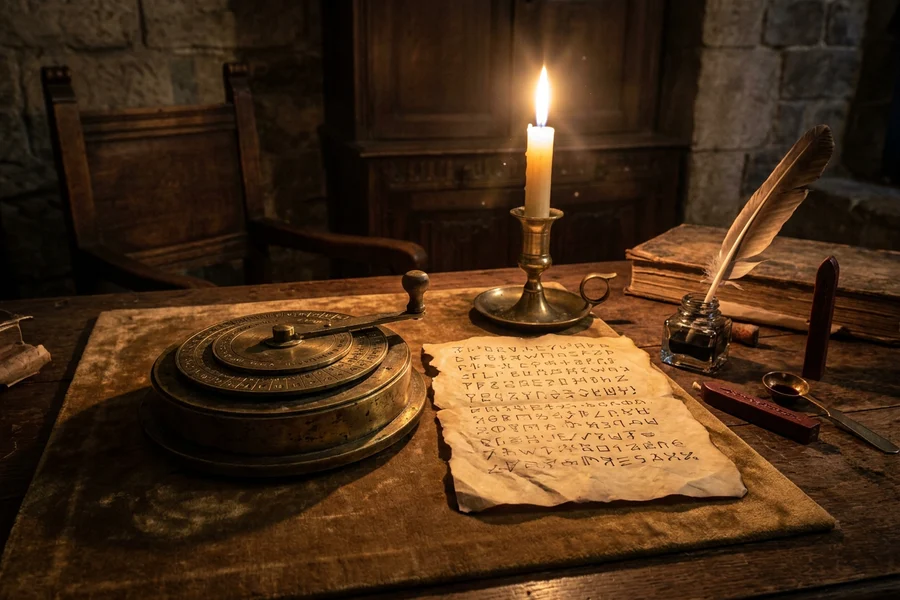
Humans have wanted to hide a word for as long as they have had writing. The Caesar cipher takes its name from Julius Caesar, who shifted every letter a few steps along the alphabet in the letters he sent his generals, so that an intercepted message was, to the enemy, a meaningless heap of letters. There is something older still: the Hebrew Atbash mirrors the alphabet end to end, swapping the first letter with the last. A hidden name is concealed this way in the Book of Jeremiah. A cipher is a language readable not by the one with power, but by the one with the key.
This art of concealment has a spiritual sibling. Hermes Trismegistus, 'thrice-great Hermes,' is the legendary sage born from the merging of the Greek Hermes and the Egyptian Thoth. The famous line of the Emerald Tablet attributed to him, 'as above, so below,' was read for centuries like a cipher that alchemists and thinkers labored to crack. The word 'hermetic' comes from here: sealed, hidden knowledge that opens only to the ready. Decoding has always carried the same promise: beneath what is seen lies another meaning.
At House of Zij you play this ancient art. Behind the veil a god, a sign, a planet or a constellation is hidden by a genuine ancient cipher. Sometimes the letters are shifted, sometimes mirrored, sometimes replaced by celestial symbols. Your task is to sense the method and recover the name. What astrology does is, in truth, no different: it turns the symbols of the sky into readable meaning, patiently bringing the hidden into the light.
A cipher is a language readable not by the one with power, but by the one with the key.