
Loading...
The origin of the game
The sliding puzzle, the whole born from its pieces
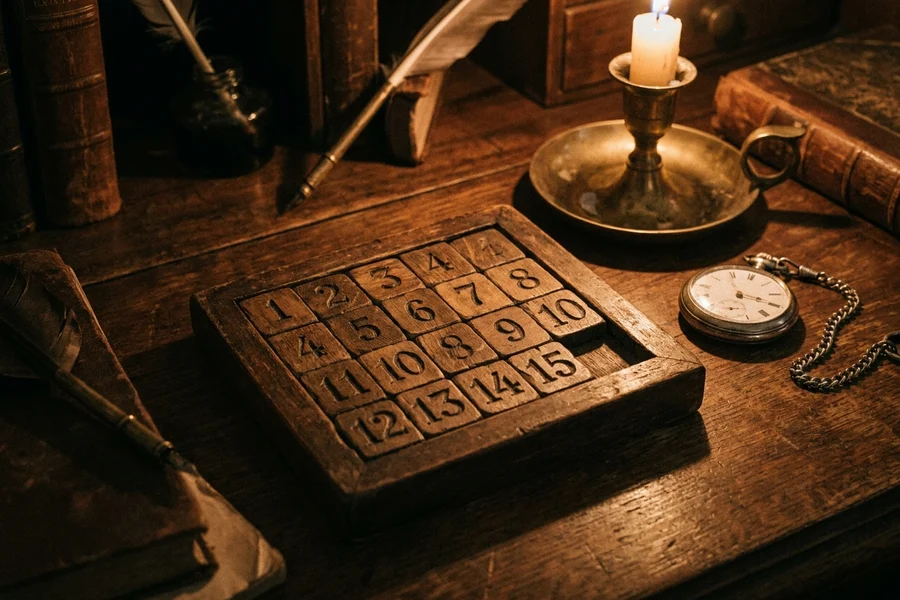
The ancestor of the sliding puzzle was invented in the 1870s by Noyes Chapman, a postmaster in the town of Canastota, New York. There were fifteen numbered tiles and one empty cell, and the player slid the tiles into the gap to set the order right. Chapman took out his patent in 1880, but by then a craze had already begun. It leapt to Europe, factories could not keep up with demand, and employers complained that their workers slid these tiles at their desks all day.
The famous puzzle master Sam Loyd later claimed he had invented the game, and offered a thousand dollar prize for an arrangement that could not be solved. That arrangement was mathematically impossible, as had already been proven, and Loyd never had to pay. Even so, the bluff made the game more famous still. The sliding puzzle has lived on ever since, in pockets, in nurseries, on tabletops.
At House of Zij this puzzle breaks a Mythic Arkana card into its pieces. By sliding the tiles one by one, you make a fractured image whole again. There is a fine metaphor here: the card is already there, complete, only scattered. Astrology often feels the same, the pieces are in our hands but seeing the whole takes patience. With each right move the broken image settles into place, and suddenly meaning appears.
The card is already there, complete, only scattered; seeing the whole takes patience.