
Loading...
The origin of the game
Solo Noble, the patience of the lone noble
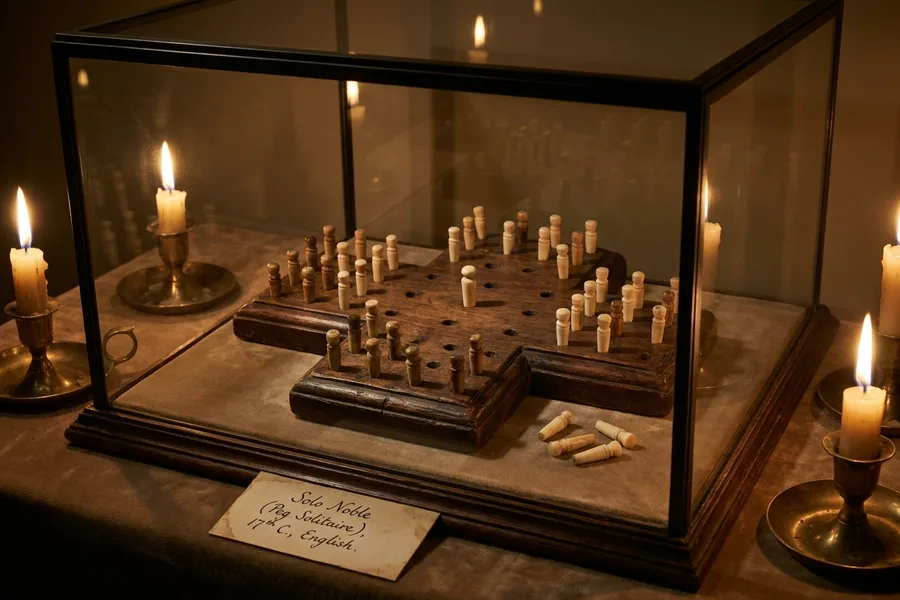
The most beloved legend of this game is set in a prison. The story goes that a French nobleman locked in the Bastille in the seventeenth century sought a game he could play alone, and invented it with the pegged board before him. True or not, the French name comes from here: solitaire, the one played alone. Its first certain record appears in 1697, in an engraving of a princess at a French court playing this very game.
The board has two classic forms: the thirty-three-hole English cross and the thirty-seven-hole French board. The rule is the same in both and strikingly pure: a peg jumps over its neighbor into an empty hole, and the jumped peg is removed. Despite its simplicity the game hides deep mathematics; to finish with a single peg you must see the order of moves with real skill.
At House of Zij the pegs become stars. You begin with thirty-two, each jump dims one, and your aim is to leave a single star behind. The quiet lesson of this game rhymes with a mystic intuition: to ripen is often not to add but to subtract. By letting go of the needless, piece by piece, you are left with the essence alone, a single bright point.
To ripen is often not to add but to subtract; you are left with the essence alone, a single bright point.