
Loading...
The origin of the game
The twelve houses of Mancala
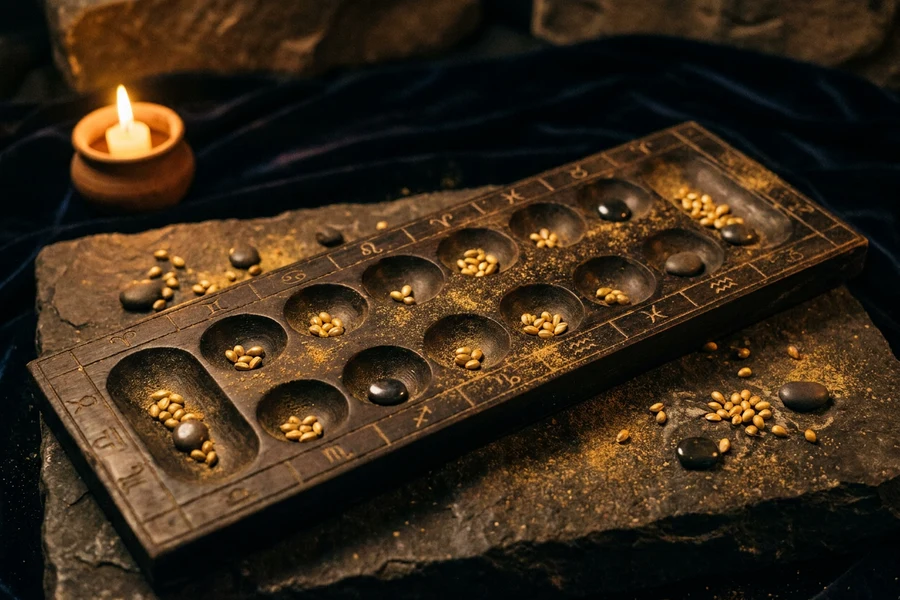
Mancala is one of the oldest families of board games the world has known. Its roots stretch into Africa, and from there back to ancient Egypt. Rows of pits carved into temple walls and rock faces have been found, from many thousands of years ago. Stones or seeds are laid into hollows cut in a board, or even in the bare earth, and the player sows them from place to place in a set order. Its name comes from the Arabic naqala, to move.
This game was built on a farmer's logic: take the seed, sow it along the row, gather the harvest. It spread from continent to continent along trade caravans, slave routes and pilgrim roads. In Africa, the Middle East and Asia it was played under hundreds of different names and rules. With a simple board and a handful of stones, needing not even paper and pen, it passed from one generation to the next. Perhaps that is why it still lives.
At House of Zij the pits of Mancala have become the twelve astrological houses. From the first house to the twelfth, every stone you sow feeds a domain, every harvest you gather tells a story. The deeper wisdom of the game lies at the heart of astrology too: you reap what you sow, and when everything is gathered into the right house, a wholeness is born. What the old farmer knew, the sky knows as well.
You reap what you sow, and when everything is gathered into the right house, a wholeness is born.