
Loading...
The origin of the game
Chess, the game of kings and gods
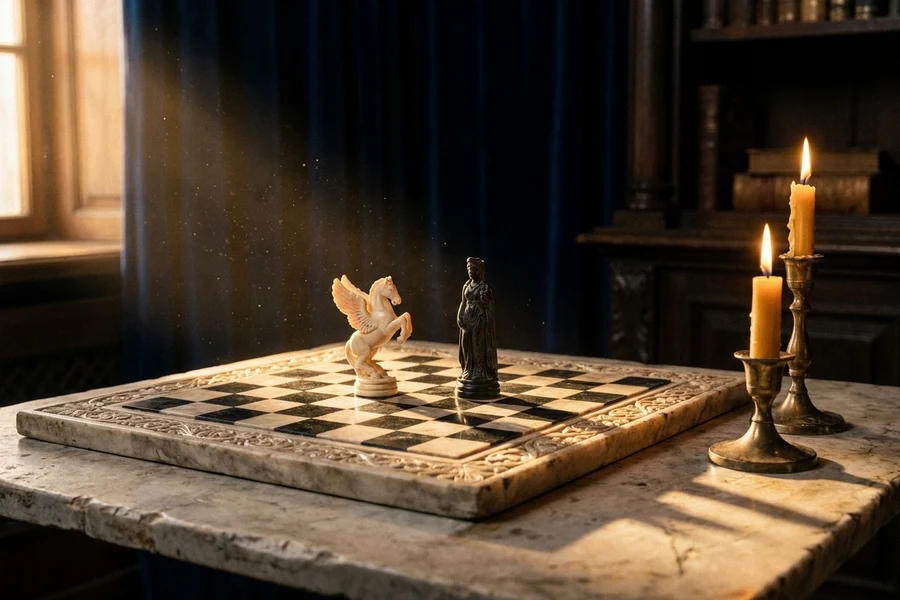
Chess was born around the sixth century in the India of the Gupta Empire. Its first name was chaturanga, the four divisions: infantry, cavalry, elephants and chariots, the four limbs of an ancient army. In time these four divisions became the pieces we know. When the game passed to Persia its name turned to shatranj, and our word checkmate comes from there: shah mat, the king is helpless. A miniature of war, a dance of one mind with another.
The Islamic world embraced chess and carried it into Europe across the Iberian Peninsula. Around the fifteenth century the rules changed deeply, the queen became the most powerful piece, the bishop opened onto long diagonals, and the game took on the swift, sharp form we play today. For centuries kings, philosophers and poets bent over these sixty four squares. It is perhaps the most elegant way to learn war without spilling blood.
At House of Zij chess narrows to a single move checkmate puzzle, and the board is dressed in the gods of Olympus. The position before you is like a moment: the right move is there, you need only see it. Astrology loves a moment like this too, the instant when a critical aspect lines up flawlessly, a threshold where the sky readies a move. Chess lets you play the seeing of that threshold, the choosing of the one right step out of many.
The position before you is like a moment: the right move is there, you need only see it.