

What the cup is saying
Cup Reading
Photograph your cup from three angles, and add two close ups if you wish. Lila scans the symbols with AI Vision and reads them in depth, following the classic Turkish tradition and archetypal symbolism. Always open, unlimited.
Upload your cup →
The Cup Journal
Every cup and every symbol gathered in a single archive. Recurring symbols, patterns that surface over time, the traces of the past in the present.
Open my journal →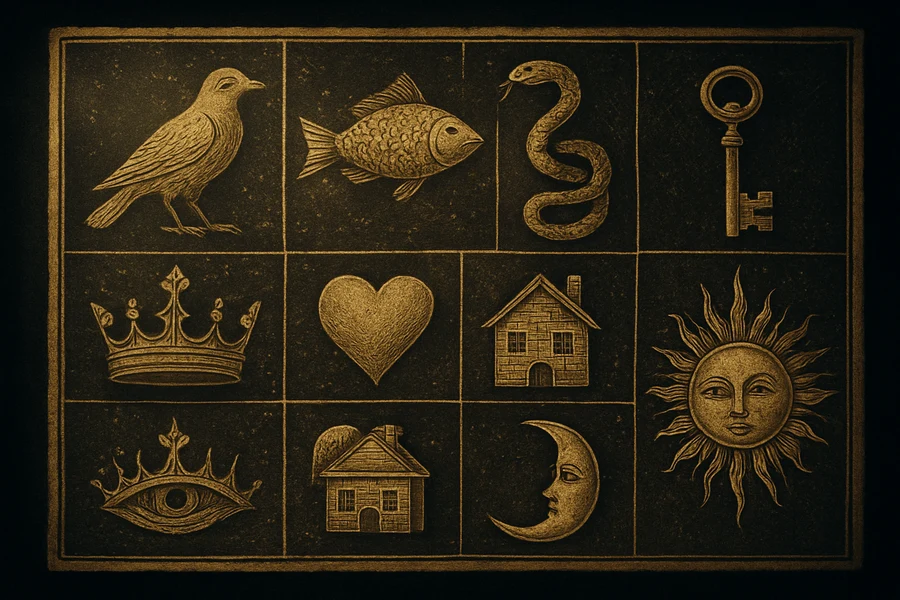
A wide view of the symbols
More than three hundred symbols in one place. For each one, its traditional Turkish meaning, its Jungian archetypal reading, its combinations and the way the reading shifts with its position in the cup. You can use it as a reference atlas, kept open beside you as you read your own cup.
This is not a single reading, it is the dictionary of the language of coffee. Always open, unlimited, for everyone.
Open the symbol library →What is coffee reading?
Coffee reading is the practice of reading the shapes that Turkish coffee grounds leave on the inner surface of the cup as a symbolic language.
Its roots run deep. In Mesopotamia the baru priests read drops of oil (lecanomancy), the Roman auspex read the flight of birds (augury), and in Europe tasseography was practiced with tea leaves. All of them share the same epistemology: drawing meaning from a pattern that forms on its own, without conscious design.
In the Turkish and Ottoman tradition it arrives alongside coffee from the sixteenth century onward. The symbol dictionary settles over time: a bird for news, a fish for abundance, a snake for caution and transformation, a key for a new door, a crown for success, a heart for love, a house for security.
The cup divides into three zones. The handle is the present and the people close to you, the inside is the near future, the saucer is the distant future and the outcome. Position tells the time frame, the symbol itself tells the content.
At House of Zij we read the cup in three layers: its meaning in the Turkish tradition, Carl Jung's archetypal reading, and the personal association that belongs only to you. We analyze the photograph with an AI Vision system, but the language of the interpretation comes from Özge's pen, and the three layers are read together.
FAQ
Is coffee reading a form of fortune telling?
No. Coffee reading is a practice of reading symbols. The shapes the grounds take are an expression of what the unconscious is holding in that moment, one of the tools closest to Carl Jung's method of symbol amplification. It does not tell you what will happen, it tells you what you are already inside of.
Which cup, which coffee?
Classic Turkish coffee in a white porcelain cup is ideal. Filter coffee leaves no grounds, so it is not suited to cup reading. Espresso gives only a very fine residue. The traditional preparation yields the richest symbols.
What do the handle, the inside and the saucer mean?
The three zones give the reading its sense of time. The handle is the present, it speaks of the people close to you and the situation right now. The inside of the cup is the near future, what is on its way. The saucer is the distant future and the outcome. Symbols are read according to how far away they sit.
What does each symbol mean?
In the traditional Turkish symbol map, a bird carries news, a fish abundance, a snake caution and transformation, a key a new door, a crown success, a heart love, a house security. At House of Zij we set Carl Jung's archetypal reading and your own personal association alongside these traditional meanings.
Is coffee reading scientific?
It is not scientific, but it is not random either. It belongs to a four thousand year tradition of symbolic observation that descends from the Mesopotamian baru priests, the Roman augur practice and European scrying cup reading. Not a science, but a disciplined practice of reading symbols.