
Loading...
The origin of the game
Go, four thousand years of silence
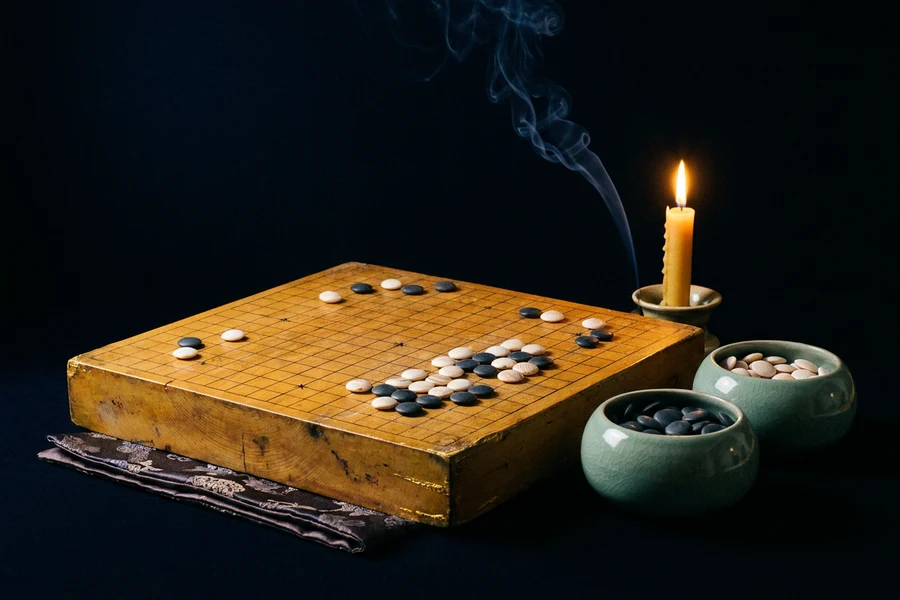
Go is the oldest strategy game humanity still plays. It was born in China, where its name is Weiqi, the encircling game. Legend ties it to the mythical emperor Yao, said to have designed it to teach his restless son patience, balance and foresight. History is rarely so romantic, but the age of the game is genuinely dizzying. Confucius mentions it in his writings, and old China counted it among the four arts of a cultivated person: music, calligraphy, painting and Go. It was less a war than a way of thinking.
From there it crossed to Korea, where it became Baduk. Then it reached Japan and turned into an art. State academies were founded in the seventeenth century, masters played before the emperor, and the strongest player earned the title Meijin, the master. The marked points on the board are called hoshi, meaning stars. For centuries players have set their stones among those stars and shared an emptiness like the sky. The game truly has only one rule: a stone with no breath dies. Everything else is the endless depth born from that single law.
At House of Zij you play this old silence with Sun and Moon stones. What Go teaches is not foreign to astrology at all: power lies not in filling but in surrounding. You do not seize a space by force; you open a space for it. If you are just beginning, do not be afraid, the masters too started by learning to capture a single stone. That is exactly why First Stone mode exists. Play a few hands on the small board, and before long you will find you have quietly encircled a whole field of emptiness.
Power lies not in filling but in surrounding; you do not seize a space, you open a space for it.