
Algol and Medusa: The Two Faces of the Sky's Most Feared Star
Four separate civilizations, with no contact between them, looked at the same star and called it 'the demon's head.' Yet that severed head can protect you as fiercely as it can frighten you.
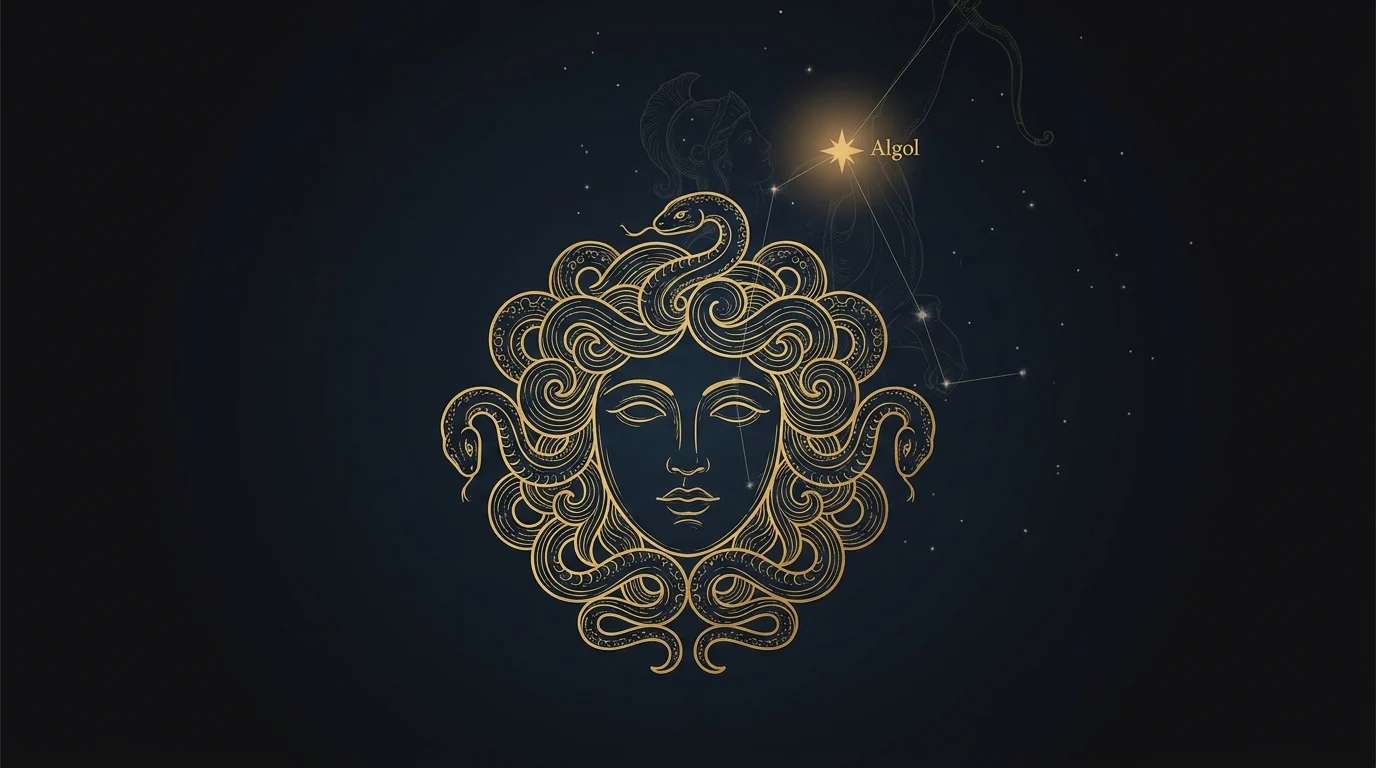
Picture someone on a clear winter night, lying on a rooftop or standing in the middle of a field, staring up at the sky for a long time. No phone, no light pollution, nothing else to do. This person reads the night like a calendar, because life depends on it. And at some point their eye catches a star that Perseus seems to hold in his hand. A few nights later they look at the same star again, and something is off. The star, as if winking at someone, dims over a couple of hours and then flares back to full brightness.
Now imagine you are that person. You watch an eye in the sky look down at you and close. The human mind hates an empty space, so it fills it at once with a story. And the story of this star began, all over the world, in the mouths of civilizations that never met one another, with the very same word: death. This is the story of why the star most often called the unluckiest in the sky was also carried, for centuries, as a charm of protection.
The star that blinks
Let us start with the astronomy, because that is where the legend is rooted. This star in the constellation Perseus has the scientific name Beta Persei. But the name everyone knows is Algol, and that name carries a riddle inside it.
Algol is not a single star. It is a system of stars circling one another. From our point of view here on Earth, two of those stars pass in front of each other at regular intervals. When the dimmer one partly covers the brighter one, an eye looking up from the ground sees the star suddenly fade. The cycle is astonishingly regular: it lasts roughly two days and twenty hours, and then the star brightens again. Modern astronomy calls this an eclipsing binary, and the first person to explain the mechanism correctly was a young English amateur observer at the end of the eighteenth century, John Goodricke.
But thousands of years before Goodricke, people reading the sky with their bare eyes had already noticed the blink. They could not explain it, but they saw it. And they gave what they saw a name.
Four languages, one fear
This is where the most unsettling part of the story begins. Cultures separated by thousands of miles, sometimes by centuries, looked at this star and said almost exactly the same thing.
The name we use today, Algol, comes from Arabic. The original phrase is ra's al-ghûl, which means "the head of the ghoul" or "the demon's head." Observers who had watched the stars across the clear nights of the desert for who knows how many generations saw a monster's head in that flickering light. When the name passed into Latin it became Caput Algol, the head of Algol.
In the Hebrew tradition the same star was called the head of Satan, and at times tied to Lilith. In old Chinese astronomy the star sat at the very center of a dark cluster whose name can be translated as "piled-up corpses." And in the Greek world, because of the famous myth we will come to in a moment, Algol marked a severed head, the head of Medusa.
Stop for a second and think about how strange this is. Arab, Hebrew, Chinese, and Greek observers who had never seen one another looked at the exact same point in the sky and, without any agreement between them, said: death, head, dread. A convergence that sharp is hard to call coincidence. Maybe they all saw the same thing: a light that blinks, dims, and returns, a light that dies and is reborn. And the human mind has always filed away the thing that dies and returns on the same shelf.
Medusa: monster or victim
Greek mythology gave this star its richest story, so let us linger there a while.
Medusa was one of three Gorgon sisters. The other two were immortal, but Medusa was mortal, and that detail decided her fate. Her hair was made of snakes, and her gaze turned anyone who met it to stone. That much is the classic picture. But how the story is told changes completely depending on which narrator you listen to.
In the earliest version, in Hesiod, Medusa is a monster from birth. No explanation, no cause, simply a terrifying creature. Centuries later, though, the Roman poet Ovid tells a very different version in his Metamorphoses. In his telling, Medusa was once an extraordinarily beautiful young woman, a priestess in the temple of Athena. Inside that temple she was raped by Poseidon. And what happens next explains why the myth has lived so long: the goddess Athena punishes not the attacker but the victim. She turns Medusa's beautiful hair into snakes, and her gaze into a curse that turns flesh to stone.
It is hard not to read that with modern eyes. A woman is assaulted, and the punishment is carved into her. She is silenced, cast out, made into a monster. That is why, for many people today, Medusa is no longer a figure of horror. She is the emblem of the survivor, the silenced one, the person forced to turn her rage into stone. What gets told as a curse is in fact a defense. A shield, hard to pay for, granted so that no one could ever come near her again.
The face that kills, the face that guards
The story does not end there. The real turn comes now.
Perseus, a demigod hero, is sent to bring back Medusa's head. He cannot do it alone. Athena gives him a polished shield, Hermes lends him his winged sandals. Perseus's stroke of genius is this: he never looks at Medusa directly, because if he did he would turn to stone. Instead he uses his shield as a mirror, approaches her watching only her reflection, and cuts off her head while she sleeps. Approaching the terrible thing not head-on but through its reflection. Keep that image in a corner of your mind, because it will be useful when we get to the astrology.
From the severed neck, out of the very middle of death, life bursts forth. The winged horse Pegasus and a giant named Chrysaor are born. Even in the instant of her death, Medusa gives birth. And Perseus does not toss the severed head away like garbage. He turns it into a weapon. He uses it to turn his enemies to stone, and to defeat a sea monster while rescuing Andromeda. In the end he gives the head to Athena, who sets it into her shield.
That moment is the heart of the myth. The face that once killed everyone becomes, on the goddess's shield, the face that guards her. The Greeks gave this protective Medusa face a name: the Gorgoneion. They carved it over doorways, onto shields, onto coins, onto pottery. The logic was simple: hang the greatest terror at your gate, and whatever evil approaches will fear it before it reaches you. The thing that drives off the bad is something that looks even worse.
Even Medusa's blood ran two ways. By one account, the blood that flowed from her left side was a deadly poison, while the blood from her right could heal, and even raise the dead. That healing blood was given to Asclepius, the god of medicine. Poison and cure from the same being. That twin face appears again and again throughout the story: curse and protection, death and birth, always side by side.
Algol in the hands of the astrologer
Now let us return to the sky, because astrology inherited the exact logic of this myth.
In traditional astrology the fixed stars are read as a separate layer from the planets. The planets wander across the sky, while the fixed stars sit almost motionless against the backdrop of the zodiac. I say "almost," because they do drift, very slowly, roughly one degree every seventy-two years. So a fixed star's position in your chart shifts gently over the centuries. Algol is currently sitting at around the twenty-sixth degree of Taurus.
There is a poetic detail here. Taurus rules the throat and the neck in the body. A star known for the theme of beheading, sitting in precisely the sign tied to the neck, creates a correspondence between myth and sky that raises the hair on your arms. Coincidence, of course, but a beautiful one.
Astrological tradition gave Algol a harsh reputation. The classical sources count it as the most difficult, most ill-fated fixed star in the sky. Vivian Robson, the important twentieth century compiler of fixed star lore, went so far as to describe it as the most evil star in the heavens. The ancient astrologer Ptolemy assigned it a nature blending Saturn and Jupiter. Its themes come straight from the myth: "losing your head," both in the figurative sense of losing your composure and in the literal sense of matters tied to the neck, along with violence, the rage of crowds, intense passion.
But here we need to be clear about where House of Zij stands, because this is the point where most writing slides into fear-mongering. Algol is not an unlucky curse. Algol is an intense point. When it sits close to the Sun, the Moon, or the rising degree in a chart, it loads that place with extraordinary force. The issue is not that the force is evil, but that it is raw. A star forces you toward nothing. It only opens a capacity. Where you aim that capacity is up to you.
The head that is a curse, the head that is a charm
And here the myth's Gorgoneion and astrology's Algol meet in exactly the same place.
In medieval and Renaissance astrology there were fifteen special fixed stars known as the Behenian stars. They were the stars considered most powerful, the ones used in making talismans. Algol was one of those fifteen. In other words, the "worst" star in the sky was at the same time one of the most sought-after stars for crafting charms. This looks like a contradiction, but it is not. It is the Medusa logic itself.
The Renaissance magician Cornelius Agrippa describes the Algol talisman. Ideally, the image of a human head with a bloodied neck was engraved onto a diamond or a dark stone. Made at the right moment in the sky, this talisman was said to give its wearer courage, to protect the body, and to send back upon their senders the ill will and the spells aimed at the wearer. Exactly what the Gorgoneion did. The severed head protected when hung at the gate, and it protected when carved into stone.
Think about that. The same star is both the "demon's head" people feared and the thing hung around the neck to ward off evil. The same face both kills and guards. This is not an inconsistency. It is one of humanity's oldest intuitions: when you face your deepest fear, that fear can turn into your shield. The thing you suppress, the thing you avoid even glancing at in a mirror, once it is claimed, becomes the thing that protects you best.
What to do if Algol is in your chart
Say you have run your chart and you have an important point near the twenty-sixth degree of Taurus, your Sun, say, or your Moon, or your rising. Algol is there, sitting close to you. So what do you do now?
First, do not be afraid. Thousands of people who carry this star have lived ordinary, even extraordinary, lives. Algol is not a prophecy, it is a frequency. What it does is intensify a single theme. What is asked of you is to recognize that intensity. Is there an area of your life where, wherever you look, passion, anger, or a question of control flares up? Maybe a relationship, maybe work, maybe a tension you hold with your own body. Algol holds a reflector up to that area. It burns not because it is dark, but because it is bright.
Second, remember Perseus's lesson. He did not look at Medusa directly, he looked at her reflection. The way to handle something rising in you as anger or as power is, more often than not, the same. Rather than charging straight at it, step back and watch it through a mirror, through a journal, through the eyes of someone you trust. Intensity, seen from a distance, turns into a weapon. Fallen into, it turns you to stone.
Third, do not forget that one face of that power is protection. People with Algol often share a quality: they do not break easily, they do not fall apart under pressure, they guard the ones they love without giving ground. That is what the myth whispers to you. Your shield is forged from the very place you fear most.
Closing
Let us go back to that winter night, to the observer on the rooftop. When that person looked at the star blinking in the sky, they saw a monster, and they gave it the name of death. For centuries people looked at the same star, felt the same fear, repeated the same word in four separate languages. But then something subtle happened. They hung that fear at the gate, wore it around the neck, carved it into the shield. And the fear turned into the thing that guards.
That is what Algol teaches, in the sky, in the myth, and in the chart all at once. The face you run from hardest can, when you turn and look at it, become the face that protects you best. As long as you know how to look at it the way Perseus did: not head-on, but without looking away either.
You can ask a question about this reading
Atlas (Mit Anlatıcısı) answers your questions about Algol and Medusa: The Two Faces of the Sky's Most Feared Star
Comments
You can share your thoughts about the piece here.