
Seeing a Bird in the Coffee Cup: The Four Thousand Year Story of a Symbol
When a grandmother in Turkey turns a cup over and says 'news is coming,' she is carrying on a four thousand year old chain of observation, though she has no idea.
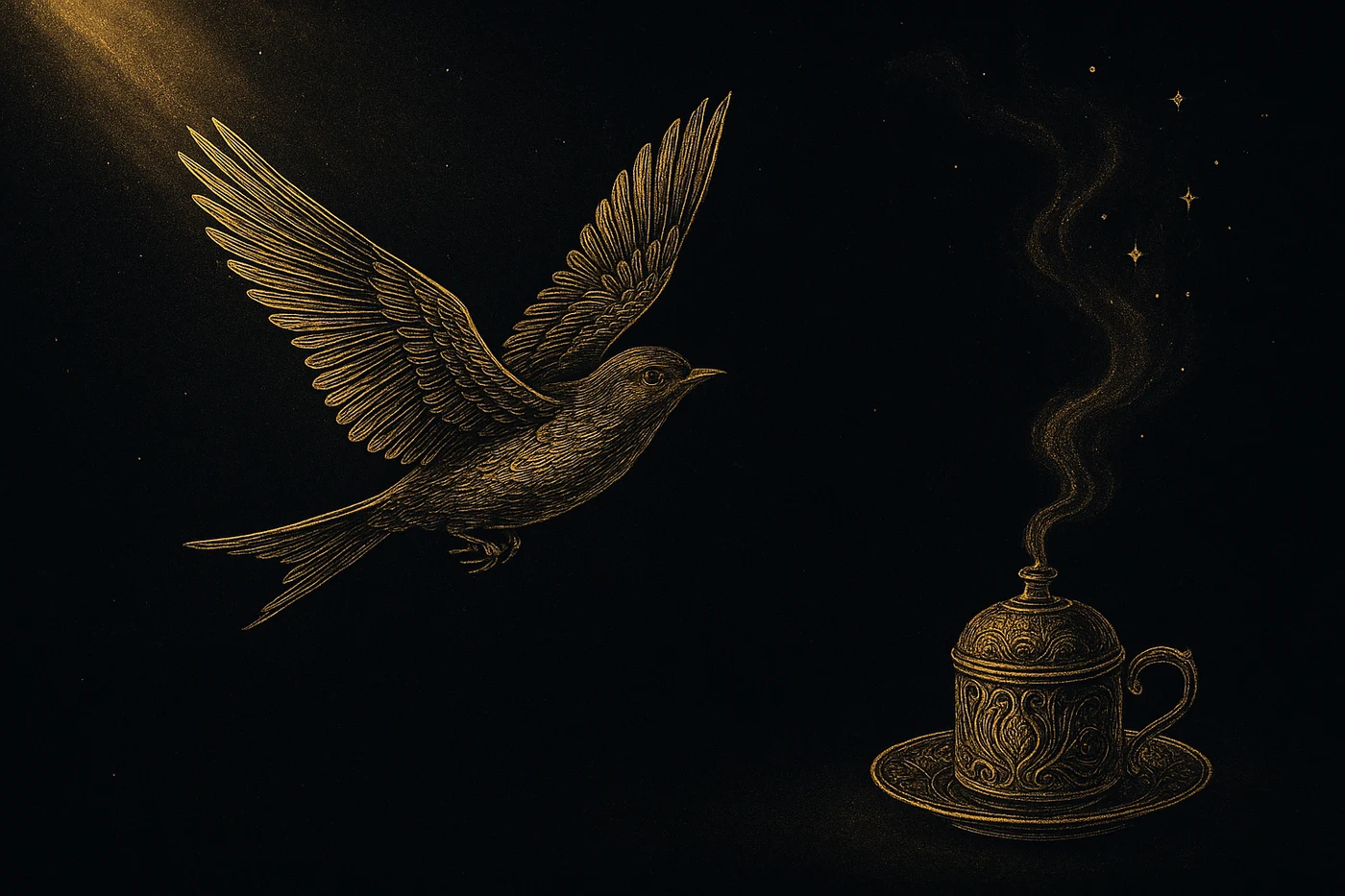
In an old apartment in Istanbul, at the kitchen table, a grandmother is turning a cup over. Her grandson sits beside her, nineteen years old, waiting for the result of the university exam. The coffee slides slowly out of the cup onto the saucer. A minute passes, maybe two. Then she lifts the cup, looks inside, and her eyes settle on one spot. "A bird has come out," she says, in a calm voice. "News is coming."
The grandson smiles, because he has heard this sentence before. His great-grandmother used to say it too, and her mother before her. "A bird in the cup means news" is like a small prayer stuck to the Anatolian kitchen, a reflex. Nobody asks where the sentence came from. But if you stop for a moment, a strange question appears: this woman, with no idea what was happening in a Mesopotamian temple four thousand years ago, is repeating a sentence a priest there once said in exactly the same way.
Sumerian priests and letters falling from the sky
Thousands of years before our era, in the mud cities between the Euphrates and the Tigris, there was a class of priests called the barû. The work of the barû was to observe. They studied the liver, watched how drops of oil spread on water, measured the direction of smoke. But most of all they followed the sky, and the things that flew across it.
For the Sumerians, the gods were not silent. They spoke, but not in words. In signs. If a bird flew south, that meant something. If an eagle suddenly appeared over the city, that meant something else. The kind of bird, its direction, its number, its call, all of it was read like a sentence. The barû carved that sentence onto a tablet and carried it to the royal court. Whether there would be a war, whether the harvest would be good, whether a child would be born healthy, all of it took shape through this reading.
This was not a simple superstition, at least not for that time. In Mesopotamia, written knowledge was still new, the calendar was only just settling, astronomy was being built tablet by tablet. Within the logic of the age, the barû's observations were part of a deeply systematic discipline. A bird was not just a bird, it was a written message coming down from the sky. The wing was the thing that carried the message from afar. The height pointed to the source of the message.
This idea did not vanish there. It spread.
The man who watched birds in Rome: the augur
Centuries passed. The mud cities of Mesopotamia turned to dust, but the tradition of observation walked west. On the Italian peninsula, when it passed from the Etruscans to the Romans, this craft had a new name: augurium. The art of watching birds.
A Roman augur was a state official. At the city's important decisions, at the declaration of a war, at the laying of a temple's foundation, even at the choosing of a consul, the augur was called. He took up his staff and divided a certain part of the sky into sections with lines. Then he waited. When a bird passed, he recorded what kind of bird, from which direction, with what call, in what number. And he interpreted it.
The great Roman legend says that even the founding of the city of Rome was decided by watching birds. Romulus and Remus, the twin brothers, argue over which hill the city should be built on. They cannot agree. They leave the decision to the augur, that is, to the sky. Remus sees six birds, Romulus sees twelve. Romulus wins. He gives the city his name.
How much of this story is history and how much is later legend is another matter. But here is what is interesting for us: the word augur comes, etymologically, from the joining of two Latin words. Avis (bird) and spicere (to look). So by its dictionary meaning it is "the one who looks at birds". Even the words for "luck" and "good fortune" that passed from this root into European languages quietly carry a Roman priest inside them: a man looking at the sky, waiting for a bird to pass.
Anatolia's own dictionary
What did this old tradition of watching birds do to Turkish folk culture? Quite a lot, in fact. Because Anatolia is a land where traditions have piled up on top of one another. The Hittites, the Byzantines, the Seljuks, the Ottomans, each had their own language of the sky. And all of them speak of birds.
In Ottoman poetry the nightingale is the beloved, the turtledove is separation, the stork is a sacred migration. In folk telling, the sight of a crow is taken as a warning, though not always as something bad. The crow is clever and watchful, a sentinel. The dove is different, it is the carrier of love and of the word. The dove that Noah sent out from the ark, returning with an olive branch in its beak, is counted as the news that the world is beginning again. This story passes into the Anatolian table, into kitchens, into the speech of grandmothers.
So when a bird appears in the cup, not every bird means the same thing. Are its wings open or closed? Is it one bird or two? Is it looking up or down? Is its tail large? Folk tradition draws these distinctions. An open wing means the news is on its way, a closed wing means the news is delayed. Two birds together mean an invitation or a visit. A single bird, a letter or a phone call. A bird looking up is good news, a bird looking down is a warning that asks for care.
The species has a language too. If a dove was seen, the news is sweet, soft, a sentence from someone loved. If a crow was seen, the news asks for attention, though Anatolia's reading of the crow is not as dark as the Western one, it points more toward watchfulness, keep your eyes open, what is coming matters. If a stork was seen, it carries the meaning of a seasonal change, a birth, a new beginning. The eagle is rare, and when seen it is read as a brave decision, a moment of leadership, a rising. A nightingale or a small singing bird is an emotional piece of news, most often about love.
These passed from one generation to the next by word of mouth. They barely made it into writing, because most grandmothers approached coffee reading not as a lesson but as conversation. But the core of the sentence is the same, a bird is a messenger that comes from the sky. From the Mesopotamian barû to a kitchen in Istanbul today, a four thousand year old sentence.
What a bird means in a psychologist's room
At the start of the twentieth century, a man was listening to a patient in Zurich. The patient had told a long dream, and in one scene a bird from the sky had landed on the windowsill. The listener opened his notebook and wrote this down: the bird is a message carried from the unconscious up to the level of consciousness.
His point was this: in the deep layers of the human mind there is a store of images that everyone shares. In this store, animals, numbers, colors, places, all of them carry symbolic meaning. He called these archetypes. And the bird was one of the most powerful archetypes.
Why? Because the bird is the only creature that joins the two layers of the world. It walks on the ground, but it rises into the sky. While a human cannot lift their feet from the earth, the bird has lifted itself. This physical ability opens a symbolic door. The bird is the one that carries a message from the unknown to the known, from the sky to the earth, from the soul to the mind. In ancient Greece Hermes had winged sandals, in Christian imagery the messenger angel was winged, in Islam even the number of an angel's wings was spoken of with reverence. All of them are different faces of the same archetype.
So in this reading, a bird does not really bring news. A deep layer of your own mind, using the figure of a bird, is telling you something. It is carrying into consciousness something you knew without knowing. Coffee reading shows this symbolically inside the cup, because the cup is a map of the unconscious. As the coffee grounds take shape, your intuition is whispering its own answer back to you.
This modern reading does not reject the ancient tradition. It only changes its language. The Mesopotamian barû saw the bird as the messenger of the gods. The Roman augur watched it to read the fate of the state. In Anatolia the grandmother says news will come from a grandchild she loves. The modern reading says yes, news is coming, but the place the news comes from is your own inside. They all strike the same arrow from different places.
What is striking is the shared core. On a Sumerian tablet and in the Roman forum and in an Istanbul kitchen and in a Zurich office, in four different languages, in four different worlds, the same equation is written. A wing means distance. Distance means the unknown. What comes from the unknown is a piece of knowledge. Whether that knowledge comes from the gods, from the city, from someone who loves you, or from the unconscious, it needs a wing to reach you. The bird is that wing. Who you are, or which century you live in, does not change the equation.
What to do when you turn the cup over
Say you have turned a cup over and you really did see the figure of a bird inside. What happens now? If you want to do a real reading, not a cliche, there are a few layers to look at.
First, the location. Is the bird near the handle, inside the cup, or on the saucer? If it is near the handle, the matter is personal, belonging to you or to someone close. Inside the cup, in the middle, it is a development of the medium term. On the saucer it is something later, more distant, sometimes the reflection of something that has already happened.
The second layer is the bird's movement. Are its wings open or folded in? An open wing means a message that has set out. A folded wing means the message is still waiting, it has not yet left. You can read this as a span of waiting.
Third, the direction. Is the bird flying upward or downward? An upward movement, in most readings, carries the meaning of rising, good news, an opening. A downward movement is the sign of something that needs to transform, or a matter that asks for attention. It is not frightening, only a warning that asks you to slow down.
Last, the figures around it. A bird rarely appears on its own. Whatever is beside it, a path, a letter, a heart, a house, completes the reading. A bird alone means news, but the symbol next to it tells you what the news is about. If you see a path beside the bird, the news is about a journey or a meeting; if you see a heart, it is an emotional message; if you see a house, it is a development about your family or your home.
While you do this reading, do not forget to begin with your own intuition. The first thing you see when you look at a cup, the first word you feel, is most often the true one. The first impression is stronger than the list. Then you look at the detail, you confirm it or you refine it. But the door opens at the first glance.
What that grandmother knew
Let us return to the start of the story. In the kitchen the grandmother turned the cup over and said "news is coming". The exam result arrived a few days later, the grandson had gotten into university. The family was glad, the grandmother laughed, "didn't I tell you," she said.
Here is the interesting part: that grandmother was the last link in a four thousand year old tradition, but she did not know it. If you mentioned the Sumerians she would be surprised. She would hear the word augur for the first time. The name of that Zurich psychologist she had probably never heard in her life. But the sentence in her hand was a drop that had filtered through all those traditions and fallen onto the kitchen table. History passes through homes, and tells no one.
Maybe the next time you turn a cup over and see a bird, you will remember this. Do not exactly think "news is coming", and do not deny it in haste either. Just stop for a second and ask: what does this bird want to tell me? The answer is most often already inside you, and it is because you could not put it into words that you wait for a bird to come and speak with you.
Maybe what we call fortune telling was always this. The intuition you could not put into words, growing wings and arriving in front of you.
You can ask a question about this reading
Atlas (Mit Anlatıcısı) answers your questions about Seeing a Bird in the Coffee Cup: The Four Thousand Year Story of a Symbol
Comments
You can share your thoughts about the piece here.