
Sirius: Why It Has Mattered So Much in Human History
Today, July 6, is the day of the Sun-Sirius conjunction. The brightest star in the sky sits at the very bottom of its seventy days of invisibility. From Egypt to Samarkand, this is the story of the star by which humankind first learned to read time.
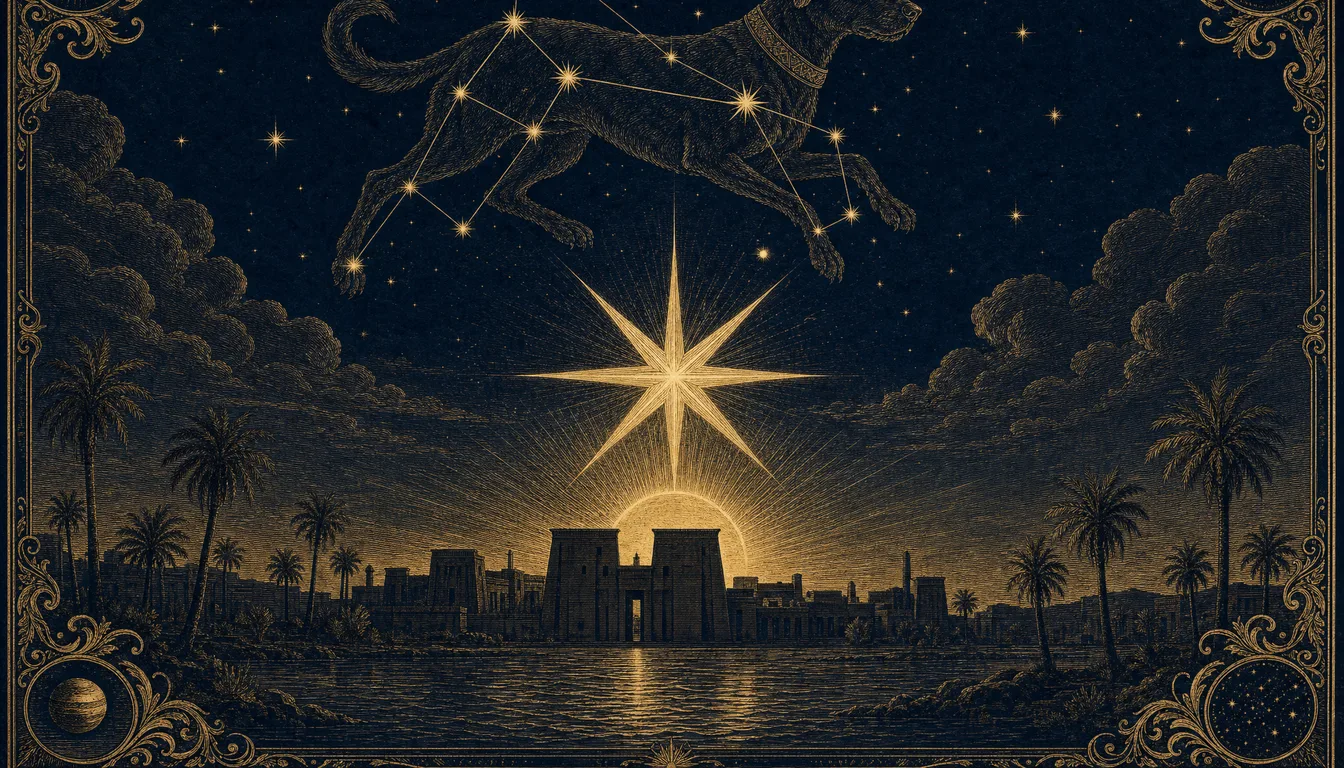
Sirius: Why It Has Mattered So Much in Human History
Picture a star so important that when it vanished from the sky, an entire civilization held its breath. Gone for seventy days, then one morning, just before dawn, appearing again in the red haze of the horizon while a whole country said, "the year has begun." That is what Sirius is, the star by which humankind first learned to read time in the sky. Today, July 6, 2026, is the day of the Sun-Sirius conjunction. But be careful: today is not the day Sirius rises. The star has already been out of sight since late May. What happens today is quieter. The Sun has come to sit exactly in front of Sirius, and we are at the very bottom of those seventy days of invisibility.
So today is not a celebration; the celebration will come in August. Today is the darkest, purest point of the threshold between disappearance and return. Ancient tradition says that in this moment the star rests "in the heart of the Sun." Anyone looking from outside cannot see it, yet the star has not vanished. On the contrary, it is at its most concentrated. Hold on to that, because it is the whole point of this piece. Some things are not dead simply because they have gone out of sight. Sometimes they ripen in the very place where no one can see them.
So why did so many cultures circle back to this one star for thousands of years? The plainest answer is in the sky itself. Sirius is by a wide margin the brightest star of the night sky. Not "a little brighter," but almost twice as bright as the next star down the list. That large white light in the southeast on winter nights, flickering now and then into color, is impossible to miss once you have learned it. Part of that brilliance comes from nearness: Sirius is only eight and a half light years away, one of our closest neighbors in the sky. And it is not alone. Beside it it carries a white dwarf companion you could never see with the naked eye, Sirius B. A magnificent light and its unseen confidant, and as you will see shortly, that pairing is the heart of this piece too.
The Star of the Nile: Egypt
In Egypt its name was Sopdet. And when Sopdet, seventy days after disappearing from view, was reborn at dawn, it meant one thing for this country in the middle of the desert: the Nile will swell, the soil will grow fertile, the year will begin again. The priests aligned their temples toward the star so they could watch it rise. A star's dawn return was the zero point of an entire agricultural calendar.
The lovely part is that the Egyptians tied a story of tears to this return as well. According to the belief, Isis wept in mourning for her murdered husband Osiris, and the single tear she shed made the Nile swell. Grief and abundance come from the same source. This belief was so strong that centuries later it passed into Arab tradition under the name "the Night of the Drop" (Leylet en-Nukta). The idea that loss can make something grow keeps circling around this star.
And there is one more thing, a detail that sits exactly on today's threshold. Sirius stays invisible for about seventy days, and the ripening process of mummification also lasted about seventy days. To the Egyptian mind this was no coincidence, it was a mirror. The star beneath the sky, the dead in the preparation room, both waiting patiently for their return. Invisibility was not death for them, it was preparation. That is why today, this deepest point of the conjunction, is really a season of the womb. Not vanishing, but not yet born.
The Dog Days: Greece and Rome
For the Greeks, Sirius was the star of summer's hottest days. But note that the moment they took their cue from was not a conjunction like today's; the conjunction is an unseen event that no one can watch. The moment they looked for was the star's reappearance at dawn. In the age of Hesiod this dawn rising fell in mid-July, at the very peak of summer. The place of the stars in the calendar drifts very slowly over millennia, and today the same rising has slipped into August; but in the ancient world the return of Sirius and the fiercest heat overlapped. In Works and Days, Hesiod describes those days with surprising vitality: when Sirius scorches, men are at their most listless, women at their most cheerful, goats at their fattest, and the wine at its best. So the dog days were not only drought and exhaustion, but also harvest and plenty. Sirius burns, yes, but the same fire also ripens the fruit.
The Romans called this stretch dies caniculares, the days of the little dog, and officially placed it between July 24 and August 24, at the star's dawn return. Summer fever, torpor, rabid dogs, all of it was blamed on this star. Their reasoning ran like this: in these weeks Sirius crosses the sky by day together with the Sun, and even though the eye cannot see it, it is there and adds its fire to the Sun's fire. This is exactly the cultural root of the fear of "burning" we still discuss in astrology today. But do not forget, the same season was also ripening the wine.
Shi'ra, Two Brothers, and House of Zij
Now we come to the part closest to us. The Arabs called Sirius eš-Ši'ra, and they wove a fine story around it. As they told it, Ši'ra was a brother who had "crossed" (ubur) the river of the sky, the Milky Way, and migrated toward Yemen; that is why its name is Ši'ra al-Abur, the Ši'ra who crossed. Left behind, in tears, was another brother: Procyon, al-Ghumaysa. One went, one stayed, two separate fates. In the Qur'an, too, a verse in the surah of the Star names this body directly, saying "He is the Lord of eš-Ši'ra." Sirius is the only star named in the Qur'an by its own name.
So why is this brand called House of Zij? A "zij" is an astronomical table, a chart that writes the place of every body in the sky as a number. In the fifteenth century Ulugh Beg, at his observatory in Samarkand, had the positions of one thousand and eighteen stars measured anew. It was the most precise catalog prepared since Ptolemy, and its name was the Zij-i Ulugh Beg. And in that table Sirius stands as eš-Ši'ra al-Yamaniyya, its degree measured one by one. So the tradition this brand carries is the tradition of the Samarkand observers who were not content to look up and say "how lovely," but pinned down with a number exactly where Sirius shone. Poetry and measure together.
There is one more name worth mentioning here: Abu Ma'shar of Balkh. In the ninth century he was the one who carried the planetary natures of the fixed stars westward. Sirius's nature as "a mixture of Mars and Jupiter" passed into European astrology largely through his pen. Now let us come to that astrological meaning itself.
Astrological Meaning and Today's Threshold
In the Tetrabiblos, Ptolemy counts Sirius as a mixture of Jupiter and Mars. Jupiter means expansion, honor, abundance; Mars means fire, courage, edge. When the two come together, the result is "a great but dangerous brilliance." Sirius can lift a person very high, but if it slides into showing off, it can drop them from sight just as quickly. Honor and downfall stand inside the same star. Shine, but do not forget your unseen companion.
Sirius sits today near fourteen degrees of tropical Cancer. That has a practical meaning: if you have a placement between thirteen and fifteen degrees of Cancer in your birth chart, say your Sun, Moon, Ascendant or Midheaven, then Sirius is already woven into your story. This is not a sentence of fate, it is an invitation. That placement tells you why rising and being seen are, for you, both deeply attractive and a little dangerous.
And today, this conjunction, is the most invisible moment of that brilliance. The star withdrew quietly from the evening sky in late May, and now it lies hidden in the heart of the Sun. It will stay unseen for a few more weeks, then be reborn in the dawn sky: in early August at the latitude of Cairo, around August 11 for Istanbul and Anatolia. The celebration is that morning. Today is its seed. Disappearance, invisibility, rebirth; we are right in the middle of this three-act arc, and the middle act is the act of patience.
There is also a fine coincidence that modern astronomy later confirmed. Sirius's companion Sirius B, which can never be seen with the naked eye, was calculated by Bessel in 1844 from a slight wobble in the star's motion; in 1862 Alvan Clark saw it through a telescope. This star, as small as Earth yet as heavy as the Sun, has a single teaspoon of matter that weighs tons. No ancient culture could see it. And yet the idea that "behind the visible light there is an unseen companion" stands as if it had been sensed thousands of years in advance.
The Sun Behind the Sun
Perhaps the most striking thing that shows the place of Sirius in the human mind is this. For centuries the esoteric traditions of the West called this star "the Sun behind the Sun." In the Theosophical school Sirius was held to be the distant source of spiritual light; in Freemasonry that "Blazing Star" adorning the walls is, on most readings, Sirius itself. In other words, even our own Sun was thought to draw its light from a more distant center.
Do not read this as a scientific claim, because it is not. For astronomy, the Sun does not orbit Sirius; the two are neighbors walking their own paths through the Milky Way. But there is something here more interesting than science. Humankind, in dozens of cultures unaware of one another, gave this single star the rank of "the true source" again and again. That it took the same role in so many different minds shows how much weight it carries in our imagination. This may be the most honest answer to the question of why Sirius matters so much: almost no civilization has managed to ignore it in the sky.
What to Do in the Days of Sirius
These weeks are a stretch in which the sky draws inward. A time of invisibility, of preparation, of ripening. The star waits as if in a womb, and you can fall into step with this rhythm: a few weeks turned inward rather than out.
For today, the finest thing is to plant an intention quietly in the soil. Write down a single wish on a piece of paper, put it in a sealed envelope and set it aside, and tell no one. As long as Sirius stays unseen, let your intention stay unseen too, like a seed under the ground. On August 11, when the star is reborn at dawn, open that envelope and see how quietly your intention has ripened. To grow something without speaking of it is sometimes the greatest chance you can give it.
This matter of the unseen companion is also worth dwelling on. That heavy, invisible sibling of Sirius holds the balance of the brightest light. Split a page in two: on the left, the bright side people see in you, and on the right, the side no one sees but whose weight you carry in silence. Then ask yourself a single question. Which of the two really keeps you standing? Most of the time the answer is on the right.
There is a place for grief in these days as well, because the story of this star begins with a tear. Put clean water in a vessel, quietly speak over the surface of that water a sorrow you are tired of carrying, then give that water to a plant. As Isis's tear swelled the Nile, let your grief too make something grow. The aim is not to throw it out, but to transform it.
There is also the matter of making peace with the heat itself. In these scorching weeks, choose one deliberate slowdown: an argument you will not enter, a promise to yourself that you "will not rush," a genuine fifteen-minute pause in the hottest hour of the day. As Hesiod advised, in the burning season it is not the one who runs but the one who knows the shade who wins.
Finally, remember the two brother stars, one that crosses over, one that stays behind. Think of something in your life that is passing away and something that is staying, and write each of them a one-sentence farewell or greeting. Ši'ra al-Abur left, al-Ghumaysa stayed, but both are part of the sky. This is how you turn a loss into a rhythm rather than a fate.
When the Star Disappears
Sirius is out of sight in the sky right now, at the very bottom of its invisibility today. But it is not lost. It is hidden in the heart of the Sun, waiting to be reborn at dawn when its time comes. This is astronomy, and it is also a quiet lesson in living left to you. The stretches when you are invisible are not the stretches when you have vanished. Sometimes you ripen most when no one is looking.
Today you do not have to shine. Even a star knows this. For now, gather yourself in the heart of the Sun, and prepare. When the August morning comes, you will step into the dawn, and then you will shine.
This reading is offered as a guide. The final decisions are always yours to make, with your own intuition and mind.

You can ask a question about this reading
Atlas (Mit Anlatıcısı) answers your questions about Sirius: Why It Has Mattered So Much in Human History
Comments
You can share your thoughts about the piece here.