
The Meaning of the Summer Solstice: Why the Longest Day Is Also the Turn Toward Darkness
Today is the longest day of the year. But a moment passed at dawn that almost no one noticed: the sun stood still for a heartbeat, then began its return. The day with the most light is also the day darkness sets out.
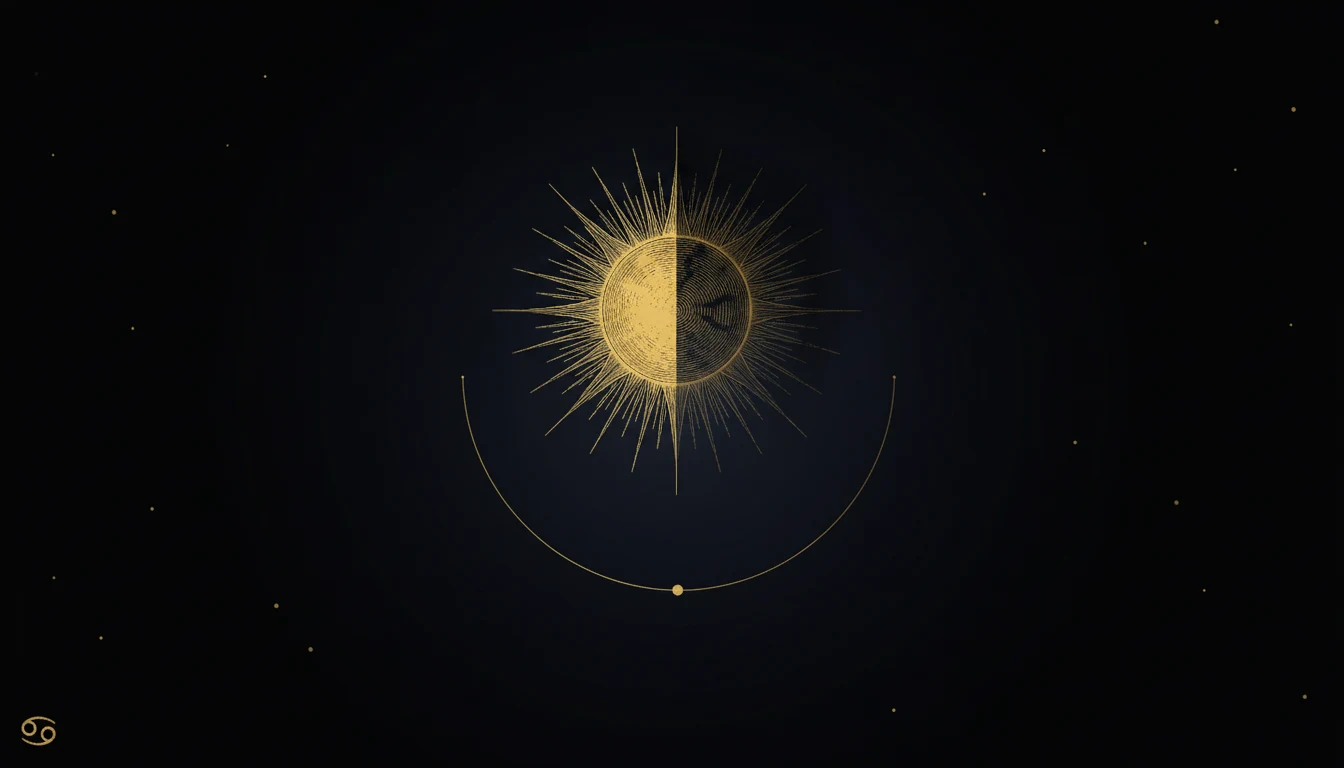
Today is the longest day of the year. But let me tell you something quietly, something most people never notice in their whole lives. Toward dawn this morning, a moment passed in the sky that no one saw. For months the sun had been climbing a little farther north, a little higher, every single day. And today, at the very top of that climb, it stood still. It stayed motionless. Then, with no warning at all, it began to return.
So even as you read this sentence, the light is already drawing back. We are on the brightest day of the year, and from today onward the days have started to shorten again. This piece is about exactly that: why the moment of the most light is also the moment darkness sets out, and what this paradox whispers to your own life.
What is the summer solstice, and why is it called a "turning"?
The summer solstice is the moment the Sun reaches its highest point in the sky for the year, giving the northern hemisphere its longest day and shortest night. That peak is also the turning point where the days begin to shorten again. Put another way, the day with the most light is also the first day of darkness coming back.
The name itself carries the whole secret. The word solstice comes from two Latin pieces: sol, the sun, and sistere, to stand still. The standing still of the sun. Ancient observers named it this way because that is exactly what they saw. Each day the sun rises a little farther north on the horizon and climbs a little higher in the sky. Then, as the solstice nears, that movement slows, and slows, and for a few days it barely changes at all. The sun seems to hang in place. That pause is the turning point itself.
Astronomically, today the Sun reaches its northernmost point in the sky. On the astrological calendar, it moves into the sign of Cancer. And there is a lovely resonance here: Cancer is the sign of the shell, the home, the turning inward. At the very moment the outer light reaches its peak, the chart points us inward, toward home, toward feeling. It is as if the sky drops to a whisper precisely when it is shouting its loudest.
Why did ancient people fear the sun might not return?
To really feel this, we need to go back, far back, to a time without a calendar, a clock, or a weather app.
For an ancient person living through this part of the year, the movement of the sun was not an abstract astronomy lesson. It was life itself. As the sun climbed, the crops grew, the herd fed, the daylight stretched. But that person also watched the sun sink a little lower each day toward autumn, watched the daylight shorten, watched the cold come. There was an anxiety learned over years: what if one day the sun does not stop, but keeps sinking? What if it never comes back?
The solstice was the day that anxiety found its answer. The moment the sun stood still and turned around was, at the winter solstice deep in the cold, a kind of salvation. At the summer solstice it was a different, more subtle feeling. The light was at its peak, yes, but the experienced eye knew this peak was also a moment of farewell. After today, the days would shorten.
Stonehenge's stones were raised for exactly this reason. Outside that great ring of stones, the single stone called the Heel Stone marks precisely the point where the sun rises on the morning of the summer solstice. Thousands of years ago, the people who set those stones calculated the sun's northernmost point with the precision of an engineer. Because for them this moment was not a curiosity but the nail that held a calendar, and a life, together. Stonehenge proves something to us: even while celebrating the longest day, humanity was really marking the moment of return. Not the peak, but what would come after the peak.
The fires came from the same feeling. From northern Europe to Anatolia, in many places people lit fires on the hilltops on solstice night. On the surface it was a celebration, the triumph of light. But beneath those fires lay another, quieter meaning: because the sun had now begun to sink, people were offering it a light with their own hands. As if to say, "we know you are withdrawing, here, let us light a flame too." Lighting a fire on the brightest night of the year. Once you notice this, it stays with you. Because a person blesses the thing they are beginning to lose most fiercely while it is still in their hands.
Why does every peak hold a farewell inside it?
Now let us step out of astronomy and look inward, because this paradox lives there too.
The Swiss psychiatrist Carl Jung loved an old concept: enantiodromia. This word, from the Greek, describes the tendency of a thing to turn into its opposite once it reaches an extreme. When anything arrives at its furthest point, it already carries the seed of its opposite within it. The highest point is where the descent begins. The brightest moment is the one in which the darkening has already set out.
In old Chinese thought the same intuition is told in a completely different language. Picture the symbol of yin and yang. On the side where the darkness is deepest there is a small point of light, and on the side where the light is brightest there is a small point of dark. Nothing is pure. Inside every full there is an empty. The summer solstice is the day the sky plays this symbol out for real. While the yang of light is at its peak, the yin of darkness has already begun to stir inside.
Once you see this, you start to see it everywhere. In the most beautiful moment of a life, an unexpected sadness appears. The mother whose eyes fill at a wedding, the student touched by a strange ache at graduation, the person who finally moves into the home they worked years for and feels an unaccountable emptiness. None of this is wrong. None of it is ingratitude. This is the soul recognizing the solstice. Because it knows it is at the peak, it senses that the descent has begun.
What is "that sadness I feel when everything is fine"?
Maybe you have felt it too. That quiet, nameless sadness that seeps in when your life is just as you wanted it, when there is nothing in the outer world to complain about. In that moment a person even gets angry at themselves: with so much to be grateful for, why do I feel this way?
The answer is older and more tender than you think. That sadness is not a malfunction. It is the solstice inside you. The moment you realize you are at the peak of something, a part of you also knows that peak is temporary. While your child is at their sweetest age, you know that age will pass. In the warmest season of a relationship, you sense that nothing stays the same forever. This sensing is there not to poison your happiness but to deepen it.
Human culture has always known this. In ancient Rome, the victorious general entering the city through the cheering crowds, riding in his chariot, had a servant standing behind him who kept whispering the same thing: remember that you are mortal. Right in the middle of triumph, a reminder of impermanence. Because the only way to truly live a peak is to accept that it is a peak, which means it has a descent. You can never taste the real flavor of anything you imagine to be eternal.
What can you do today?
What the solstice leaves you is not a fact to memorize but a small gesture. Today, pause.
There is surely something in your life right now that is going well, that is full and bright. Maybe something big, maybe something that looks ordinary but is in fact precious. A relationship, a piece of work, a habit, a phase your child is in, a state of your health. Find it. Just as the sun stands still in the sky today, you too can stand still in the very middle of that thing. Name it, run it through your mind, look at it with gratitude.
And then, the hardest part: do not cling to it. Know that this moment will one day change, turn, descend. This knowledge does not make it less precious. On the contrary, it makes it more precious, because it is here today. If you like, write a single sentence on a piece of paper: this is what is at its peak in my life right now, and I know that I have seen it. That is enough. To greet the peak without fearing the descent is the oldest practice the solstice teaches.
Let us go back to that ancient observer, the person on the rooftop watching the sun stand still. While celebrating the longest day, they knew they were also living a moment of farewell. But this did not fill them with grief. Because they no longer feared that the sun would fail to return. Since the sun came back every year, they knew this was a cycle, and that every part of the cycle would come again when its time came.
The peak is not a collapse. The descent is not a failure. Both are points on the same circle. Today the light is at its highest and turning back, but this is not a loss, it is a breath. You breathe in, then you breathe out. The moment your lungs are fullest is the moment the releasing begins. And no one, not once in their life, ever stopped breathing in just because they would have to breathe out.
You can ask a question about this reading
Atlas (Mit Anlatıcısı) answers your questions about The Meaning of the Summer Solstice: Why the Longest Day Is Also the Turn Toward Darkness
Comments
You can share your thoughts about the piece here.