
Pamela Colman Smith: Seventy-Eight Cards in Six Months, No Name on the Box
If you can look at a tarot card today and feel what it means, you owe that to a design decision made in a Chelsea studio in 1909.
A card turns over on a table. Three of Swords. A red heart, three blades driven through it, grey sky and rain behind.
Nobody reaches for a book. Nobody needs to. The picture says itself.
That sounds unremarkable. It isn't. Tarot has been around for more than five hundred years. Being able to look at a card and feel what it means goes back about a century, to one person: a woman in a small Chelsea studio in London who drew seventy-eight cards in six months in 1909.
Her name was Pamela Colman Smith. For decades it did not appear on the box.
What the numbered cards looked like before her
A tarot deck comes in two halves. Twenty-two major cards (the Fool, the Lovers, the Tower, the Star) and fifty-six numbered cards across cups, swords, wands and pentacles. The major cards had been drawn as scenes for centuries. The numbered cards had not.
In the Marseille-pattern decks that dominated Europe for generations, the Three of Cups was a drawing of exactly three cups. The Five of Swords was five swords. Ornament, yes; scene, no. To read them you memorised a meaning. The card handed you a number and a symbol and left your memory to fill the rest.
Smith changed that. She turned all fifty-six numbered cards into scenes with people in them, with weather, with a moment caught mid-event. In the Five of Cups a figure stares at three spilled goblets and misses the two still standing behind him. In the Ten of Wands someone is bent double under a load he picked up himself. Anyone looking gets something. That feeling you have when you sit down to a tarot spread, the sense that a card is telling you something, comes largely from that one decision.
She did not invent the idea from nothing. The Sola Busca deck, made in northern Italy around 1491, illustrated all seventy-eight cards as scenes, and Smith is thought to have seen it in the British Museum collection. The influence is widely read in her Three of Swords and Ten of Wands. But the Sola Busca was never printed for circulation. It stayed in private hands for centuries and takes its name from the Milanese family that held it for five generations. Smith took that idea and made it the standard. Most decks on sale today copy her staging, whether they know it or not.
Six months, seventy-eight cards
She and Waite had met in 1901, both in the orbit of the Golden Dawn. In 1909 he asked her to draw a deck.
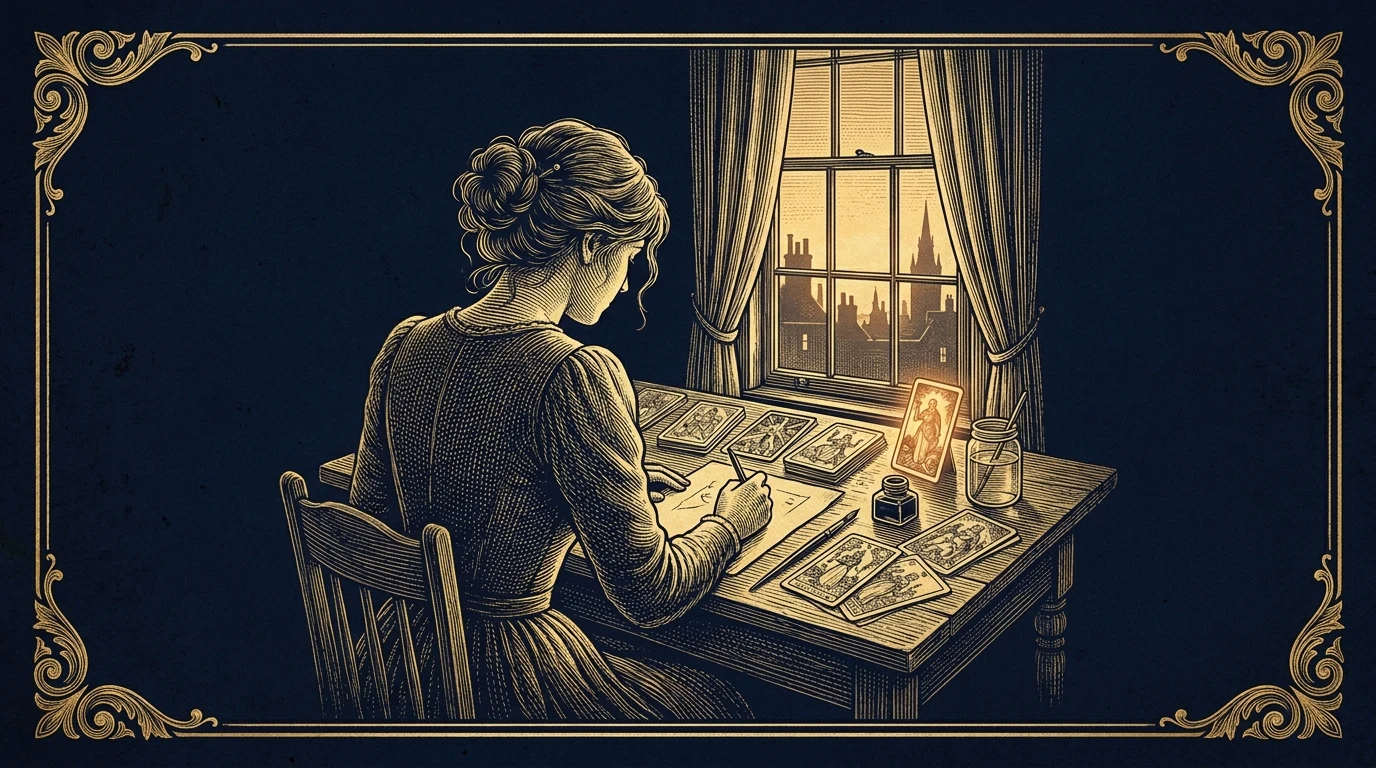
The division of labour ran like this. Waite supplied detailed descriptions for the major cards; for the numbered cards he handed over the lists of divinatory meanings he had. So the person who staged those fifty-six scenes was Smith. Who carries what, who looks where, whether the sky is open or closed: her call.
She finished between April and October. Black ink first, then the cards were coloured in watercolour. Seventy-eight cards in six months. In December 1909 William Rider & Son published the deck.
She was paid once, and not much. No royalties. In a letter to Alfred Stieglitz she described it as a large job done for a very small payment.
Why she could build those scenes
My favourite part, because those scenes did not come out of nowhere.
She was born in London in 1878. At eleven she moved with her family to Jamaica, where her father had taken work with the American company that had taken over the island's railway, and she met Caribbean folk tales in those years. Later she collected the Anansi stories into two books and performed them at her London home in costume, with small figures and bits of stage business. People came to listen.
At fifteen she enrolled at the Pratt Institute in Brooklyn under Arthur Wesley Dow. Back in England in 1899 she fell in with the Lyceum Theatre circle: Ellen Terry, Henry Irving, and the theatre's business manager Bram Stoker. Yes, that Bram Stoker. Smith did costume and set design there and toured with the company. The nickname "Pixie" is said to have come from Ellen Terry.
And there is this: she had synaesthesia. She painted the images that rose in her mind while she listened to music. Beethoven, Bach, Schumann. In 1907 Alfred Stieglitz hung those paintings at his 291 gallery in New York, making her the first painter shown in a room that had exhibited only photographs.
Put the picture together. A folk storyteller. A set designer. Someone who saw sound as image. Ask a person like that for fifty-six numbered cards and she will not draw repeated symbols. She will build a set. It is the only language she has.
The name that wasn't on the box
The deck went out under the publisher's name, as the Rider Tarot. Later it became the Rider-Waite. The illustrator's name was on neither the box nor the booklet inside it.
The only place she could sign was the cards themselves. She folded her initials into a small looped monogram and placed it on all seventy-eight, usually in the lower right corner. When the deck went on to be printed on the scale it did, that monogram was printed with it. Taking her name off the box was easy. Taking it out of the drawing was impossible.
Smith died in September 1951 in Bude, on the Cornish coast. She was seventy-three and she had no money. The paintings she left were sold to settle her debts. Where she lies is not known with any certainty today, because the burial records from that period were lost in a fire.
The deck is thought to circulate in more than twenty countries in something close to a hundred million copies. Her name came back years later; the deck is now called the Rider-Waite-Smith more and more often. She never saw it.
The next time you pull a card
Don't reach for the meaning the moment the card turns over. Look at the lower right corner first. Once you spot those looped letters you know who made the thing in your hand, and under what conditions.
Then watch the scene. Where is the figure looking, what is behind them, what is the weather doing? What someone has dropped tells you as much as what they hold. The man in the Five of Cups is fixed on the spilled ones and cannot see the two still upright. No keyword list gives you that.
Lay the backgrounds side by side too. Smith carries the landscape across cards, and the same distant hills and pale yellow sky turn up again and again. Pull three cards and that repeating ground shows how they talk to each other. Worth watching for even in the card library, one card at a time.
Best exercise I know: draw a card and, before you look anything up, write three sentences about what is happening in the picture. Then read the meaning. Most of the time the two land in the same place, because the card was drawn to tell you.
The letters in the corner
Back to that table. The Three of Swords is still face up and nobody has reached for a book.
There is no hidden power in the card. In 1909, in Chelsea, a woman arranged that heart and those three blades so anyone looking would understand. Cards speak to you because someone designed them to. Good design works this way: the maker disappears and the work explains itself.
Smith disappeared rather too well. But she is still there, in the corner of every card, in those few letters folded over one another.
You can ask a question about this reading
Atlas (Mit Anlatıcısı) answers your questions about Pamela Colman Smith: Seventy-Eight Cards in Six Months, No Name on the Box
Comments
You can share your thoughts about the piece here.