
The Perseids and the Man Born from a Shower of Gold
In AD 36 someone in China wrote down that more than a hundred meteors flew by before dawn. The same rain falls again this August, and this year it falls into the darkest sky we have had in a decade.
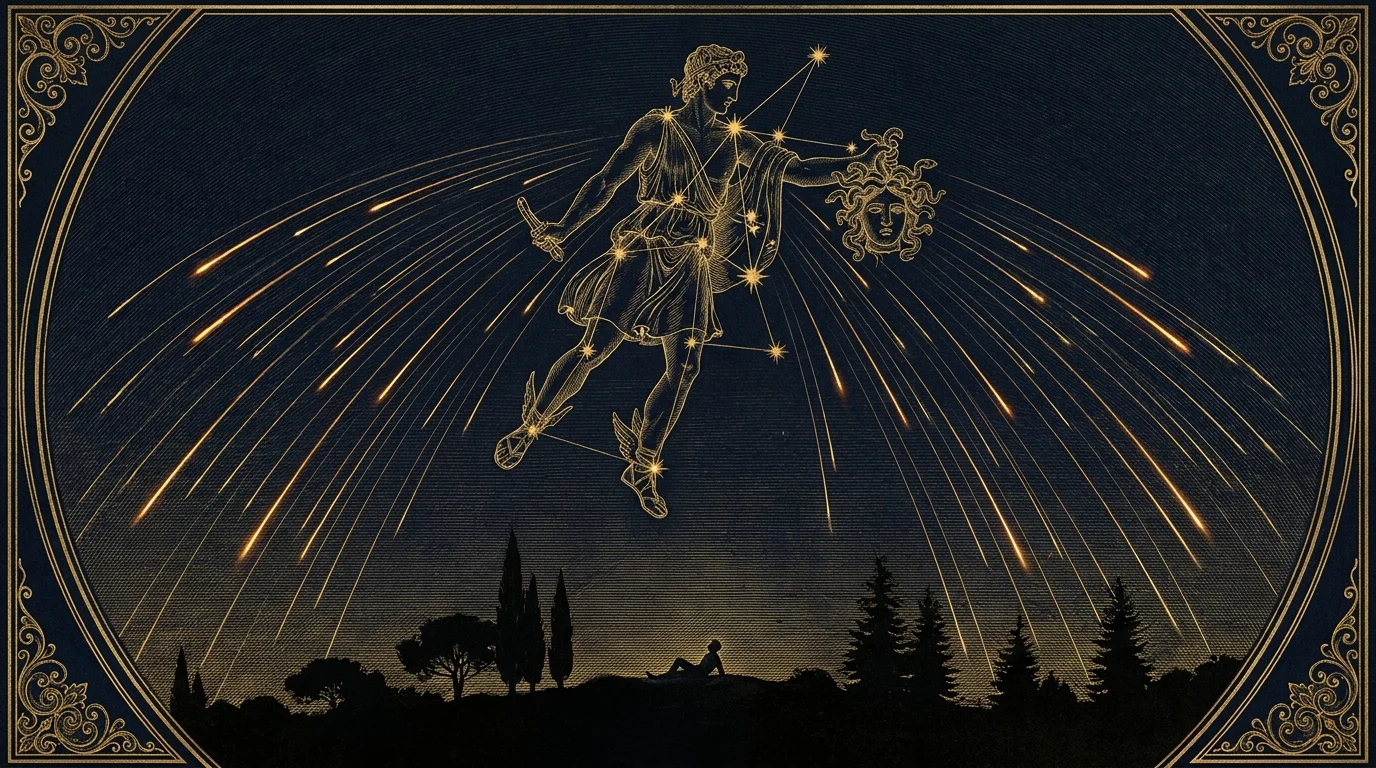
In AD 36, someone in China looked up and wrote a single line: more than a hundred meteors flew by before dawn. That is the whole entry. The observer did not know what they were, where they came from, or when they might return. They counted, and they wrote it down.
That line is the oldest surviving record humanity has of the Perseid meteor shower. Two thousand years later the same rain falls again this August, and we will do the same thing, turn our faces up and count. The only difference is that we now know what we are counting.
What you are actually looking at
Leave the sky for a moment and go to the source.
There is a comet called 109P/Swift-Tuttle. Its nucleus is roughly twenty-six kilometres across, which makes it the largest object in the solar system that comes near Earth on any kind of regular schedule. It takes a hundred and thirty-three years to orbit the Sun. It last passed through in 1992 and is not due back until 2126.
But what it left behind is still here. Every pass sheds dust and grit along its orbital path, and that trail hangs in place. Every August, Earth drives straight through it.
The streak you see overhead is usually no bigger than a grain of sand. It enters the atmosphere at fifty-nine kilometres per second and burns up eighty to a hundred kilometres above your head, in less than a second. That grain is almost certainly older than you are. It may have come off the comet centuries ago.
It was Giovanni Schiaparelli who worked out the connection in 1865. Tying meteor showers to comets was a new idea at the time, and the Perseids were one of the first cases where it was made to stick.
Why they seem to come from Perseus
The shower takes its name from the point in the sky the meteors appear to spray out from, which astronomers call the radiant, and which sits in the constellation Perseus.
That appearance is an illusion. The meteors enter the atmosphere on parallel paths. Perspective makes them look as though they are fanning out from a single spot, the same way straight railway tracks appear to meet at the horizon. Perseus has nothing to do with the dust. The constellation simply happens to be behind it.
Still, people have always pinned the sky to something. And the figure pinned here has one of the strangest origin stories in the whole sky.
A man born from a shower of gold
King Acrisius of Argos is told by an oracle that his daughter's son will kill him. His solution is to lock her in a tower of bronze. Her name is Danaë. No one gets in, no one gets out.
Zeus comes through the ceiling. He turns himself into a shower of gold and pours into the tower, described in some tellings as golden dust and in others as gold raining through the roof. Perseus is conceived in that rain.
The rest is the familiar part. The king puts mother and infant in a chest and sets it adrift. It washes up on Seriphos, Perseus grows up there, and is eventually sent to fetch the head of Medusa. He uses Athena's polished shield as a mirror so he never has to look at her directly, and takes the head.
That is the figure overhead: a man holding a severed head. The star in that head is Algol, and it has a history strange enough to deserve its own article. It dims and brightens on a fixed cycle, which is why four separate civilisations independently gave it names about death and severed heads.
Now hold the two facts side by side. A man conceived in a rain of gold, who once a year throws fire off his shoulder. The myth appears to repeat itself in the sky. It is a coincidence, of course. The radiant landing in Perseus has nothing to do with Danaë. But it is a good one, and the sky has always worked this way.
The other name for the same light
Perseus does not have sole claim on this rain.
In AD 258, on August 10, Saint Lawrence was executed in Rome, roasted alive on a gridiron according to tradition. Medieval Europe gave the mid-August meteors his name: the tears of Saint Lawrence. The belief was that his tears hang suspended in the sky and fall back to earth each year on the anniversary of his death. In Italy and Spain the shower still carries that name.
East Asian records note the same August rain repeatedly from the eighth century through the eleventh. There is an Egyptian sighting logged in 1029.
So different cultures looked at identical light and saw entirely different things. One saw the gold a hero was born in, one saw a martyr weeping, one saw a number worth writing down. The sky told none of them what to see.
What makes this year different
The Perseids come every August, but they do not come under the same conditions every August. The deciding factor is the Moon.
When the peak lands near a full moon, the sky washes out and most of the meteors disappear into the glare. This year is the opposite. The peak falls on a new moon, which means no moonlight at all. Darkness is the single best condition meteor watching can ask for, and this alignment is being called the best in a decade.
That same new moon becomes a total solar eclipse on August 12 across the far north of the Atlantic, tracking over Greenland, western Iceland and northern Spain. If you are anywhere along that line you get both events in one day. Everywhere else on Earth sees nothing of it. What matters here is simpler than the eclipse itself: an eclipse means a new moon, and a new moon means no Moon in the sky that night.
Something had to go dark for something else to become visible. The Moon hides itself completely, and only then does Perseus catch fire.
How to watch
The peak is the night of August 12 into the morning of August 13. The best hours are after midnight, particularly between 2am and 5am, when the radiant has climbed high enough to throw meteors across the whole sky.
Get away from city light. That one decision matters more than everything else combined. A dark site should give you fifty to eighty meteors an hour, suburbs twenty to forty, a city centre only the brightest few.
Do not bring a telescope, and do not bring binoculars either. Both narrow your field of view, and meteors cross every part of the sky. You do not need to find the radiant, and in fact looking away from it makes the trails appear longer. Lie flat on your back and take in as much sky as you can.
Your eyes need about twenty minutes to adapt to the dark, and every glance at a phone screen resets that clock. If twenty minutes without a phone sounds difficult, treat those twenty minutes as part of the shower.
Closing
Think about what that observer in AD 36 actually did. No telescope, no concept of a comet, no way to know the thing would ever repeat. They looked up, they counted, they wrote it down. The record outlived them by two thousand years and it is still accurate: in mid-August, before dawn, more than a hundred lights cross the sky.
They will cross again this August, into a sky as dark as it gets, on a night the Moon has stepped out of. The only thing left to do is go outside and count.
You can ask a question about this reading
Atlas (Mit Anlatıcısı) answers your questions about The Perseids and the Man Born from a Shower of Gold
Comments
You can share your thoughts about the piece here.