
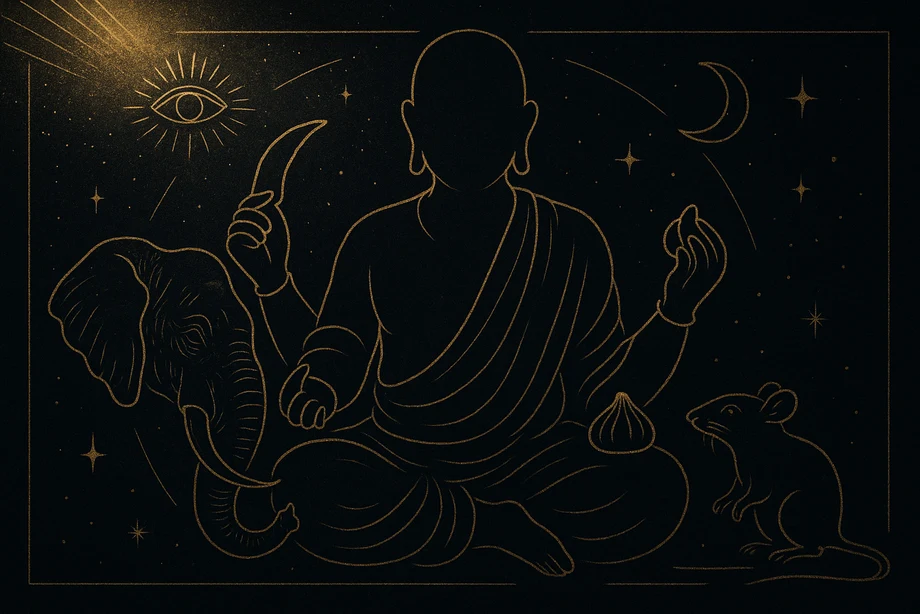
Engel kaldırma, başlangıç, bilgelik
Archetype: Engel kaldırıcı
Created to resemble his mother's eye
Ganesha's birth story is told in many of the major texts; the best known are the Shiva Purana, the Skanda Purana, and especially the Ganesha Purana and the Mudgala Purana, which are devoted to him. One version begins like this.
Parvati, Shiva's wife, wished to take a bath one day. There was no one nearby, and she needed someone to guard her private space. From the mixture of turmeric and oil she rubbed from her body, Parvati gave life to a son, a child belonging to no one but herself. She set him at her door and said, "Let no one in." The child agreed.
Then Shiva arrived and tried to enter his home. In front of him stood a child he did not recognize who refused to let him pass. Not knowing that this was a son his wife had made, Shiva grew angry, and a fight broke out. In the end the trident of Shiva cut the child's head from his body.
When Parvati saw her son in that state, she mourned in a way that shook the foundations of the world. Only then did Shiva understand what he had done. " They returned with the head of an elephant.
Shiva placed that head on the child's body and brought him back to life. That child became Ganesha. A son born of devotion to a mother, who passed through a misunderstanding with his father, a god with the head of an elephant.
The end of the story matters. Shiva gave his son an extraordinary gift: among all the gods he would be the first to be invoked, every ritual would begin with his name. This is why in the Indian tradition every new undertaking, every ritual, every journey, every book, every house-warming opens with the name of Ganesha.
He is the god of thresholds, the place where every beginning is given permission.
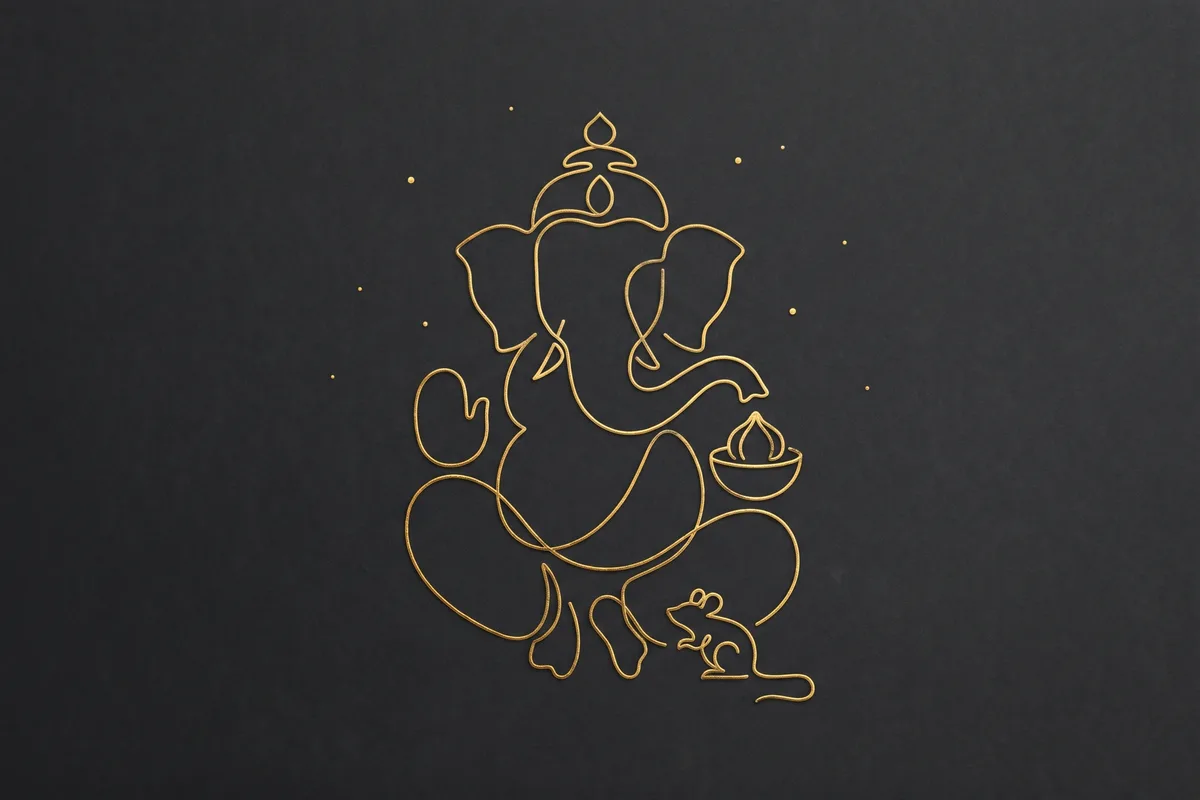
The pen that wrote the Mahabharata and the broken tusk
Another deep scene of Ganesha has to do with writing. The traditional account of the Mahabharata goes like this. The sage Vyasa, having conceived the vast epic in his head, looked for a scribe to write it down.
The god Brahma proposed Ganesha. Ganesha accepted, but with one condition: Vyasa was to dictate without pausing. Vyasa accepted, but added his own condition: Ganesha would understand the meaning of each line before writing it.
The agreement was made. The more than one hundred thousand verses of the Mahabharata were written like this. Vyasa would slip difficult passages into the flow, gaining time during the moments Ganesha paused to comprehend.
At one point Ganesha's pen broke. To keep the writing from stopping, he broke off one of his own tusks and used it as a pen. " That broken tusk is not an accident; it is a choice made so the work could continue.
The myth says a great deal about Ganesha's nature. He is not only the remover of obstacles; he is also the god of writing, of the book, of learning, of the record. In him wisdom is not oral but written; not something remembered but something handed on.
He tells us that for a work like the Mahabharata to exist, a sacrificing pen is needed, and that every reader carries a piece of that pen inside themselves. A teacher cannot transmit knowledge without giving up a piece of himself.
Many other myths describe his rivalry with his brother Kartikeya (Murugan, Skanda). " Kartikeya mounts his peacock and sets off around the world. " His cleverness wins him the prize.
The myth says something to us: to roam the world is not always to know it; sometimes looking with reverence at what is closest is the longer journey.
The mouse, the modaka, and Ganesh Chaturthi
Ganesha's symbols whisper his wisdom. The elephant head: great capacity to listen (wide ears), long sight (broad forehead), fine sensitivity (the trunk). His wide belly means that he holds the whole universe inside himself, refusing nothing; he takes in the good and the difficult, the sorrow and the joy, in the same breath.
His single tusk, as we just told, is a sign of sacrifice.
His mount is curious. Ganesha rides on a mouse (Mushika). A god the size of an elephant, on the back of a tiny mouse.
The myth says something graceful here: the largest is carried by the smallest. Wisdom without pride consents to the most humble mount. The mouse also represents our desires; Ganesha does not destroy them but rides on top of them, keeping them in proportion.
The most frequent thing in his hand is a modaka, a small sweet dumpling made of rice flour and coconut filled with palm sugar. The modaka stands for the sweetness of wisdom; knowledge is not meant to be bitter, it is meant to be sweet from the inside.
His brightest day of the year is Ganesh Chaturthi. It begins on the fourth day of the month of Bhadrapada (late August or early September) and lasts eleven days. In Maharashtra, especially in Mumbai and Pune, statues are set up house by house and street by street, prayers are said, modakas are passed around.
The festival closes on the eleventh day, Anant Chaturdashi, when the Ganesha statues are released into water, symbolizing the god returning the way he came. In Maharashtra the Ashta Vinayaka are the eight great Ganesha temples. In Tamil Nadu he is called Pillayar, in Bengal Siddhidata; Wednesdays and the fourth day of each month, Sankashti Chaturthi, are dedicated to him.
The one who places obstacles and removes them
What does Ganesha say to us today? Astrology has no single planetary equivalent for him, but his energy sits in the same room with the wit of Mercury, the wisdom of Jupiter, and the patience of Saturn.
The Ganesha within us is the god of thresholds. The voice that knows how to pause and think before opening a book, sending an email, beginning a conversation, leaving on a trip. " They are the same god.
Because real wisdom is knowing when to open a road and when to close one.
When a project gets stuck, the Indian tradition invokes Ganesha. But the deeper reading of the myth is different. Ganesha sometimes places certain obstacles on purpose, because without meeting that obstacle we could not have ripened.
A project that struggles at the beginning, a relationship that asks for a waiting period before it begins, a decision that does not become clear right away: these are the protective faces of Ganesha energy. The god aligns us with delay.
His elephant head also teaches us great listening. Before deciding, hear, and even more than hearing, sense; then speak. The wide belly is a tolerance that can take everything in.
The broken tusk means that a work asks for a piece of yourself. And the mouse says that even the smallest desire can carry a god. Ganesha is not a beginning but the consciousness that blesses a beginning.
The voice within
Yeni başlangıçların, içsel direncin yumuşatılmasının ve nazik bilgeliğin arketipi. Bir işe başlarken çağrılır çünkü o yolu açar. Modern okumada içsel "evet" diyebilmenin sesidir.
"Vakratunda Mahakaya, Suryakoti Samaprabha. Engelsiz kıl beni daima, bütün eylemlerimde." Ganesha Mantrası, geleneksel.
Sources: Ganesha Purana · Mudgala Purana · Şiva Purana · Skanda Purana · Mahabharata (Vyasa-Ganesha sahnesi) · Brahma Vaivarta Purana
You can ask a question about this reading
Hypatia (Bilge Astrolog) answers your questions about Ganesha