House of Zij, Birth Chart, Tarot, Coffee Reading, Numerology and Astrology

Mythos · Free

Atlas of Gods

The main gods and goddesses of seven pantheons. Each one with its symbol, its attributes, its astrology match and the archetype it carries. A door, a story, a direction.

Choose a Pantheon
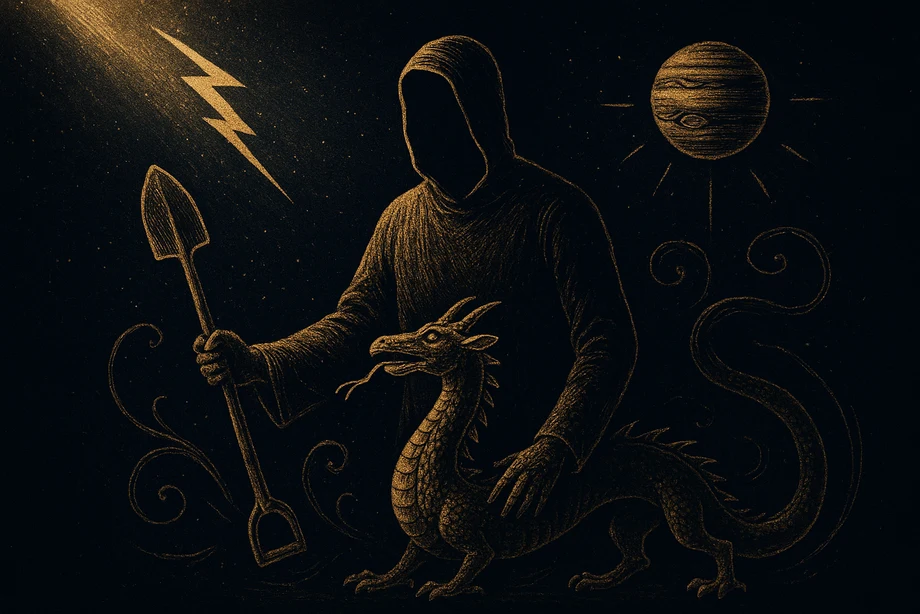
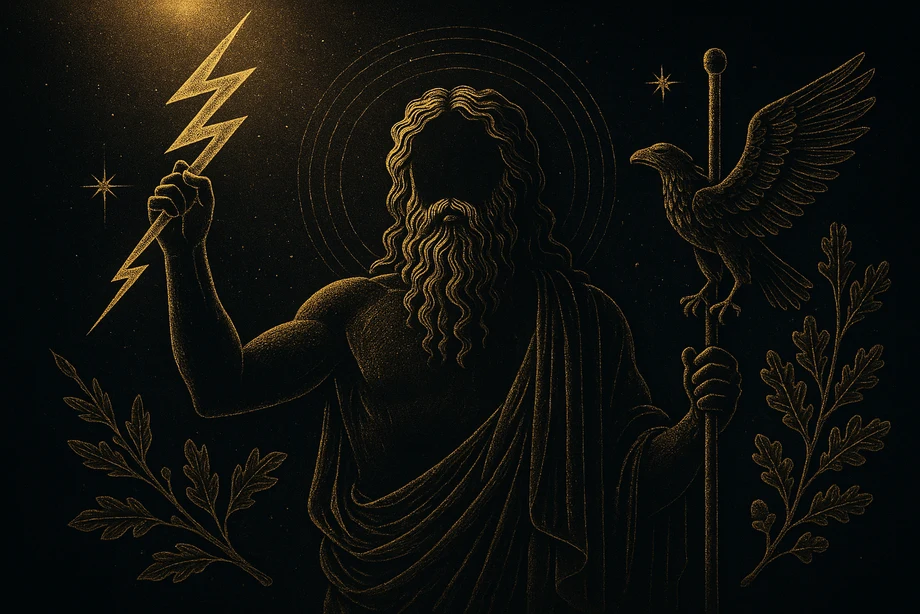
Zeus, Sky, lightning, cosmic order, alchemical engraving silhouette
Greek-Roman

Zeus

Jupiter (Roman) · Dyaus (Indo-European root)

Sky, lightning, cosmic order

JupiterSagittariusPisces

Archetype: The order-making father

Cronus used to swallow his own children, and Rhea, to hide the last born, offered a stone in the baby's place. Raised in a cave on Crete, Zeus, once grown, entered a ten-year war against his father and the Titans. He won, and the rule became this: lots were drawn, the sky fell to him, the sea to Poseidon, the underworld to Hades. From the peak of Olympus he gave order to the cosmos, yet on every page of the myths we saw that the one who builds order carries chaos within himself too.

"The son of Cronus, who casts lightning from the sky, the greatest, father of gods and of men." Hesiod, Theogony, 7th c. BCE.

lightningeagleoaksceptre
Modern reading

The archetype of authority, visible power and an order that takes everyone in. The voice inside us that sets a limit, gives meaning, widens life. Its shadow is domination, its light is generosity.
Read the full story →
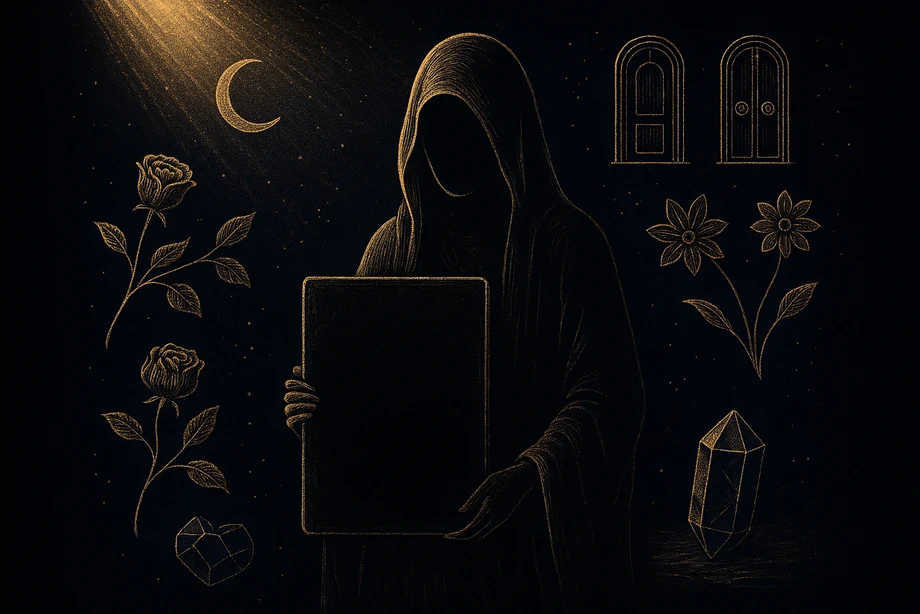
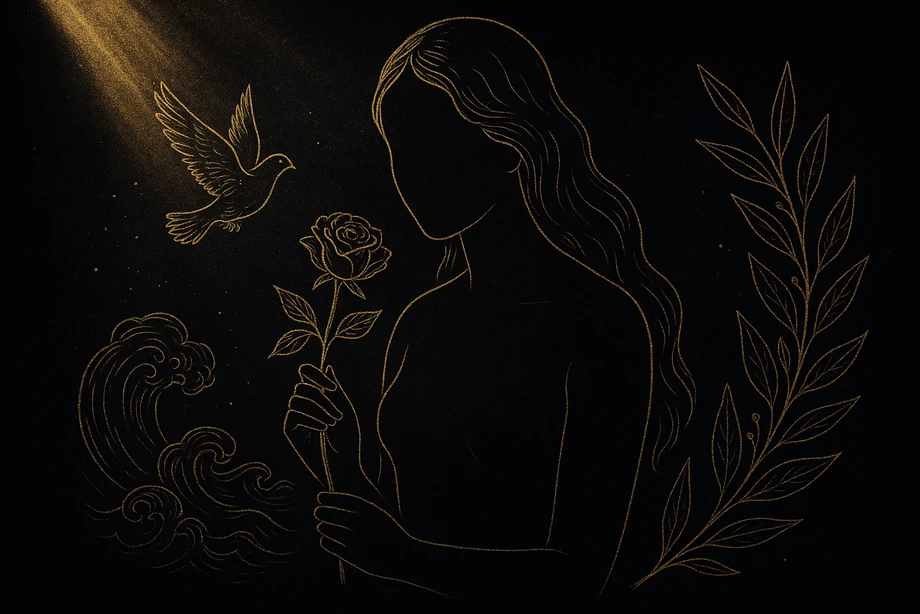
Aphrodite, Love, beauty, attraction, alchemical engraving silhouette
Greek-Roman

Aphrodite

Venus (Roman) · The Cyprian

Love, beauty, attraction

VenusTaurusLibra

Archetype: The goddess of attraction and union

Her birth is older than most of the gods of Olympus. When the seed of Ouranos, cut off by Cronus, fell into the sea, a white foam rose from the waves, and out of it came Aphrodite. She reached Kythera, then Cyprus. Flowers opened wherever she stepped. When she joined Olympus she carried an attraction even the strongest gods could not resist, because she had already been born before them, from the first wound of the cosmos.

"From the severed seed of Ouranos a foam was born on the sea, and within it a girl grew." Hesiod, Theogony, 188-200.

rosesea foamdovemyrtle leaf
Modern reading

The archetype of Eros, of beauty, and of the capacity to relate. The voice that gives worth to oneself and to another, that knows pleasure without shame, that makes love with form.

Read the full story →
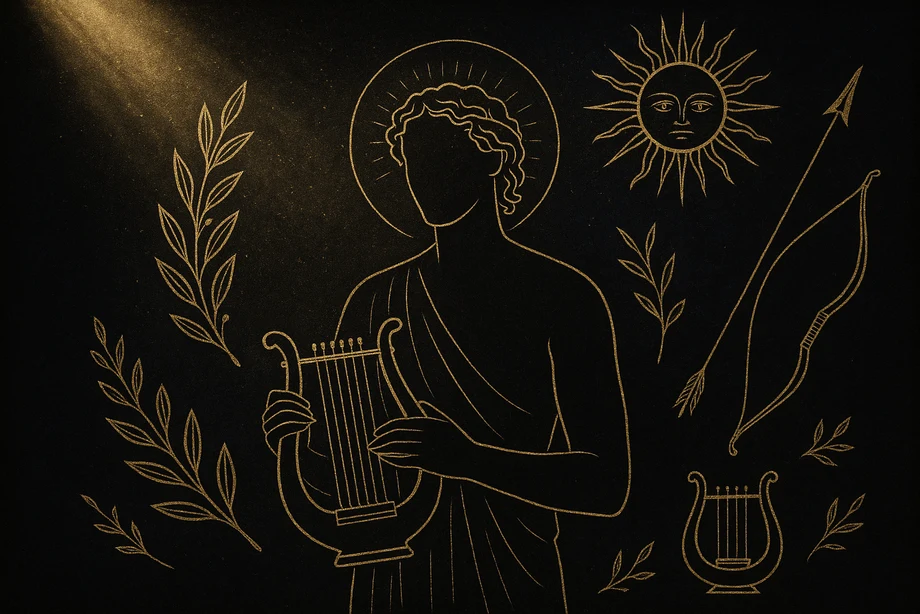
Apollo, Sunlight, music, prophecy, healing, alchemical engraving silhouette
Greek-Roman

Apollo

Phoebus · Apollon

Sunlight, music, prophecy, healing

SunLeo

Archetype: The enlightened artist, the seer

Leto bore him at the foot of a palm tree, on the floating island of Delos. While still a baby he took up his bow, defeated the dragon Python at Delphi and became the oracle there. With the Muses he played the lyre on the mountain, he loved the shepherd Hyacinthus and lost him. He stands for both the light and the measure, because the true gift of the sun is not to burn, but to let us see.

"Know thyself." The command written at the entrance of the temple at Delphi, attributed to Apollo.

lyrelaurelbow and arrowsun
Modern reading

The archetype of form, measure, clarity, and knowledge that rises from within. The place where intuition and reason, music and mathematics speak the same language. Its shadow is excessive perfectionism, its light is inspiration.

Read the full story →
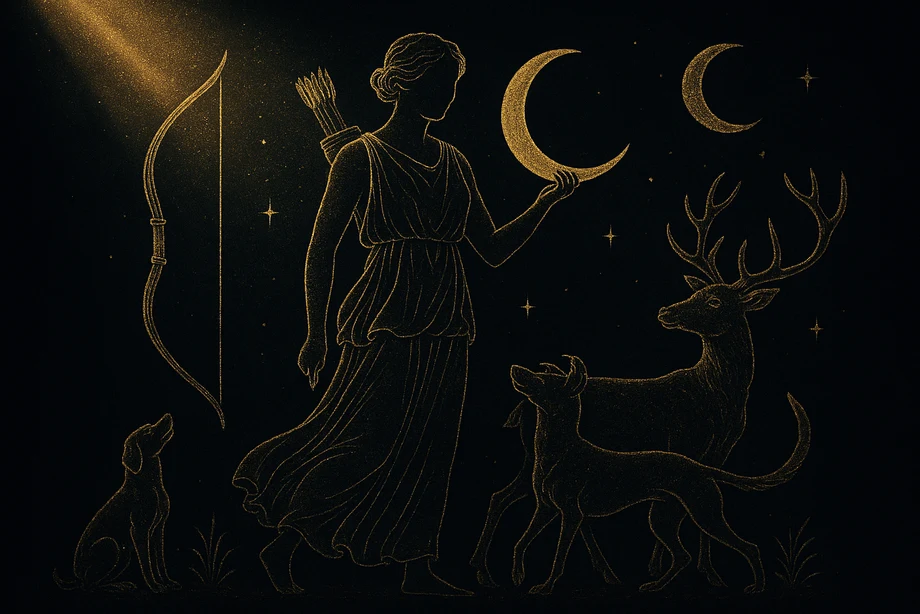
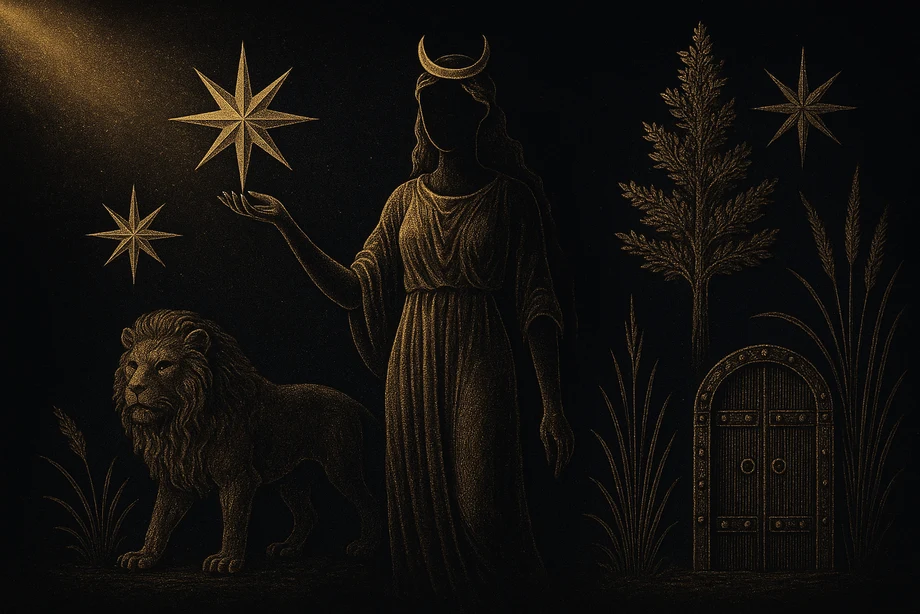
Artemis, Moon, the hunt, maidenhood, the wild, alchemical engraving silhouette
Greek-Roman

Artemis

Diana (Roman) · Cynthia

Moon, the hunt, maidenhood, the wild

MoonCancerVirgo

Archetype: The one who stays her own

She was born as the twin sister of Apollo, and while only three years old she told her father Zeus what she wanted: her own arrows, her own hounds, her own mountains, never to marry. With the nymphs she roamed the forests, and though she hunted the deer she also protected it, and she arrived in time for women in childbirth. When Actaeon saw her bathing, the goddess had him torn apart by his own hounds, because Artemis's boundary is not to be trifled with. Her purity was not childhood, it was being unowned.

"Give me eternal maidenhood, father, and the mountains, to go up there alone." Callimachus, Hymn to Artemis, 6-7.

silver bowdeercrescenthounds
Modern reading

The archetype of independence, of the boundary, and of a life turned toward oneself. To be no one's possession, to be able to withdraw from the crowd into the forest, to find direction by intuition. In a modern reading she is the voice of inner sovereignty.

Read the full story →
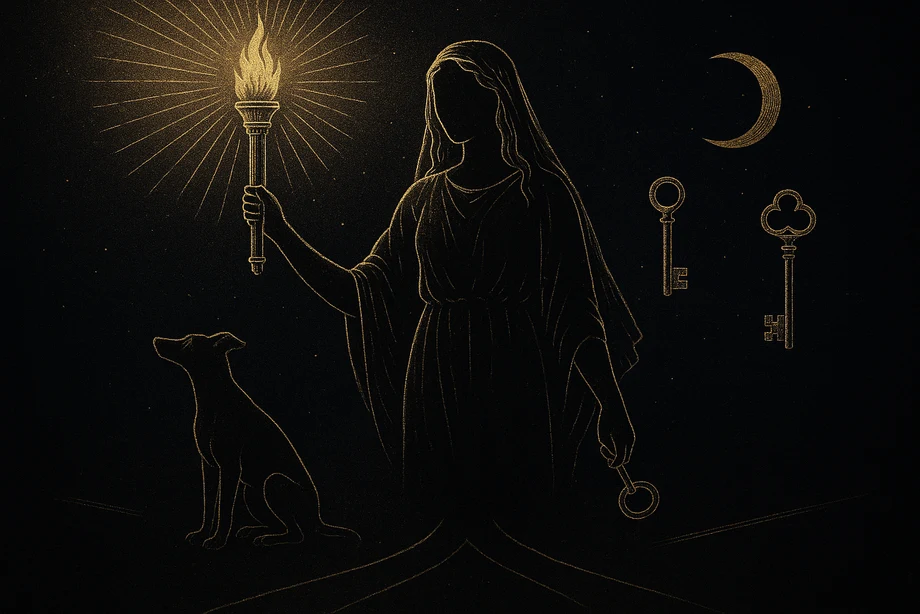
Hecate, Threshold, crossroads, moon magic, night, alchemical engraving silhouette
Greek-Roman

Hecate

Trivia (Roman) · The Three-Wayed

Threshold, crossroads, moon magic, night

MoonPlutoScorpioCancer

Archetype: The goddess of the threshold

Her origin was not from Olympus but from an older generation of Titans. Zeus gave her a share in the sky, the sea and the underworld, so she held authority in all three realms. She was worshipped at crossroads, because every choice is a small death and a birth. When Persephone descended to the underworld, it was Hecate who carried the torch and brought word to Demeter. She should be remembered not as fearsome, but as the keeper of thresholds.

"Queen of the three roads, who sees both night and day." Hesiod, Theogony, 411-415.

torchkeyhoundthree roads
Modern reading

The archetype of passages, of the points of choice, and of night knowledge. The inner torch that shows the next door when one closes. In modern depth psychology she is read as the guarding guide of transformation.

Read the full story →
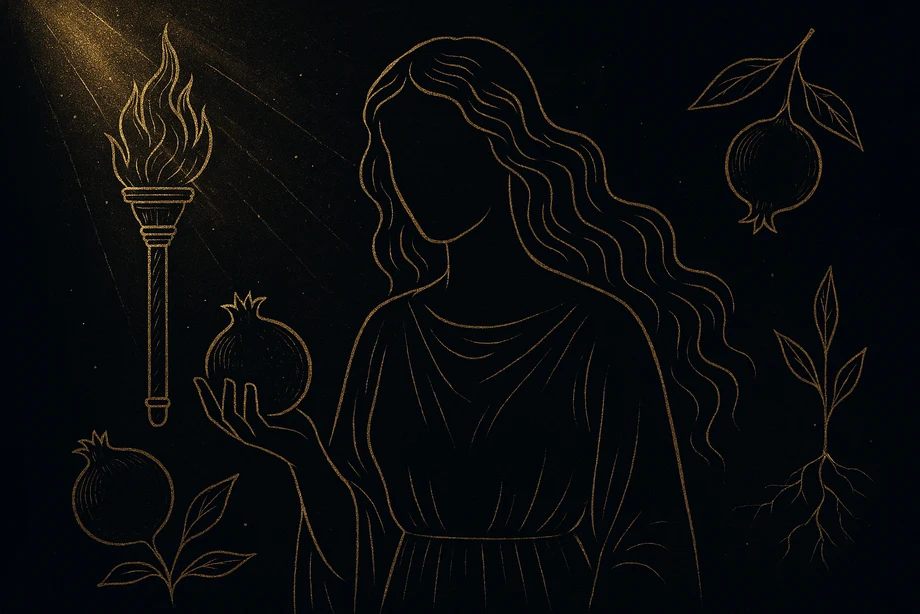
Persephone, The underworld, the seasons, transformation, alchemical engraving silhouette
Greek-Roman

Persephone

Proserpina (Roman) · Kore

The underworld, the seasons, transformation

PlutoMoonScorpioCancer

Archetype: Loss and return

Persephone, the daughter of Demeter, was one day picking flowers in the plain when Hades drew her down beneath the earth. Her mother had the whole world searched, the seasons stopped, the soil gave no yield. In the end Zeus mediated, but Persephone had eaten the pomegranate in the underworld, and now she would spend half the year below and half above. The seasons began this way, winter the grief of her mother, spring the return of her daughter.

"In the underworld I ate the pomegranate, now I must spend half the year there." Homeric Hymn to Demeter, 7th c. BCE.

pomegranatetorchfresh shoot
Modern reading

The goddess of the inner descent. The intuitive guide for everyone who lives the cycle of loss, grief, transformation and return. She is the voice of the passage from being the mother's daughter to being the queen of one's own kingdom.

Read the full story →
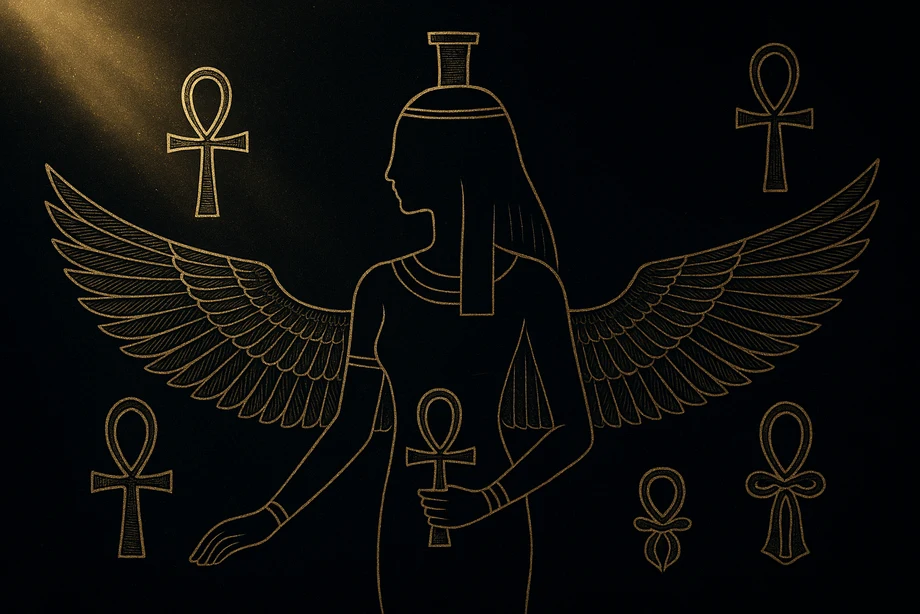
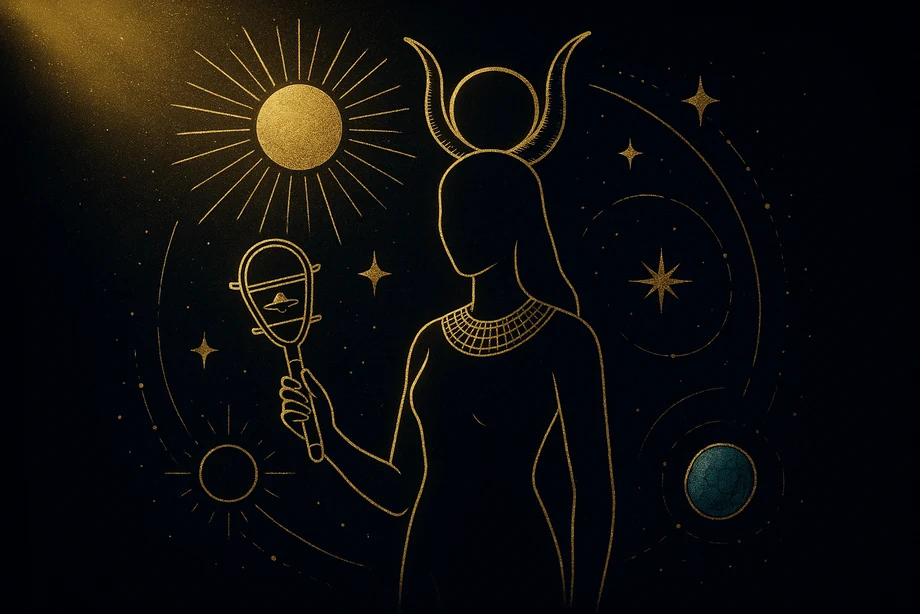
Isis, Mother goddess, magic, protection, alchemical engraving silhouette
Egyptian

Isis

Aset (Egyptian) · Stella Maris

Mother goddess, magic, protection

MoonVenusCancerVirgo

Archetype: The healing mother

When her brother and husband Osiris was torn apart by Set, when the pieces were scattered along the Nile, Isis travelled all of Egypt and gathered them. The one missing piece she cast in gold, completed the body, and gave it breath with her wings. From this reunion Horus was born. Her knowledge lay in the secret of words, and once she learned a god's hidden name she healed even Ra with her magic. She is the beloved knowledge that makes the lost whole again.

"I am all that has been, that is, that shall be. No mortal has lifted my veil." Inscription from the temple of Isis at Sais, as relayed by Plutarch.

ankhthronewinged armstyet knot
Modern reading

The archetype of grief, perseverance and magical recovery. The capacity to gather what is broken back together with love. In a modern reading she points to the inner mother who collects her own wounded parts.

Read the full story →
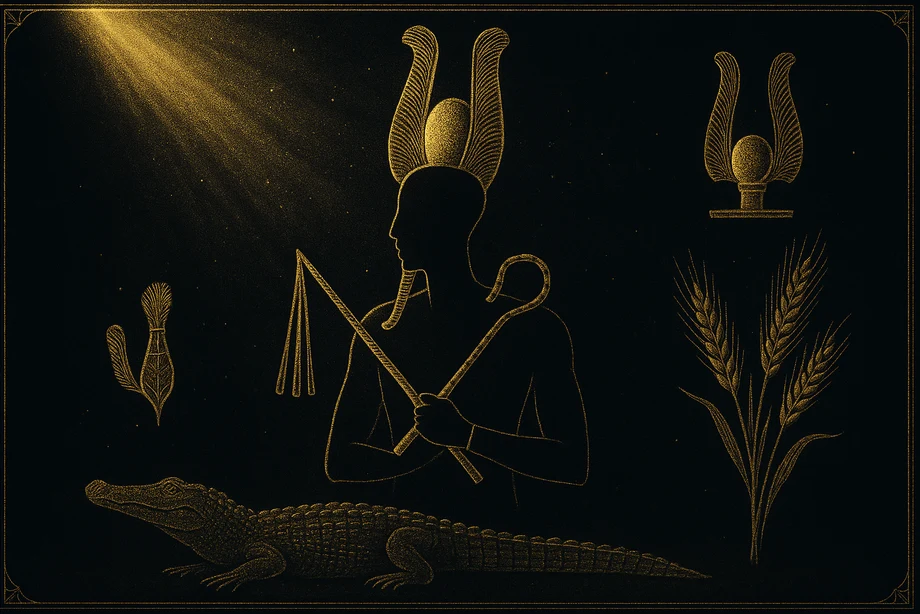
Osiris, The underworld, transformation, rebirth, alchemical engraving silhouette
Egyptian

Osiris

Wesir (Egyptian) · Serapis (Hellenistic)

The underworld, transformation, rebirth

PlutoSaturnScorpioCapricorn

Archetype: The king who dies and rises again

Osiris was once the good king of Egypt, he taught his people farming, wine, and law. His jealous brother Set shut him in a coffin and threw it into the Nile, then cut his body up and scattered it through the land. When Isis and Nephthys gathered him and brought him back to life, Osiris was no longer king of the upper world but of the lower. He weighs the heart of the dead on the scales and teaches rebirth to those who deserve it. The green skin of the mummies is his colour, because he is the seed.

"I shall not decay, I shall not be scattered. Like wheat I shall be green again." Book of the Dead, Chapter 154.

atef crowncrook and flailgreen skinwheat
Modern reading

The archetype of decay and of sprouting anew. The threshold moment where one identity ends and the seed of the next is sown. In a modern reading he is the symbol of processes of rebuilding such as burnout, divorce, and great loss.

Read the full story →
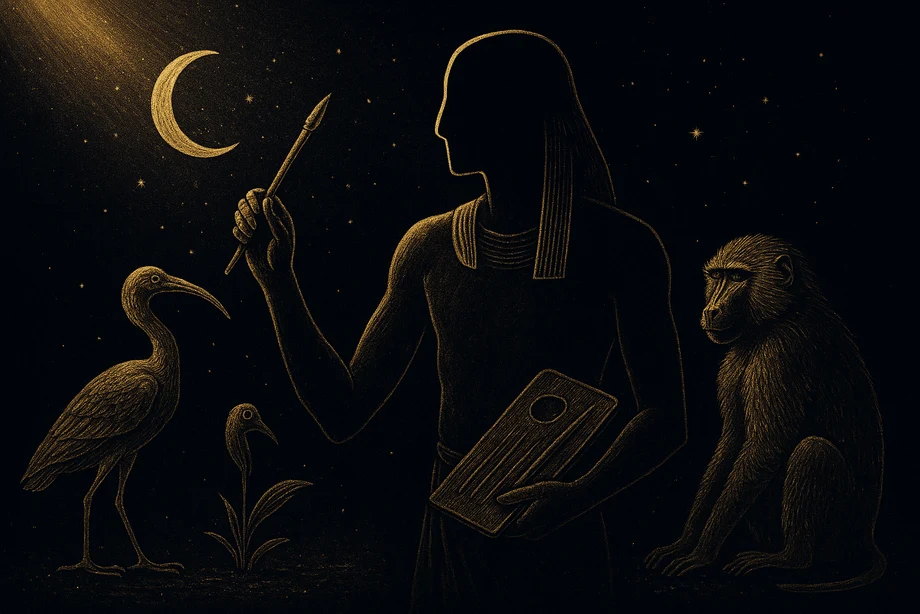
Thoth, Wisdom, writing, measure, the moon, alchemical engraving silhouette
Egyptian

Thoth

Djehuty (Egyptian) · Hermes Trismegistus

Wisdom, writing, measure, the moon

MercuryMoonGeminiVirgo

Archetype: The one who holds the universe with writing

Thoth was the scribe of the gods. The word of Ra, the court of Osiris, the scales of Maat, he held them all with writing. He was a moon god, because the moon measures time by changing each night and yet remains the same. It was he who gave hieroglyphs, alchemy and geometry to humankind. In the Hellenistic age he was identified with Hermes, and so Hermes Trismegistus, thrice-great Hermes, became the founding voice of Western esotericism.

"That which is above is like that which is below, that which is below is like that which is above." The Emerald Tablet, attributed to Hermes Trismegistus.

ibispalette and pencrescentbaboon
Modern reading

The archetype of knowledge, language and mediation. The inner voice that turns thought into form, that turns experience into a story. In the Hermetic tradition he is the guardian of inspiration and transmission.

Read the full story →
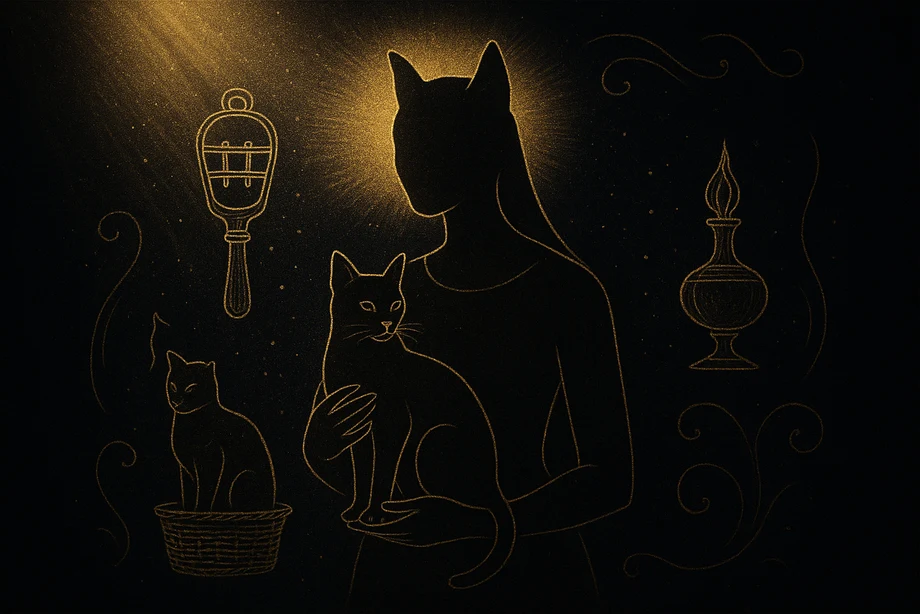
Bastet, Home, womanhood, protection, joy, alchemical engraving silhouette
Egyptian

Bastet

Bast · Ubaste

Home, womanhood, protection, joy

VenusMoonTaurusLibra

Archetype: The feminine who guards the threshold

At first she was seen as the tame face of Sekhmet, the wild lion-headed goddess, and later she became a goddess in her own right. She had a temple in the city of Bubastis, where people came by boat from all over Egypt, where music was played and people danced. Her cats were held sacred and were mummified when they died. Bastet protected the home, women and children, and drove away illness. Her claw was for defence, not for attack.

"The festival held at Bubastis is the most crowded and the most joyful feast in Egypt." Herodotus, Histories, II.60.

catsistrumbasketperfume bottle
Modern reading

The archetype where softness and the claw live in the same body. A feminine intelligence that holds pleasure, grace and the boundary together. In a modern reading she is the voice of self-care and of the capacity to protect one's own space.

Read the full story →
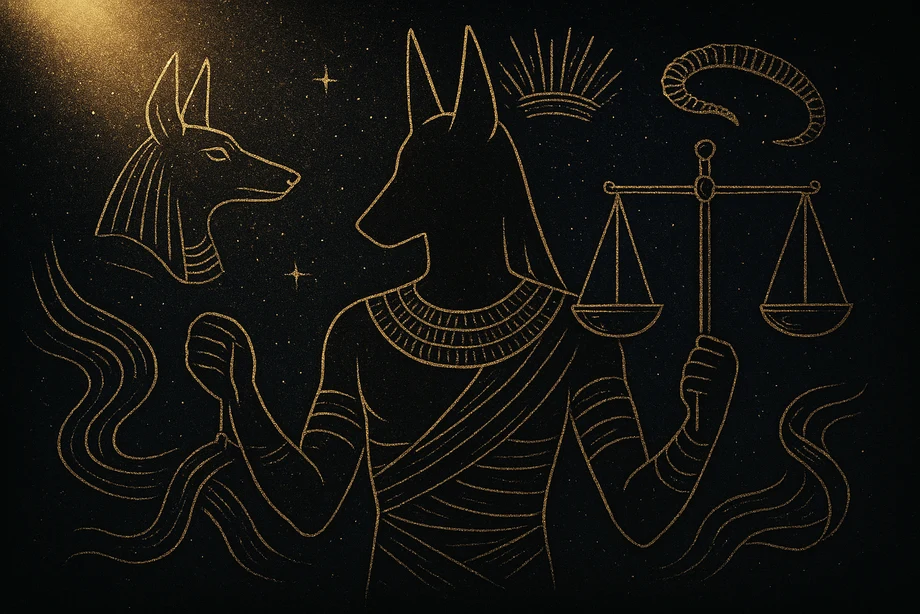
Anubis, Guide of death, embalming, the scales, alchemical engraving silhouette
Egyptian

Anubis

Anpu (Egyptian) · Hermanubis (Hellenistic)

Guide of death, embalming, the scales

PlutoSaturnScorpioCapricorn

Archetype: The guide of thresholds

The jackal-headed Anubis did not stand at the gate of death, he stood at its threshold. It is said he first practised the art of embalming on the body of Osiris, and so it became possible to halt decay. He led souls to the halls of the Duat, and when they arrived he weighed their hearts on the scales against the feather of Maat. A light heart passed on to the fields of Osiris. Anubis was not a judge, he was a witness.

"This heart is as light as the feather of truth." Book of the Dead, the heart-weighing scene, Chapter 125.

jackal headscaleswrapping linenimenti crown
Modern reading

The honourable guide of endings. The archetype of the capacity to truly bury something, to send it off with the ceremony it deserves. In modern psychology he is the guardian of the work of grief.

Read the full story →
Hathor, Love, music, the sky, joy, alchemical engraving silhouette
Egyptian

Hathor

Het-Heru (Egyptian) · Identified with Aphrodite

Love, music, the sky, joy

VenusSunTaurusLibra

Archetype: The sky cow, cosmic tenderness

Hathor was the sky itself, and at night the stars shone within her belly. She was the daughter of Ra, and also his wife, and the wife of Horus, because myth draws circles beyond time. It was she who gave music and dance to humankind, and the sistrum is her voice. She would come as the Seven Hathors to speak the fate of the newborn. The oldest songs of the land were sung in her temple, and her name is remembered with joy.

"She who is the cow of the sky, who feeds the stars with her milk." Inscription from the temple of Dendera, Late Period.

cow hornssun discsistrumturquoise
Modern reading

The archetype of pleasure, music, and the blessing of the material world. The voice that carries not the shame but the joy of coming into a body. In a modern reading she is connected with the repair of the capacity for pleasure.

Read the full story →
Inanna, Love, war, the planet Venus, alchemical engraving silhouette
Mesopotamia

Inanna

Ishtar (Akkadian) · Astarte (Phoenician)

Love, war, the planet Venus

VenusTaurusScorpio

Archetype: Feminine sovereignty that crosses the threshold

The most loved goddess of Sumer, she was the lady of Uruk. One day she descended to the underworld to see the kingdom of her sister Ereshkigal. At the seven gates she gave up her seven powers, and at the last gate she knelt naked. Ereshkigal killed her, and her corpse hung on a hook for three days. When Enki revived her with the water and bread of life she returned, but she had to leave someone in her place, and she sent her husband Dumuzi. For six months of the year Dumuzi is below and six above. The seasons turned with that parting.

"She passed through the seven gates, at each gate she removed something, and came before her sister naked and on her knees." The Descent of Inanna to the Underworld, tablets of the 18th c. BCE.

eight-pointed starliongatepost reedcedar
Modern reading

The archetype that carries love and power in the same body. The queen who can risk her own descent, who dies and rises again. In modern depth psychology she is the strongest feminine voice of shadow integration.

Read the full story →
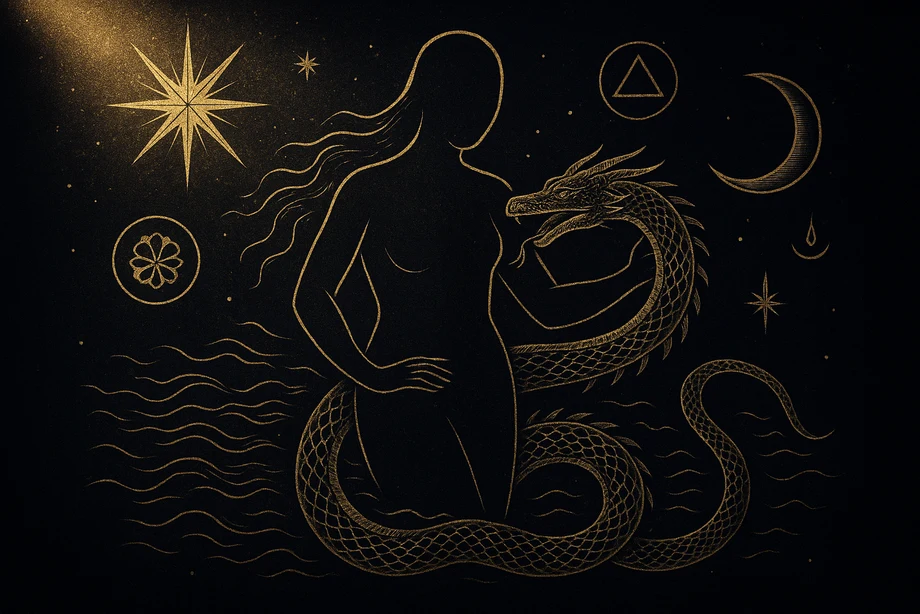
Tiamat, The primordial sea, chaos, creation, alchemical engraving silhouette
Mesopotamia

Tiamat

Tâmtu · The Primordial Sea

The primordial sea, chaos, creation

PlutoNeptunePiscesScorpio

Archetype: The first mother, the first chaos

Before everything there was Tiamat, as the salt ocean. When she mingled with the fresh water Apsu the first gods were born, noisy, restless, disturbing the sleep of the old couple. After Apsu was killed Tiamat made war on her children and created eleven monsters. Marduk defeated her with an arrow from his bow and split her body in two, the upper half becoming the sky, the lower the earth. So the world we see is still her body, and we still walk upon it.

"When the sky above was not yet named, when the earth below bore no name, Apsu and Tiamat mingled their waters." Enuma Elish, Tablet I, lines 1-5.

dragon serpentsalt waterfirst mother
Modern reading

The archetype of that which has not yet taken form, of limitless creative potential. Not the thing to be feared, but the prima materia from which everything is born. In a modern reading she is the boundless ocean of the unconscious.

Read the full story →
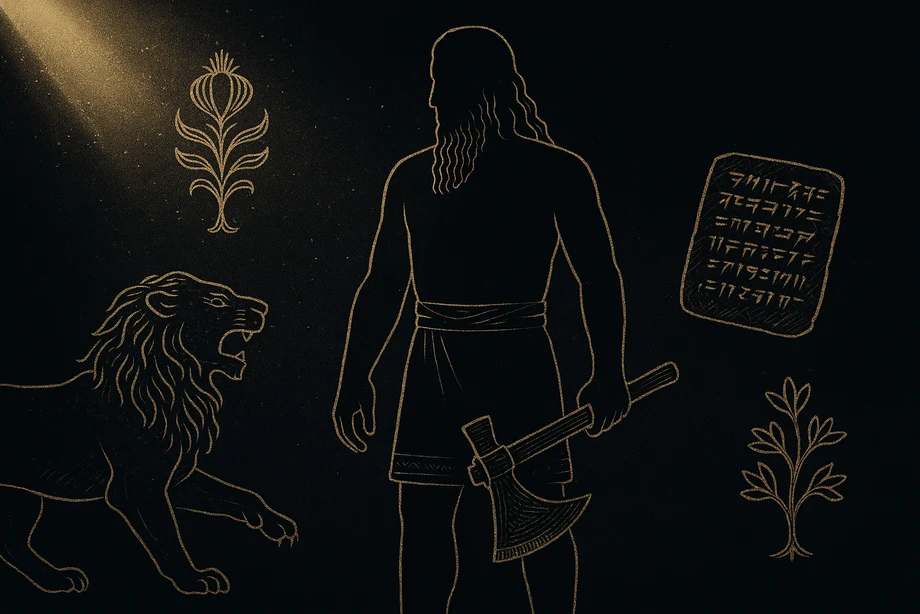
Gilgamesh, Kingship, friendship, the search for mortality, alchemical engraving silhouette
Mesopotamia

Gilgamesh

Bilgames (Sumerian) · King of Uruk

Kingship, friendship, the search for mortality

SunMarsLeoAries

Archetype: The hero who faces his own mortality

He was two-thirds god, one-third human. He was the king of Uruk but he wore his people out, until the gods sent him Enkidu. They fought the wild man, then became brothers, and together went to the cedar forests and defeated Humbaba. When Enkidu died, Gilgamesh grasped what death was and set out to find its cure. Utnapishtim, the survivor of the flood, told him of the plant of life, but a serpent stole it from Gilgamesh. He returned home and had the walls inscribed, because the work that is done remains.

"He who saw all, who knew all, who learned the secret of the deep, when he was weary he carved this story into stone." Epic of Gilgamesh, Tablet I, opening.

lioncedar axeplant of lifetablet
Modern reading

The archetype of human growth, of maturing through loss and acceptance. The hero who truly learns to live once he learns he will not be eternal. In a modern reading he is the voice of the midlife crisis and of processes of acceptance.

Read the full story →
Marduk, Creator, kingship, cosmic order, alchemical engraving silhouette
Mesopotamia

Marduk

Bel (Akkadian) · Lord of Babylon

Creator, kingship, cosmic order

JupiterSagittariusLeo

Archetype: The chief hero of order

He was the chief god of Babylon, but he was not always so. When Tiamat made war on her children the young gods panicked, and only Marduk stepped forward, with the promise of kingship. He drew his bow, defeated Tiamat, and from her body built the sky and the earth. Then he came to be known by his fifty names, each name a faculty, a power. As the star of Babylon he took his place in the sky as Jupiter, and became the signature of the king.

"He who defeated Tiamat, to him the kingship was given. His fifty names were spoken, each one naming another of his powers." Enuma Elish, Tablets VI-VII.

mushhushshu dragonspadelightningthe planet Jupiter
Modern reading

The archetype that builds structure out of chaos, that gives shape to the cosmos with a word. The inner voice of leadership, of taking on responsibility, and of carrying the larger picture. Its shadow is rigid control, its light is vision.

Read the full story →
Ereshkigal, The underworld, deep grief, acceptance, alchemical engraving silhouette
Mesopotamia

Ereshkigal

Allatu · Queen of the Underworld

The underworld, deep grief, acceptance

PlutoScorpioCapricorn

Archetype: The queen of the bare truth

She was Inanna's sister, stronger and more alone. In the upper world no one spoke her name with love, because she was the lady of death. When Inanna came she killed her, but a sister's killing was no ordinary killing, it was a reminder: on the way down, your old identity stays there. Later Nergal fell in love with her and settled at her side, and her loneliness ended. Ereshkigal was not evil, she was an ignored truth.

"Ereshkigal was alone, she had no husband, her throne had darkened, her eyes were clotted blood." The Descent of Inanna to the Underworld.

dark thronepurpleseven gateslapis lazuli
Modern reading

The archetype of grief, of withdrawal, and of transforming sorrow. The throne deserved by what has been ignored and cast out. In modern depth psychology she is the voice of the inner waiting room.

Read the full story →
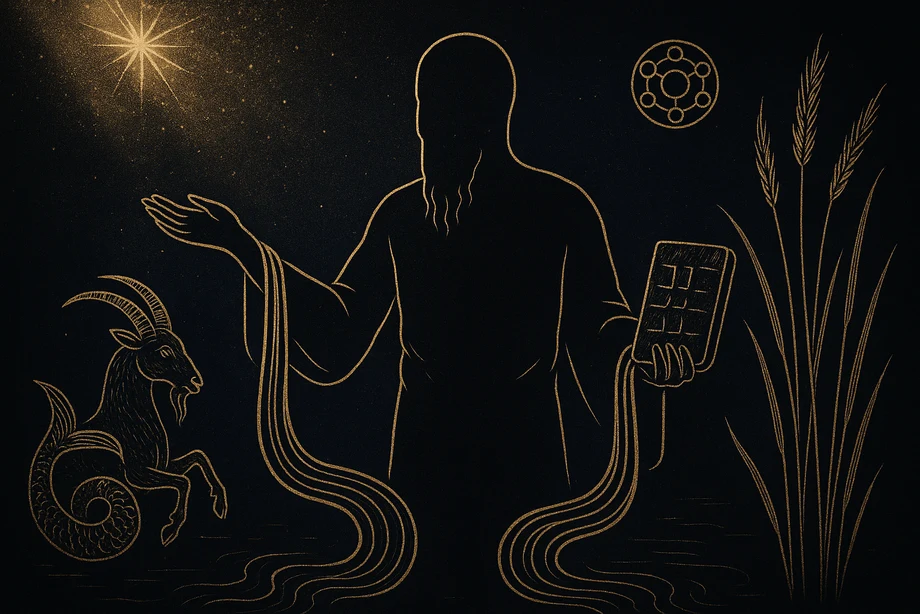
Enki, Wisdom, fresh water, life and cunning, alchemical engraving silhouette
Mesopotamia

Enki

Ea (Akkadian) · Nudimmud

Wisdom, fresh water, life and cunning

MercuryNeptuneAquariusPisces

Archetype: The creative sage

He came from Apsu, the depth of the fresh water. It was he who first made the human being, kneading it from clay and breathing life into it. When the decision for the flood was made, the other gods wiped out humankind, but Enki whispered secretly to Atrahasis: build the boat. So life went on. His wisdom was not to break the rule, but to find the water flowing beneath it. He had a temple at Eridu, and those who went down into it saw two rivers flowing.

"I am Enki, lord of the waters, who holds the me in my hand, who teaches knowledge to humankind." Enki and the World Order, a Sumerian tablet.

two flowing riversgoat-fishthe me tabletsreed
Modern reading

The archetype of creativity, of mastery, and of an intelligence that can bend the rule. The mind that finds a way around when it is blocked. In a modern reading he points to the intuitive, problem-solving intelligence.

Read the full story →
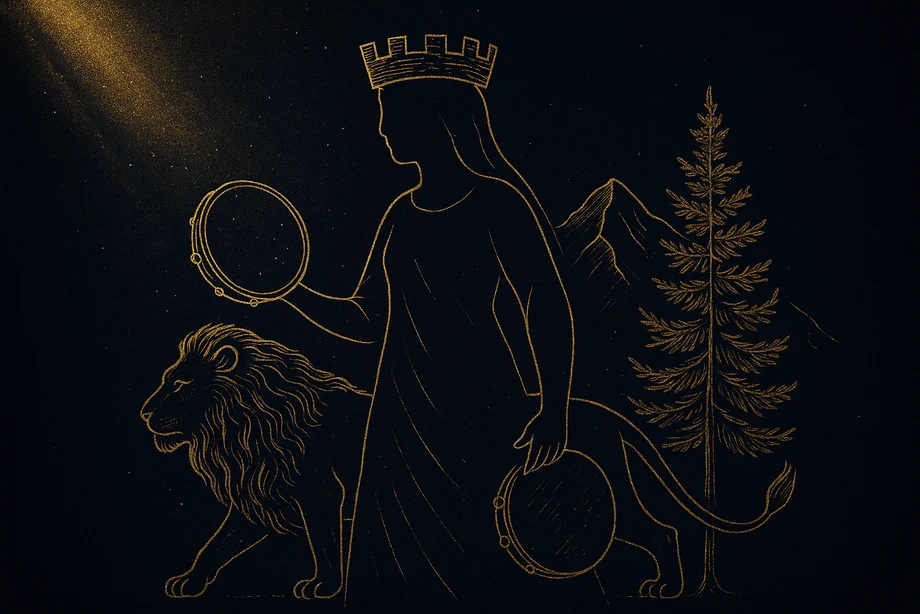
Cybele, Mother goddess, mountain, nature, fertility, alchemical engraving silhouette
Anatolia

Cybele

Kybele · Magna Mater (Roman) · Kubaba (Hittite)

Mother goddess, mountain, nature, fertility

VenusMoonTaurusCancer

Archetype: Mother earth, lord of the mountain

She was born in the mountains of Phrygia, in a stone. Pessinus was her most sacred city, and from there she travelled as far as Rome, because during the Punic Wars Rome had her black stone brought over by an oracle. She was known by rocks, by caves, by lions. When her beloved Attis wounded himself she mourned and turned him into a pine tree. Her priests, called the Galloi, served her with drums and flutes. As a mother goddess she is very old, as old as Anatolia itself.

"The great mother of the gods, her towered crown, her team of lions, comes down from the mountain into the city." Lucretius, De Rerum Natura, II.598-643.

liona crown shaped like city wallsdrumpine
Modern reading

The archetype of root, body and place. The bond with the land you belong to, the strength that comes through ancestry, the raw state of nature. In a modern reading she is the voice of body wisdom and of earth-rooted healing.

Read the full story →
Shahmaran, Wisdom, healing, secret, alchemical engraving silhouette
Anatolia

Shahmaran

Shah of the Serpents · Shah-i Maran

Wisdom, healing, secret

PlutoMercuryScorpioVirgo

Archetype: The sage of the underground

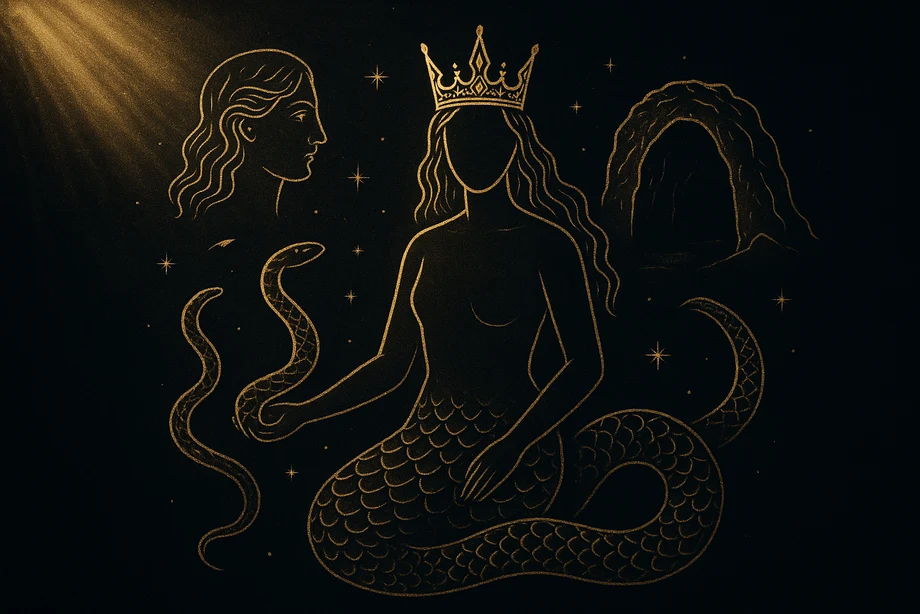
Her name is told in seven cities of Anatolia: Mardin, Tarsus, Shirvan and others. A young man, searching for honey, falls into a well and reaches a shining garden underground, whose lady is Shahmaran. For years he lives with her and learns the secret of the herbs and of healing. When he goes up, the sultan is ill, and if he tells the secret Shahmaran will die. He tells it, the queen is killed, but her bones are divided into three parts: one gives poison, one the antidote, one knowledge. In the homes of Anatolia a picture of Shahmaran is hung on the wall, because she protects the house.

"Jamshid went down into the cave, there he saw the shah of the serpents, her head a woman's, her tail a serpent's, her eyes two stars." A folk tale of Tarsus, oral tradition.

serpent taila woman's headcrowncave
Modern reading

The archetype of intuitive knowledge, of body memory, and of the secret that gains worth when it is shared. The serpent is an old symbol of healing, since the time of Asclepius. In a modern reading she is body wisdom and the healing of the hidden wound.

Read the full story →
Telipinu, Agriculture, the seasons, loss and return, alchemical engraving silhouette
Anatolia

Telipinu

Telepinu · Hittite God of Spring

Agriculture, the seasons, loss and return

MercuryVenusVirgoTaurus

Archetype: Life that vanishes and returns

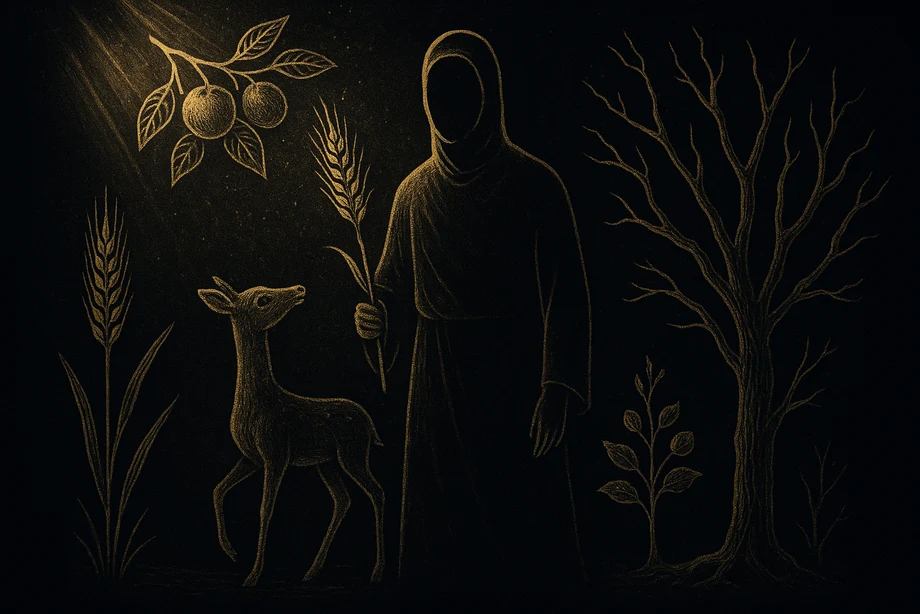
One of the most beautiful stories of the Hittite pantheon belongs to him. One day Telipinu vanished in anger, and it was not clear why, perhaps the people had forgotten an offering. Where he had gone the crops did not grow, the animals did not give birth, even the gods went hungry. They searched and searched, sent out a bee, and the bee found him asleep, his anger spent. A rite was performed to clear him of his anger, his sandals were put on the right way, and he returned, and the soil grew green again. Telipinu was a god who sulked, and who needed a call to return.

"Telipinu grew angry, put his sandals on the wrong feet, and left. The wheat did not grow, the herds did not give birth, the gods went hungry." The Myth of Telipinu, Hittite tablet, 14th c. BCE.

ear of graingazellefruiting branchdry tree
Modern reading

The archetype of withdrawal, of sulking, and of return. Sometimes life withdraws itself, the soil gives no yield, the inner spring is late, but with the right call it returns again. In a modern reading he is the voice of the cycle of depression and renewal.

Read the full story →
Sabazios, Rider god, the afterlife, salvation, alchemical engraving silhouette
Anatolia

Sabazios

Sabazius (Roman) · The Thracian Rider

Rider god, the afterlife, salvation

JupiterMarsSagittariusAries

Archetype: The nomadic saviour

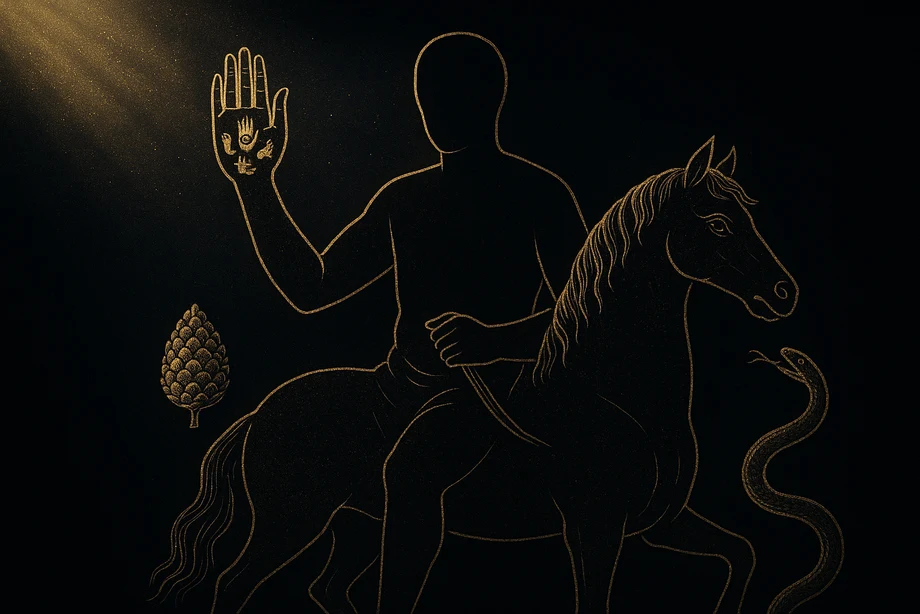
He came from Phrygia, perhaps from Thrace, a rider god. The Greeks confused him with Dionysus, the Romans with Jupiter, but Sabazios was a person of his own. He stood at the centre of one of the mystery cults that promised salvation in the afterlife. His image is a bronze hand with the fingers raised in the air. Serpents, pine cones, small god figures were wound around that hand. The mystery cults spread as far as Rome, then Christianity came and Sabazios fell silent, but the image of the hand is still used in Anatolia today against the evil eye.

"The hand of Sabazios is of bronze, the fingers raised for healing, the serpent coiled about his wrist." Roman-era votive inscriptions, 2nd c. CE.

horsethe hand symbol (mano pantea)serpentpine cone
Modern reading

The archetype of movement, of passage, of the one who travels without stopping. The guide that the soul, never bound to a single place, needs. In a modern reading he is the guardian of periods of inner journey.

Read the full story →
Men, The moon, fate, the measure of the world, alchemical engraving silhouette
Anatolia

Men

Men Askaenos · Anatolian Moon God

The moon, fate, the measure of the world

MoonCancerCapricorn

Archetype: The moon judge

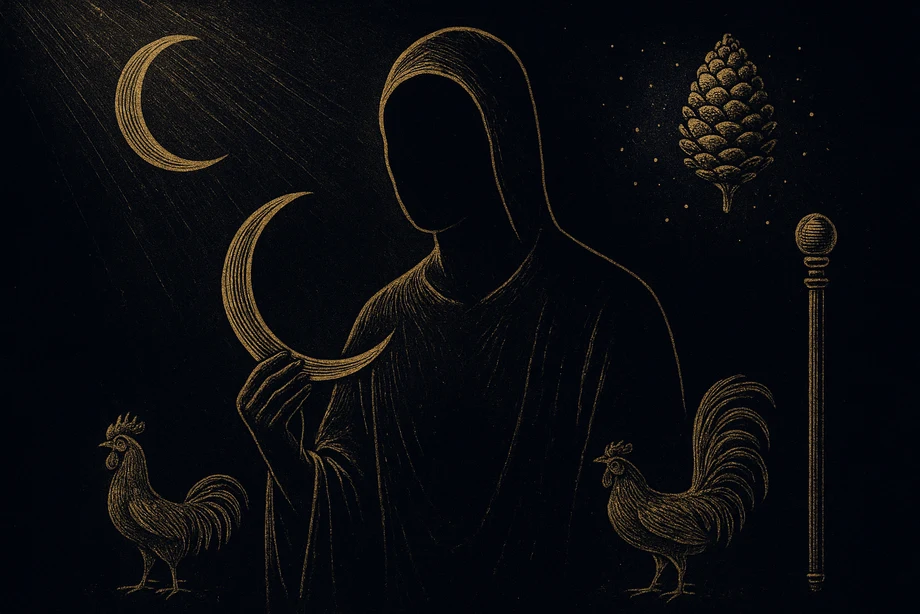
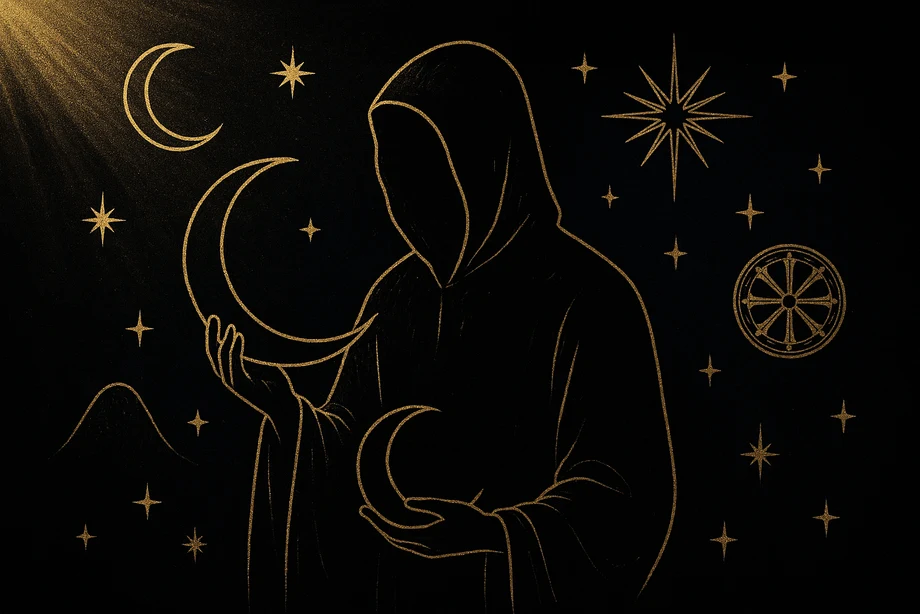
He was the local moon god of Anatolia, with temples in Phrygia, Pisidia and Lycia. Just as the moon could be male or female, like the Sin of Mesopotamia or the Hathor of Egypt, Men was a male moon god. He carried a crescent on his shoulders and a pine cone in his hand. He was a measure between the underworld and the world above, keeping the account of the dead and of births. When Anatolia became Christian his place became mingled with Saint Michael, the crescent shape passed to the flag, but his trace still survives today in the names of villages.

"Where Men sits upon his throne, the matter between sky and earth is decided." Inscriptions of Pisidian Antioch, Roman era.

crescentpine coneroostersceptre
Modern reading

The archetype of the cycle, of rhythm, and of an inner measure. The voice of staying sensitive to the ebb and flow of life. In a modern reading he is connected with the hormonal cycle, the lunar calendar and time awareness.

Read the full story →
Hizir, The water of life, wishes, the hidden helper, alchemical engraving silhouette
Anatolia

Hizir

Hidir · Hidrellez · al-Khidr

The water of life, wishes, the hidden helper

JupiterNeptunePiscesSagittarius

Archetype: The unseen helper

In the Quran, in the Surah of the Cave, he is the knowing servant Moses meets on the road, and later in the Islamic world he became Hizir. In Anatolia he was joined with the prophet Elijah, and on the night of Hidrellez (the night of May 5) the two are believed to meet. Hizir knocks on the door of the one who makes a wish, passes by on his white horse, and helps unnoticed. Because he drank from the water of life he does not die, and appears from age to age. He is especially strong in the Bektashi-Alevi tradition, where wishes are believed to be carried through him.

"Hizir passes by way of the water of life, known and unknown, dressed in green, riding a white horse." A Bektashi hymn, oral tradition.

green robewaterfresh leafwhite horse
Modern reading

The archetype of help that comes at an unexpected moment, of intuitive guidance, and of an unlooked-for reunion. The voice of the faith that when a person is in difficulty a door opens. In a modern reading he is the Anatolian form of synchronicity.
Read the full story →
Sky Tengri, The upper sky, the cosmic principle, the most high, alchemical engraving silhouette
Turkic-Tengri

Sky Tengri

Tanri · Kok Tengri · The Blue Sky

The upper sky, the cosmic principle, the most high

SunJupiterLeoSagittarius

Archetype: The most high principle

He was at the centre of Turkic cosmology. He had no form, he was the whole sky. It was he who gave authority to the kagans, and people said "as Tengri commanded". Neither male nor female, he was that which cannot be bounded. He was at the highest layer of the upper world, and the eagle at the summit of the world tree was his symbol. When Islam spread among the Turks the word Tengri became a synonym for God, but the old sacredness of the sky still stands today in oaths.
"When the Blue Sky above and the Brown Earth below were created, between the two the son of man was created." The Bilge Kagan Inscription, 8th c. CE, east face.

the blue skyeaglethe top of the world treelightning
Modern reading

The archetype of an embracing wholeness, of the single source. Not a particular form, but the span spread over everything. In a modern reading he is connected with holistic consciousness, with transpersonal awareness.

Read the full story →
Mother Umay, Birth, children, protection, feminine abundance, alchemical engraving silhouette
Turkic-Tengri

Mother Umay

Umai · Mai · Ymay

Birth, children, protection, feminine abundance

MoonVenusCancerTaurus

Archetype: The protecting mother

She was seen as the feminine companion of Sky Tengri, but more than that she was a protecting mother. It was believed she stood beside newborn children, that when a child smiled it was playing with Umay, and when it cried Umay had been hurt. With her three-horned crown she appeared in the visions of the shamans. After Islam she was absorbed in Anatolia into Mother Fatma and other women saints, but in the east of the Turkic world she is still called upon as Umay. At every birth her help is asked.

"Tengri and Umay, the sacred land and water, granted favour to the kagan and the people." The Bilge Kagan Inscription.

a three-horned crownthe umbilical cordcradlebird wing
Modern reading

The archetype of fertility, of protection, and of inner nourishment. The feminine energy that accompanies the coming of a child and stays at the bedside after the birth. In a modern reading she is the voice of self-compassion and of inner softness.

Read the full story →
Erlik, The underworld, death, balance, alchemical engraving silhouette
Turkic-Tengri

Erlik

Erlik Khan · Erklik · Khan of the Underworld

The underworld, death, balance

PlutoSaturnScorpioCapricorn

Archetype: The lord of the lower world

In the creation epics he is the brother of Ulgen, the two came from the same egg or the same water. Ulgen created the upper world, Erlik the lower, but when Erlik tried to make the human being he interfered in Ulgen's work, he shaped the body but could not give it breath. This is why the human being is said to be mortal and limited. He is not a devil, he is the khan of the lower world, and death passes through him. The shamans enter a vision as they descend to him, they bargain with him, giving one life to save another. He is not fearsome, he is a serious aspect of the cosmos.

"Erlik is the khan of the lower world, he sits beneath the nine layers, he receives the dead." An Altai creation epic, oral tradition.

black horseiron swordthe nine-layered earthblack pine
Modern reading

The archetype of the unconscious, the shadow, and what has not been accepted. The part within us refused as "what should not be", yet the place without which balance cannot be made. In a modern reading he is the ruler of shadow work.

Read the full story →
Ulgen, The upper world, creativity, light, alchemical engraving silhouette
Turkic-Tengri

Ulgen

Ulken · Khan of the Upper World

The upper world, creativity, light

SunJupiterLeoSagittarius

Archetype: The creative father

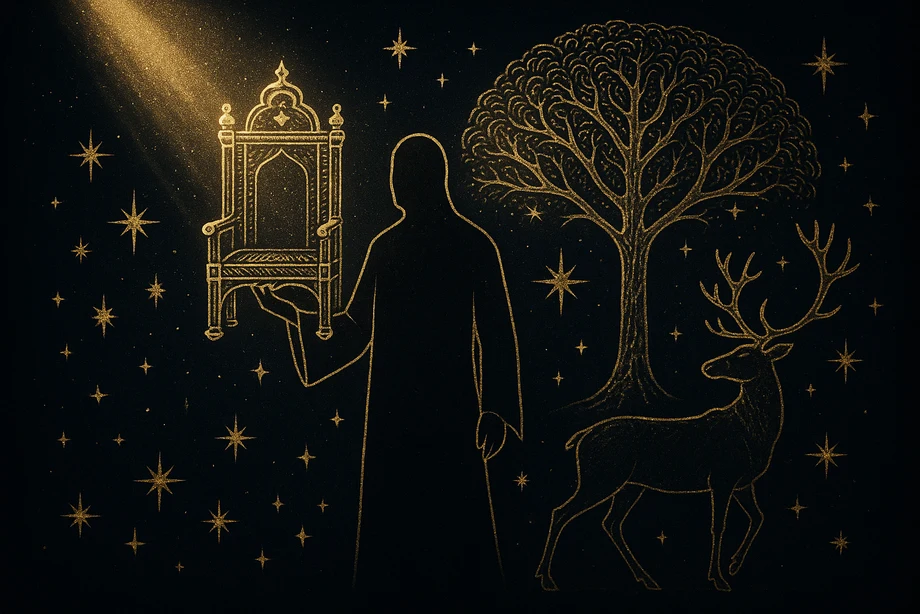
He was known as the son of Sky Tengri, sitting on a golden throne in the seventh or seventeenth layer of the upper world. He had seven sons and nine daughters, each doing a different heavenly work. He made the human being from clay, but when he could not find its breath he took it from Tengri. As the shamans climbed to the sky they passed through the seven layers one by one, and at the last gate they met Ulgen. He was the opposite of Erlik, but not his enemy, he was his brother. The light of one calls for the shadow of the other.

"Ulgen sits above on the golden throne, he has set the stars along his belt, he sends light down to the earth." An Altai shaman hymn.

golden thronethe top of the world treestarswhite reindeer
Modern reading

The archetype of building, of giving form, and of the capacity to bring something to life. The inner strength that carries an idea from seed to fruit. In a modern reading he is the guardian of creative discipline.

Read the full story →
Grandfather Moon, The moon, night, protection, alchemical engraving silhouette
Turkic-Tengri

Grandfather Moon

Ay Ata · Ay Khan

The moon, night, protection

MoonCancer

Archetype: The old moon guide

In Turkic folk tradition the moon is always a grandfather, not a father but a grandfather. He brings gifts to children, enters their dreams, lays out the stars on a silver plate. When there is a lunar eclipse people bang on pots, because it is thought a dragon or an evil spirit is trying to swallow grandfather moon. People are respectful toward the moon. His light lights the way of the departed, and so he is most remembered on the nights of festivals.

"Grandfather Moon came out, mounted his silver horse, and handed out tales to the children." An Anatolian lullaby.

crescentsilverwhite feltstar
Modern reading

The archetype of gentle night wisdom, of the hidden guide. The old grandfather a child greets when it waves at the moon. In a modern reading he is the inner sage and the guide of the sleep journey.

Read the full story →
Koroglu, Justice, the common people, revolt, alchemical engraving silhouette
Turkic-Tengri

Koroglu

Goroghli · Son of the Blind

Justice, the common people, revolt

MarsSunAriesLeo

Archetype: The one who fights for the people

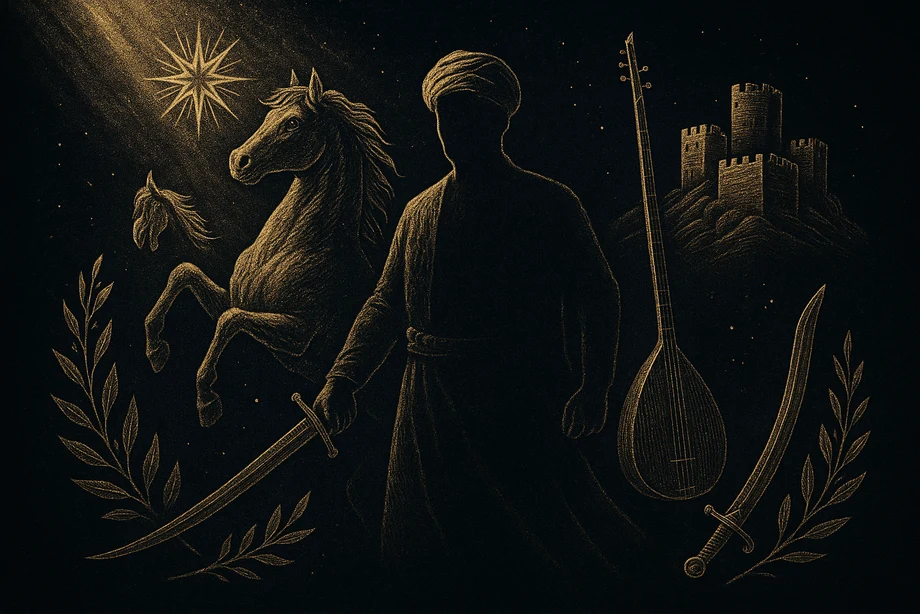
His father was blinded over a poor horse a lord had given him. His son, Rushen Ali, became "the son of the blind", went up to Camlibel and built a fortress. He fed his horse Kirat with a hidden water and it became a winged horse. He gathered brave men around him and took in those who wanted to escape the cruelty of the lords. He played his saz, sang his songs, and raised his sword as well. The same epic is sung among all the Turkic peoples, because Koroglu belongs to no one and to everyone. In his myth, myth and history embrace.

"At Camlibel I built a fortress, within it my brave men, outside it the cruel lords are afraid." The Koroglu epic, the Bolu branch, oral tradition.

the horse Kiratswordsazthe fortress of Camlibel
Modern reading

The archetype of not bowing to injustice, of turning personal pain into collective justice. The turning of an anger born from his father's blinding into a culture of revolt. In a modern reading he is the honourable voice of the inner warrior.

Read the full story →
Odin, Wisdom, sacrifice, prophecy, war, alchemical engraving silhouette
Norse

Odin

Wodan · Allfather · Yggr

Wisdom, sacrifice, prophecy, war

MercurySaturnAquariusCapricorn

Archetype: The one who wins wisdom through sacrifice

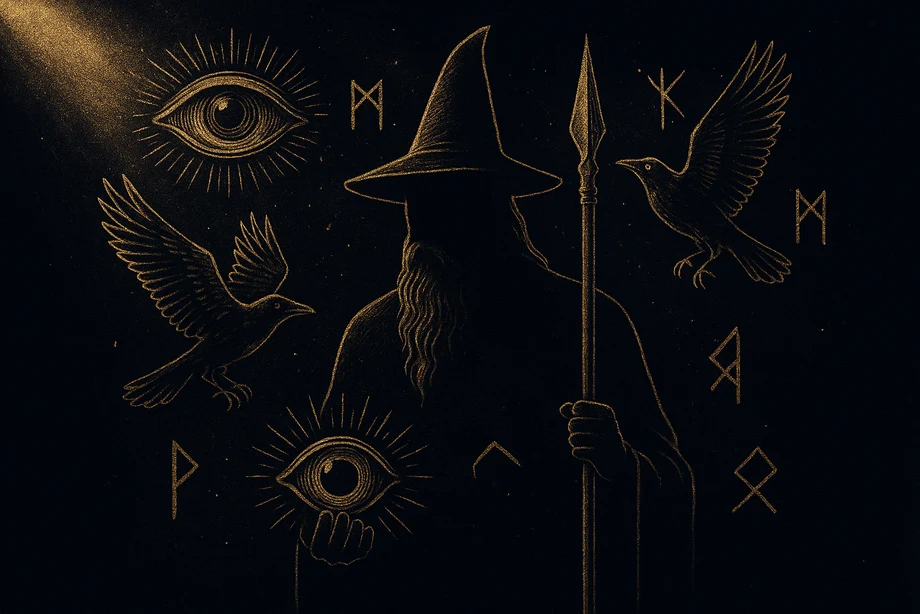
Odin was the father of the gods, but the strongest thing he felt was not curiosity, it was desire, the desire for knowledge. To drink from Mimir's well he gave up an eye, and so with one eye he saw two worlds. On the tree Yggdrasil he hung himself for nine nights, wounded by a spear, and in that ordeal he caught the secret of the runes. His two ravens, Huginn (thought) and Muninn (memory), brought him news of the world. Every piece of knowledge gives a wound, every wound a gift, Odin taught this.

"I hung myself on the branch of Yggdrasil, nine nights, wounded by a spear, given to myself as a sacrifice to myself." Hávamál, 138.

one eyetwo ravens (Huginn & Muninn)the spear Gungnirrunes
Modern reading

The archetype of the capacity to give up one thing in order to learn another. Depth in exchange for one eye, the runes in exchange for one night. In a modern reading he is the voice of the limits one accepts for the sake of an inner search.

Read the full story →
Freyja, Love, war, seidr magic, the dead, alchemical engraving silhouette
Norse

Freyja

Vanadis · Lady (Frue)

Love, war, seidr magic, the dead

VenusTaurusScorpio

Archetype: A feminine power that knows no boundary

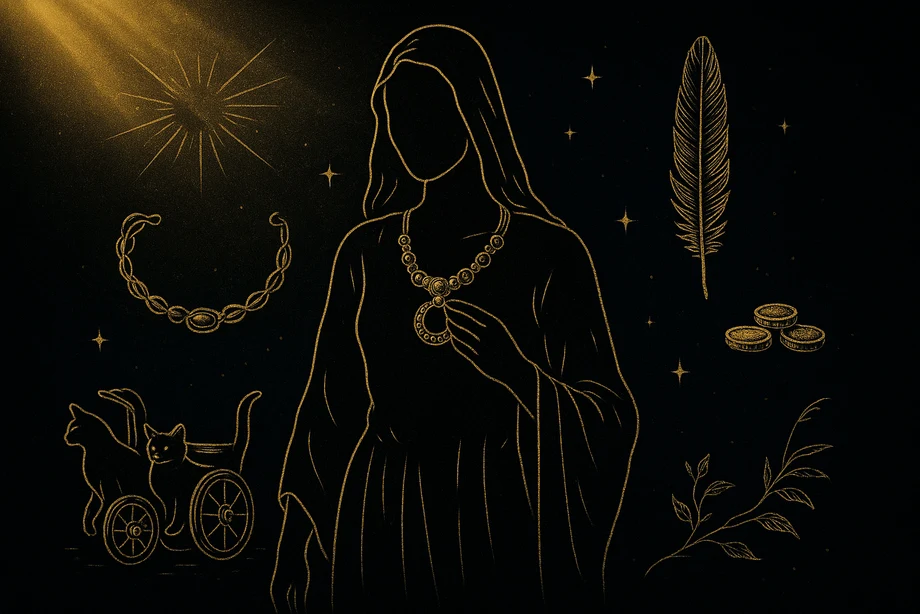
She was one of the Vanir gods, but after a war she joined the Aesir. For the gold necklace called Brisingamen she spent a night with four dwarves, because she was one who paid any price to reach what she truly wanted. She travelled the skies in a chariot drawn by cats, and it was she who taught the Aesir the magic called seidr. Half of those who died in battle went to her hall Sessrumnir, the other half to Odin's Valhalla. When Christianity came her name was pushed toward the demonic, but as "Lady" she still lives in the names of the days (Freyja's day, Friday).

"Freyja takes half of those who die in battle to her own hall Sessrumnir, the other half go to Odin." Snorri, Prose Edda, Gylfaginning 24.

the necklace Brisingamencat chariotfalcon feathergold
Modern reading

A feminine archetype that carries love, war and magic in the same body. Both graceful and strong, both generous and demanding. In a modern reading she is the voice of the woman who owns her own desire.

Read the full story →
Loki, Trickery, transformation, breaking boundaries, alchemical engraving silhouette
Norse

Loki

Loptr · Hvedrungr

Trickery, transformation, breaking boundaries

MercuryUranusGeminiAquarius

Archetype: Trickster, transformer

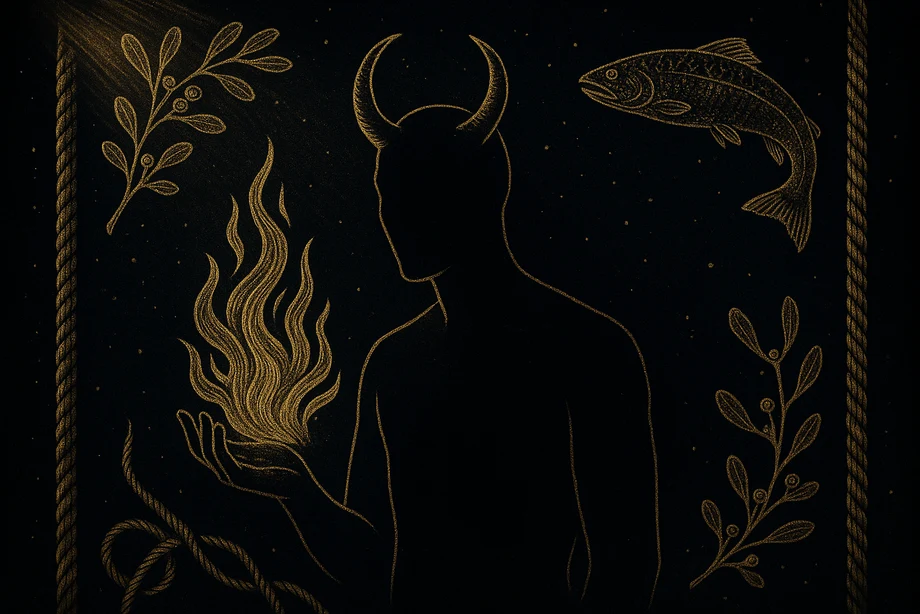
He was the son of a giant and a goddess, accepted among the Aesir but always remaining half a stranger. He shifts shape, turns into a female, turns into a fish, turns into a fly. He helped Thor, and he also got him into trouble. After the death of Baldr he was chained, and a serpent dripped its venom onto his face, and when his wife Sigyn held a bowl to catch the venom her trembling caused earthquakes. At Ragnarok he will break free of his chains and fight against the gods. He is the purest European example of the trickster figure.

"Loki turned himself into a mare, and gave birth to the eight-legged Sleipnir." Snorri, Gylfaginning 42.

flamesalmonmistletoeropes
Modern reading

The archetype that shakes order, unsettles the question, stretches the boundary. He is not evil, he is a transformer, because what does not move decays. In a modern reading he is the voice of constructive chaos, of creative rupture.

Read the full story →
Thor, Lightning, protection, strength, alchemical engraving silhouette
Norse

Thor

Donar · Thorr

Lightning, protection, strength

MarsJupiterAriesTaurus

Archetype: The protector of the people

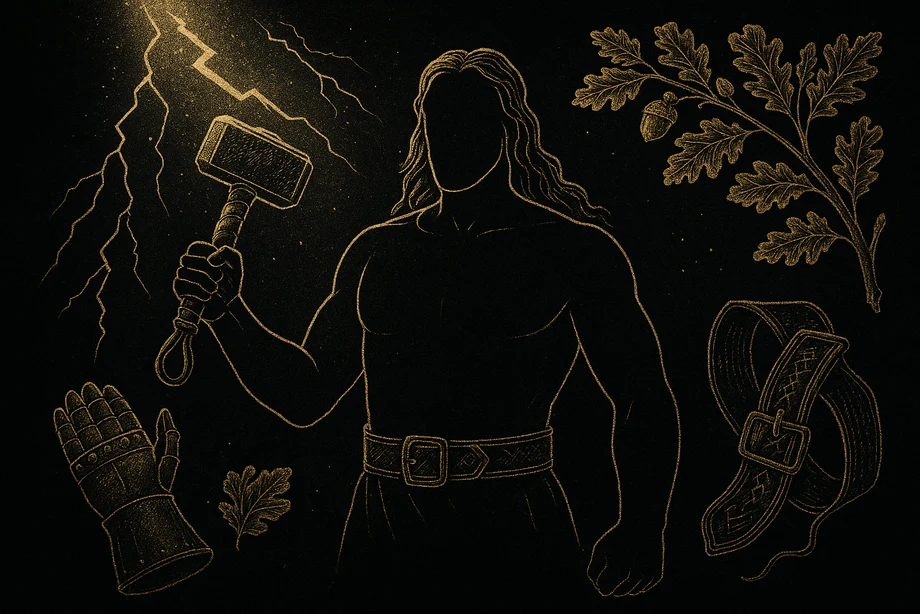
He was the son of Odin, but his nature was different from Odin's wise solitude. The people loved him, because Thor was not complicated, he was honest. His hammer Mjolnir was forged by dwarves, and when thrown it returned to his hand. He fought the giants, and three times met the great serpent Jormungandr that encircles the world. At Ragnarok both will die, but Thor will manage to kill the venom-spitting serpent. Thursday (Thor's day) is his day, and once a week it is still greeted.

"He throws the hammer, it strikes its mark, it returns to his hand. Mjolnir goes wherever it is sent." Snorri, Skáldskaparmál 35.

the hammer Mjolniriron glovesthe belt Megingjordoak
Modern reading

An open-hearted, boundlessly strong, but unshowy protector archetype. He does not get tangled in complexity, he does what he knows is right. In a modern reading he is the voice of the capacity to protect with simplicity and courage.

Read the full story →
Hel, The underworld, the world of the dead, acceptance, alchemical engraving silhouette
Norse

Hel

Hella · Helja

The underworld, the world of the dead, acceptance

PlutoSaturnScorpioCapricorn

Archetype: The quiet lady of death

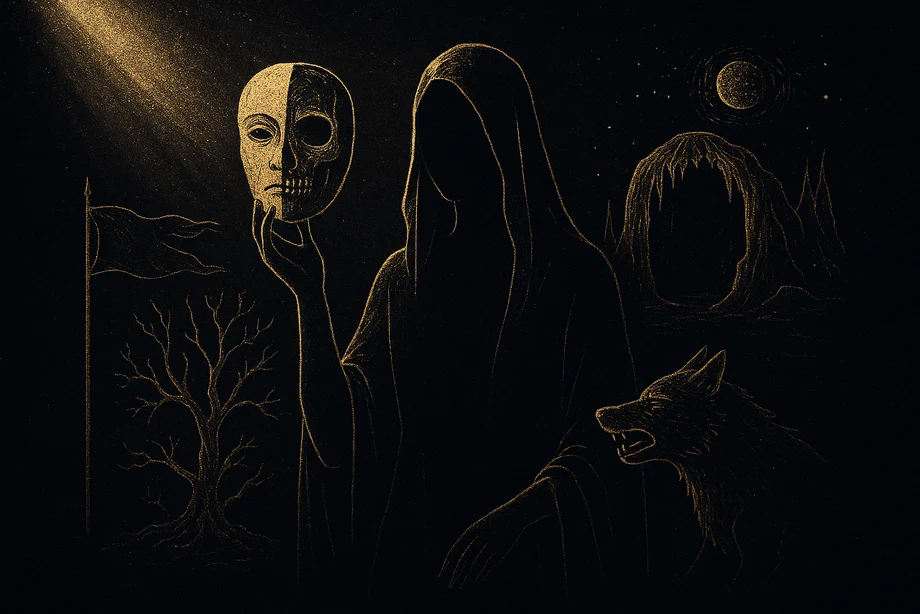
She was Loki's daughter, she carried giant blood, and so the Aesir sent her to Niflheim, the world of mist. There she built her own kingdom, the name of her throne Sickbed, the name of her threshold Stumbling, the name of her knife Hunger. These names look frightening, but Hel was not evil, she was simply, openly, whatever she was. Those who did not die in battle went to her, the children, the old, those who fell ill. Baldr too, when he died, went to her, because even the mother who loved him most could not bring him back. It is not said that Hel was unjust, only that she did not bargain.

"Half of Hel's face is the colour of life, half is dark as a corpse, and her kingdom is silent." Snorri, Gylfaginning 34.

a face half living half deaddark thronethe hound GarmNiflheim
Modern reading

The archetype of quiet, undramatic acceptance. Those who die not in battle but in their beds, ordinary losses, the unshowy end. In modern depth psychology she is the voice of still inner descents.

Read the full story →
Frigg, Fate, home, mother, the knowing goddess, alchemical engraving silhouette
Norse

Frigg

Frigga · Frige

Fate, home, mother, the knowing goddess

VenusMoonTaurusCancer

Archetype: The mother who weaves fate

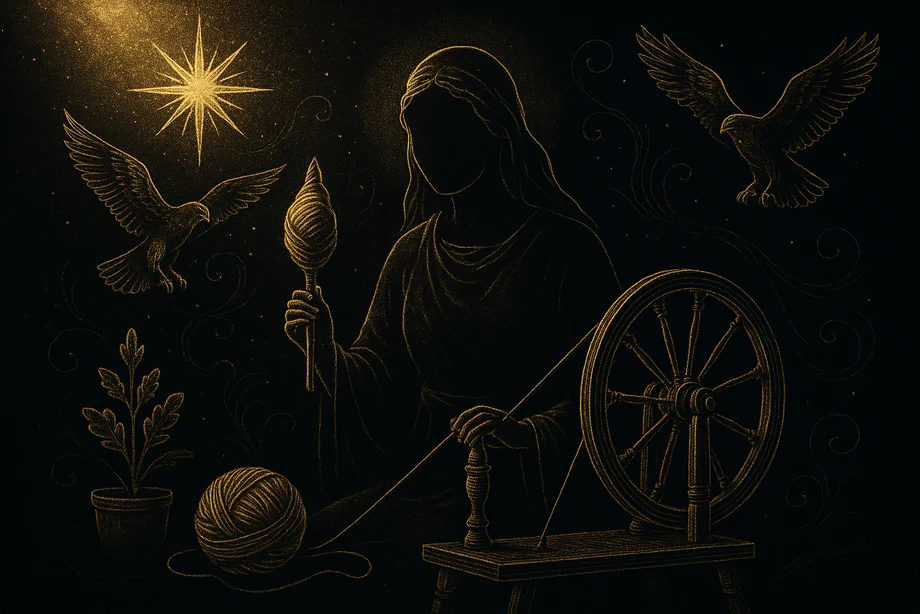
She was the wife of Odin, the chief goddess of the Aesir. Unlike Odin she did not wander, she stayed in the hall, but she always knew fate. To protect her son Baldr she made every creature swear it would do him no harm, and only forgot the small mistletoe, and Loki noticed it and had Baldr killed with that mistletoe. That sorrow is the sorrow of a mother, and the myth aches as it tells it. Frigg's distaff wove fate, like the Greek Moirai, but she alone. Friday is named, by one reading, from Frigg, by another from Freyja, perhaps from both.

"Frigg knows the fate of all things, but says nothing." Lokasenna, 29.

spinning loomdistaffwoolfalcons
Modern reading

The archetype of the mother who knows but does not tell, who protects but does not intervene. The hand that quietly weaves the threads of fate. In a modern reading she is the voice of inner wisdom and of quiet preparation.

Read the full story →
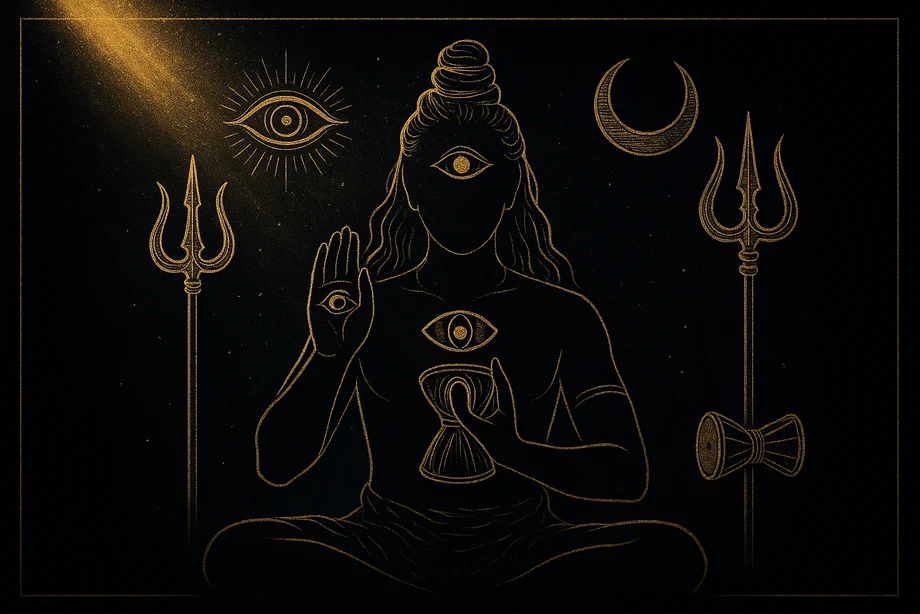
Shiva, Destruction, transformation, meditation, alchemical engraving silhouette
Vedic

Shiva

Mahadev · Nataraja · Rudra

Destruction, transformation, meditation

PlutoSaturnMarsScorpioCapricorn

Archetype: The transforming ascetic

He was the third face of the Trimurti (Brahma the creator, Vishnu the preserver, Shiva the transformer), but he was in fact the oldest, his root reaching back to the Rudra of the Rigveda. He sat on Mount Kailash, bare, covered in ash, in meditation. When his third eye opens it burns everything and begins again. In the figure of Nataraja, dancing, he embodies the rhythm of destruction and rebirth of the universe. His wife Parvati raised him, his sons were Ganesha and Kartikeya. Shiva is not called a destroyer, he is a transformer, because every transformation needs the previous form to die.

"He is Mahadev, the dancer, who in a single movement undoes the universe and builds it again." The Shiva Sutra, oral tradition.

the third eyetrishula (three-pronged spear)crescentthe damaru drum
Modern reading

The archetype of the capacity to release the old and make room for the new. Destruction is not for destruction, it is to open space. In a modern reading he is the voice of radical simplification and of processes of inner clearing.

Read the full story →
Kali, Time, the closing of the cycle, the dark mother, alchemical engraving silhouette
Vedic

Kali

Mahakali · The Dark Mother

Time, the closing of the cycle, the dark mother

PlutoSaturnScorpioCapricorn

Archetype: The closing of the cycle

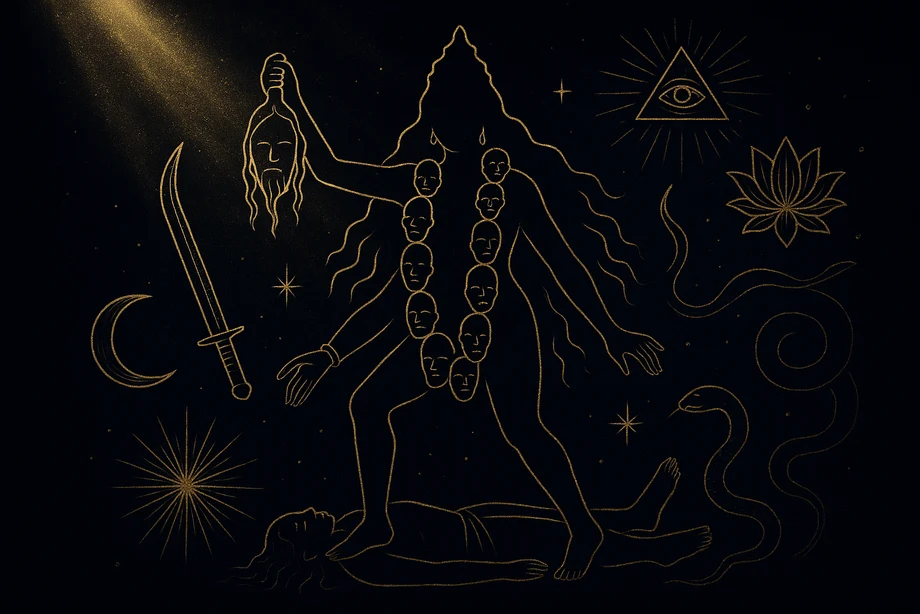
She was born from the anger of Durga, or from the dark form of Parvati, or she came on her own, the myth is plural. In a battle she had to defeat the demon Raktabija, but every drop of Raktabija's blood that fell to the ground gave birth to a new demon. Kali stretched out her tongue and drank all the blood, and so stopped the multiplying. As she danced in a frenzy Shiva lay down at her feet, to stop her. When Kali noticed she was treading on him she bit her tongue. This image is one of the most powerful in Hindu iconography: the closing of the cycle cannot be done alone, it needs love.

"She who is time, who dances within time, who has an end yet is endless." Mahanirvana Tantra, Chapter 6.

a garland of skullssworddark skinbare foot upon Shiva
Modern reading

The clean release of what must die within. The garland of skulls is the symbol not of those she has killed, but of the identities left behind. In a modern reading she is the voice of radical acceptance and of moving beyond the ego.

Read the full story →
Lakshmi, Abundance, beauty, fortune, alchemical engraving silhouette
Vedic

Lakshmi

Sri · Padma

Abundance, beauty, fortune

VenusJupiterTaurusPisces

Archetype: The goddess of abundance

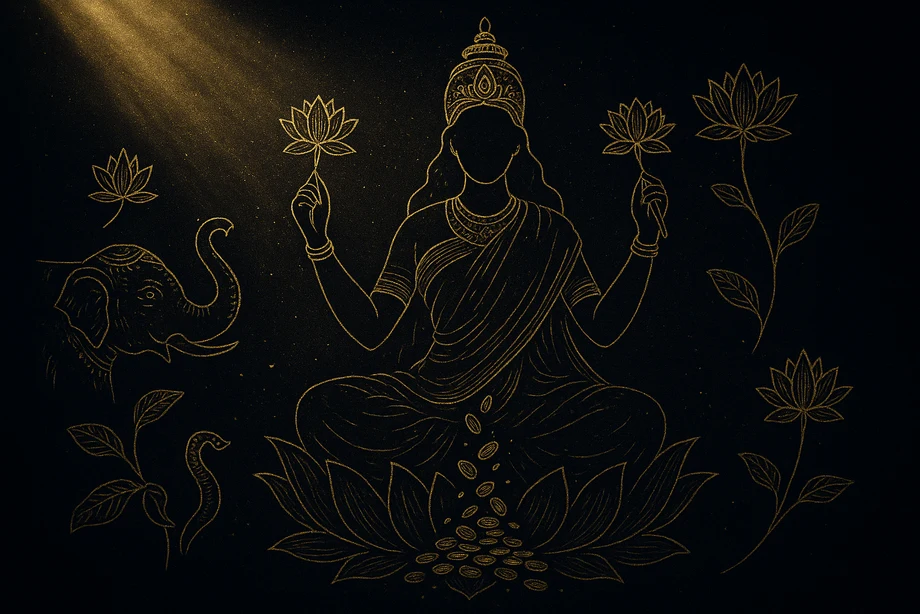
When the gods and the asuras churned the ocean of milk, one of the gifts that rose from the ocean was Lakshmi. She stands on a lotus, and she had four hands: in one a lotus, from one she pours gold coins, two are open in protection and blessing. As the wife of Vishnu she came at his side in every incarnation, she was Sita to Rama, Rukmini to Krishna. At the festival of Diwali doors are left open and lamps are lit for her to enter every home. Her abundance was not only money, it was beauty, health, love, inner wealth, all of it.

"Lakshmi rose from the ocean of milk, standing on a lotus, shining with six lights." Vishnu Purana, 1.9.

lotusgold coinselephantyellow sari
Modern reading

The archetype of material and spiritual abundance, of the feeling of deserving. The capacity to live receiving, owning, and blooming without shame. In a modern reading she is connected with abundance consciousness.

Read the full story →
Saraswati, Knowledge, art, music, water, alchemical engraving silhouette
Vedic

Saraswati

Vac · Sharada

Knowledge, art, music, water

MercuryVenusGeminiVirgo

Archetype: The goddess of art and knowledge

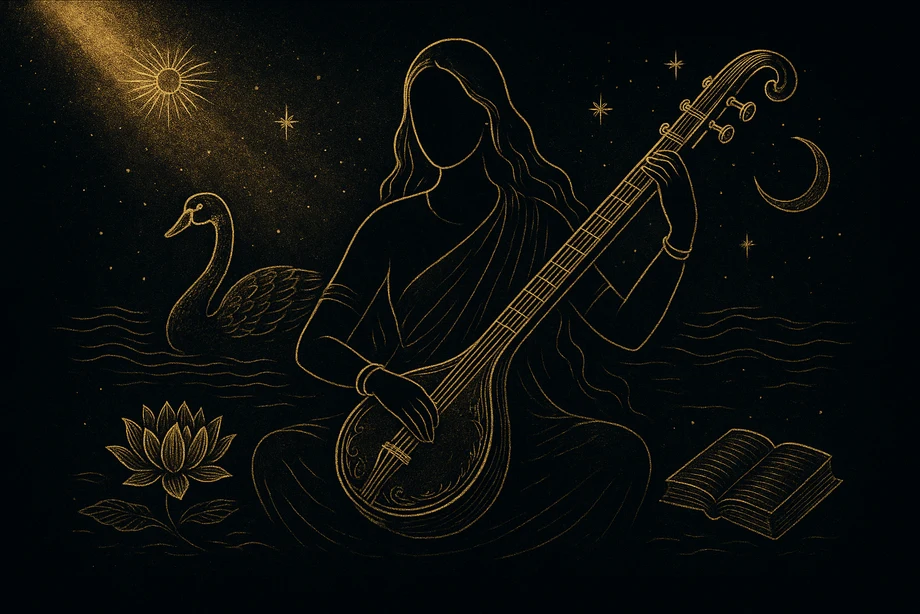
Her name means "the flowing one", at the beginning she was a river, which in time was lost in the Indian landscape, but the goddess remained. She became the guardian of knowledge, music, art, and the word. She wore a white sari and sat upon a white lotus, and the swan was her mount, because the swan can separate milk from water, a metaphor for learning. She was known as the wife of Brahma, but she was respected more in her own right. At the festival of Vasanta Panchami students lay their books before her, beginning the season's first learning with her.

"Pure flowing water, the mother of all words, who washes knowledge clean." Rigveda, 6.61.

veena (stringed instrument)swanwhite lotusbook
Modern reading

The archetype of inner expression, of creative discipline, and of the word. Both knowledge and beauty, both reason and inspiration. In a modern reading she is the guardian voice of the artist and the student.

Read the full story →
Ganesha, Removing obstacles, beginnings, wisdom, alchemical engraving silhouette
Vedic

Ganesha

Ganapati · Vinayaka · Vighneshvara

Removing obstacles, beginnings, wisdom

MercuryJupiterVirgoSagittarius

Archetype: The remover of obstacles

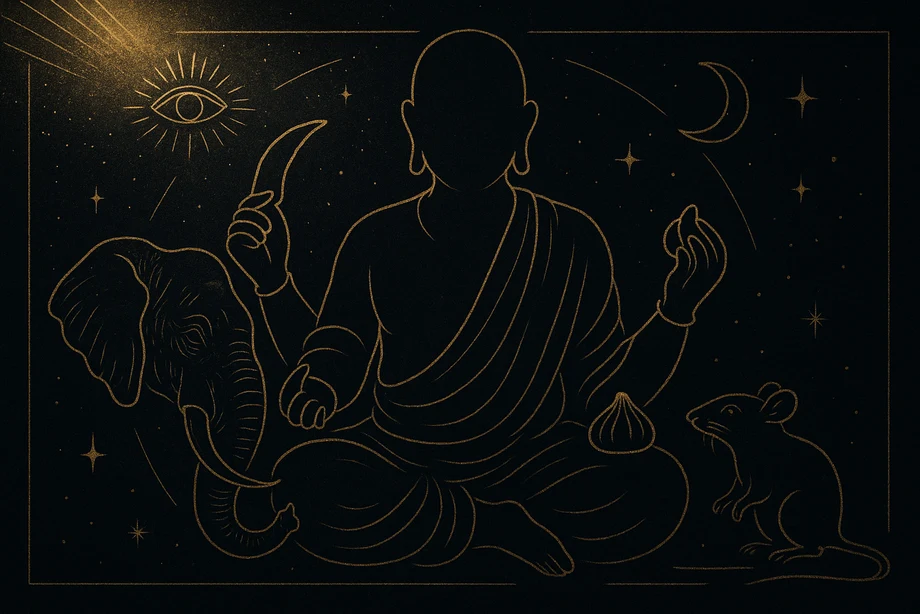
Parvati made him from her own body, from sandal paste, to stand guard at her door, so no one would enter while she bathed. When Shiva came Ganesha did not know him and would not let him in, and Shiva in anger cut off his head. When Parvati wept Shiva gave his son the head of the first living creature he saw, which was an elephant. So Ganesha became elephant-headed. The god of wisdom, the remover of obstacles. In every Hindu home, at every beginning, he is prayed to first, "salutations to Ganapati" is said, and after that the work begins.

"Vakratunda Mahakaya, Suryakoti Samaprabha. Make me ever free of obstacles, in all my deeds." The Ganesha Mantra, traditional.

elephant headthe half of a broken tuskmodak (a sweet)the mouse mount
Modern reading

The archetype of new beginnings, of softening inner resistance, and of gentle wisdom. He is called upon when starting a task, because he opens the way. In a modern reading he is the voice of being able to say an inner "yes".

Read the full story →
Devi, The great mother, the essence of all goddesses, Shakti, alchemical engraving silhouette
Vedic

Devi

Mahadevi · Shakti · Adi Parashakti

The great mother, the essence of all goddesses, Shakti

SunMoonVenusLeoCancer

Archetype: The essence of the whole feminine principle

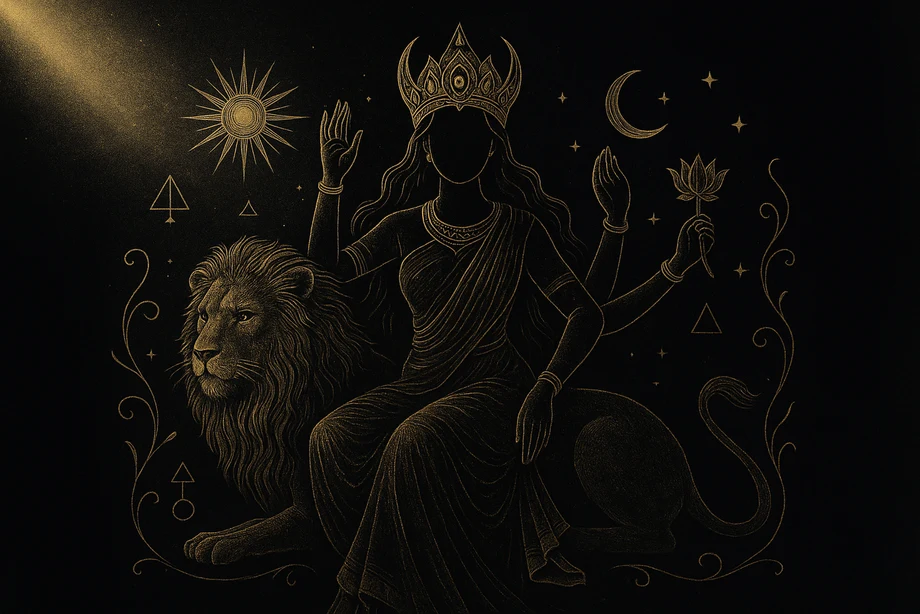
In the Vedic tradition Devi is known as the essence of all the feminine goddesses, and from her come Lakshmi, Saraswati, Parvati, Durga, Kali. The text of the Devi Mahatmya tells of her different faces: now the mother of a child, now a warrior on a lion, now an ascetic in meditation, now a beloved. The gods could not defeat the demon Mahishasura, and Devi came, ten-armed, a weapon of a different god in each hand, mounted on a lion, and defeated him in three days. In the Shakta tradition she is the one god, and everything else flows from her. The word Shakti is her essence, the feminine creative power.

"I am all things, I create, I preserve, I transform. All goddesses are a single face of mine." Devi Mahatmya, Chapter 11.

liona many-armed bodyred saria three-eyed crown
Modern reading

The source of all the feminine archetypes gathered into a single goddess. Mother, warrior, sage, beloved, in one body. In a modern reading she is the voice of an integrated feminine consciousness.

Read the full story →
Going deeper

Mythic Arcana

The signature deck of House of Zij. A 78 card reading deck of its own, with figures from seven pantheons. Hold an intention, draw your card, and let Sibylla read it.

The Atlas is a timeless reference. The gods are not far away, they are archetypes speaking inside you. Together we separate out which voice is stronger in you.