
Ev, kadınlık, koruma, neşe
Archetype: Eşiği koruyan dişi
From lion to cat
Bastet's story does not begin in one form, because she is the soft face of a goddess split in two. In early depictions from the Old Kingdom, around 2700 BCE, Bastet is shown as a lion-headed goddess, wild and warlike. In that period she overlapped significantly with Sekhmet, and the two were sometimes regarded as two faces of the same goddess.
Over the centuries something shifted. Toward the Late Period, after about 700 BCE, Bastet began to be depicted with the head of a domestic cat. By this time cats had taken a special place in Egyptian society.
Herodotus, in his travels through Egypt, describes how dearly Egyptians valued the cats in their homes. He says that when a cat died, the whole family shaved their eyebrows; when a dog died, they shaved their entire body. Herodotus also writes that he saw with his own eyes the great festival held at the temple of Bastet in Bubastis.
The shift from a lion-headed to a cat-headed goddess was not a diminution but a differentiation. The Egyptian came in the end to a decision: the wildness of Sekhmet and the tameness of Bastet are two distinct faces of the same feminine power. Bastet was the goddess who had claws, but who used those claws to defend the home.
The crowds coming up the river to Bubastis
Bastet's cult center was the city of Bubastis in the Nile delta, called in Egyptian Per-Bast, "the house of Bastet." Herodotus describes the annual festival of this city as the greatest festival in all of Egypt.
By his account, people came by boat along the Nile from every part of Egypt to Bubastis. Throughout the journey music played, women clapped, sang, and danced. Herodotus writes that 700,000 people took part in the festival; even if that number is exaggerated, it is clear the crowd was enormous.
When they arrived at Bubastis, great sacrifices were offered, much wine was drunk, and revelry went on day and night. The festival was a feast of joy, of dance, of music, of feminine energy.
The temple of Bastet at Bubastis was surrounded by a double wall and a canal. Near the temple lay a cat cemetery. Modern archaeologists have discovered hundreds of thousands of mummified cats at Bubastis and at sites such as Beni Hasan.
Cats were not merely cherished animals but sacred beings; they were regarded as the extension of Bastet in this world. To kill a cat, even by accident, was a serious crime.
The sistrum, perfume, and the threshold of the home
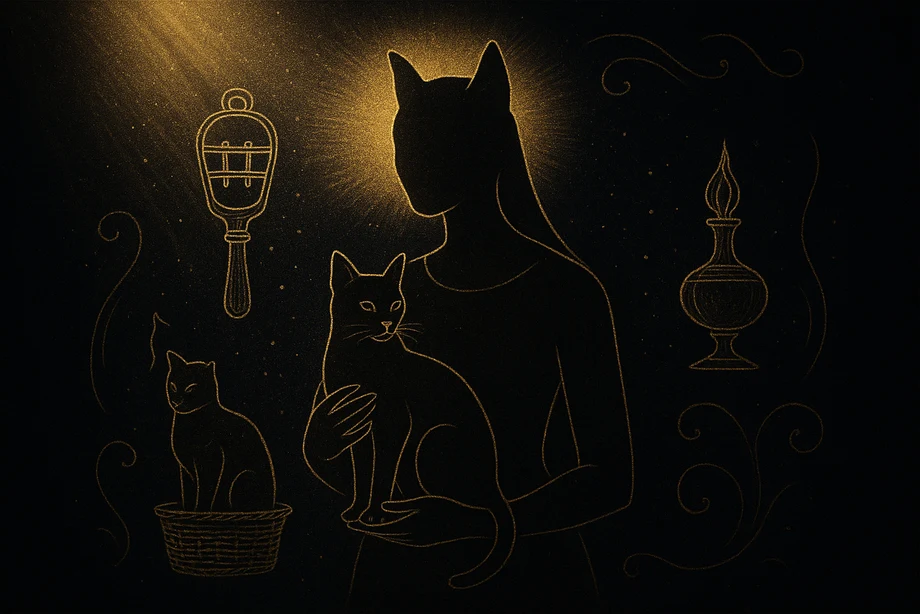
Bastet's symbols carry her soft yet protective nature. She is most often shown holding a sistrum, a kind of rattle whose small metal rings make a sound when shaken. For the Egyptian this sound was sacred; it called the goddess present and drove away ill energies. In her other hand she often holds an aegis or an ornate collar.
Small kittens are sometimes depicted beside her, and tiny cat figures may rest at her feet. These show her maternal aspect. For the Egyptian, Bastet was the goddess of household life, of women during childbirth, of children protected from illness.
When a woman went into labor or a baby fell ill, her name was invoked and a small Bastet figurine was placed in the home.
Another important aspect was perfume and oil. According to some readings, Bastet's name is connected to bas, a perfume jar. The sacred oils and perfume blends made in the temple were named after her.
For the Egyptian, scent was something that announced the presence of the invisible, just like the goddess herself. Her soft power is invisible, but its presence is felt.
A softness that guards its border
What does Bastet say to us today? The Bastet within us represents a strength whose boundary has claws but whose everyday face stays soft.
In modern readings Bastet is often read as a healthy face of feminine energy. She is neither the constantly battling Sekhmet, nor a passive figure who erases herself. Bastet is, by default, a cat who purrs, who keeps the home warm, who watches over the children, yet she does not hesitate to show her claws when danger comes. This balance is rare and precious.
Her message is this: to be soft is not to be weak. To keep a home warm, to protect small pleasures, to love music, dance, perfume, and animals, these are not signs of weakness but the very fabric of life. When the moment calls for fierceness, one can also be fierce.
The claws are there, but not always extended. Bastet's claw is for defense, not for attack. Her wisdom is that whoever guards their own ground can also open to what is outside with confidence.
Softness without a boundary gets trampled, but softness with a boundary fills life.
The voice within
Yumuşaklıkla pençenin aynı bedende yaşadığı arketip. Hazzı, zarafeti ve sınırı bir arada tutan dişil zekâ. Modern okumada öz bakım ve kendi alanını koruma kapasitesinin sesidir.
"Bubastis'e yapılan şenlik, Mısır'ın en kalabalık ve en neşeli bayramıdır." Herodot, Tarihler, II.60.
Sources: Heredot, Tarihler II · Piramit Metinleri · Bubastis Tapınağı yazıtları · Beni Hasan kedi mumyaları arkeolojik kayıtları · Geç Dönem hieratik papirüsleri

You can ask a question about this reading
Hypatia (Bilge Astrolog) answers your questions about Bastet