
Aşk, savaş, Venüs yıldızı
Archetype: Eşik aşan dişil egemenlik
Queen of Uruk, owner of Venus
Inanna was called by her name in Sumerian, the Akkadians named her Ishtar, the Phoenicians called her Astarte. They all point to the same field of pull: the brightest thing in the sky after the Sun, the planet Venus. For a Mesopotamian, this star rose twice in the same day, once before dawn and once after sunset.
So Inanna was not two-faced but two-directioned. The same goddess could stand on the two opposite shores of love and war within a single day.
Her city was Uruk. Today it sits in southern Iraq, near the old course of the Euphrates, one of the first known great cities in the world. " In the Sumerian king list the dynasty of Uruk is told at length, and long before Gilgamesh, the founding of the city becomes inseparable from Inanna, daughter of the sky god An or, in some accounts, daughter of Sin the moon god.
The poet Enheduanna is her oldest named voice. Living in the 23rd century BCE, the daughter of the Akkadian king Sargon, this priestess served as high priestess at the moon temple of Ur and wrote hymns for Inanna. " The first known signed author in the history of literature is a woman, and what she wrote about was Inanna.
That small fact alone says something. The voice that could speak Inanna already carried an authority.
She who descends through seven gates and returns bare
Inanna's most shattering myth is her descent into the underworld. The Sumerian version is known as "Inanna's Descent to the Netherworld," and the shorter Akkadian retelling carries the title "Ishtar's Descent." There are differences between the two, but the spine is the same.
One day Inanna turns her upper ear toward the lower ear, meaning she turns her attention to the land of the dead. Her sister Ereshkigal reigns there, and the reason for the journey is told differently across sources: in one telling she goes to attend the funeral of her sister's husband, in another she wants to extend her authority to the underworld as well. Before leaving she instructs her servant Ninshubur, if I do not return in three days, run to the gods to find me.
The underworld has seven gates. At each gate Inanna must leave something. At the first the shugurra crown from her head, at the second her lapis lazuli ear ornaments, at the third the beads on her chest, at the fourth a golden ring, at the fifth her measuring rod and line, at the sixth her queenly garment, at the seventh the pala robe.
Bare and bent, she reaches the throne of Ereshkigal. The seven Anunna judges fix her with the eye of death, she becomes a corpse and is hung on a hook.
Three days pass and Ninshubur begins to plead with the gods. One after another the so-called father gods turn her away. In the end Enki comes.
From the dirt under his fingernail he shapes two genderless creatures, kurgarra and galaturra. He sends them down to soothe Ereshkigal and ask back the life from the corpse. They succeed.
Inanna returns, but the rule of the underworld stands, no one departs without a substitute. She sends her husband Dumuzi, for she found him on his throne when she came back and not in mourning. Dumuzi spends half the year below, his sister Geshtinanna takes the other half.
For the Sumerian, the seasons were born from this.
Eight-pointed star, lion, and the gatepost reed
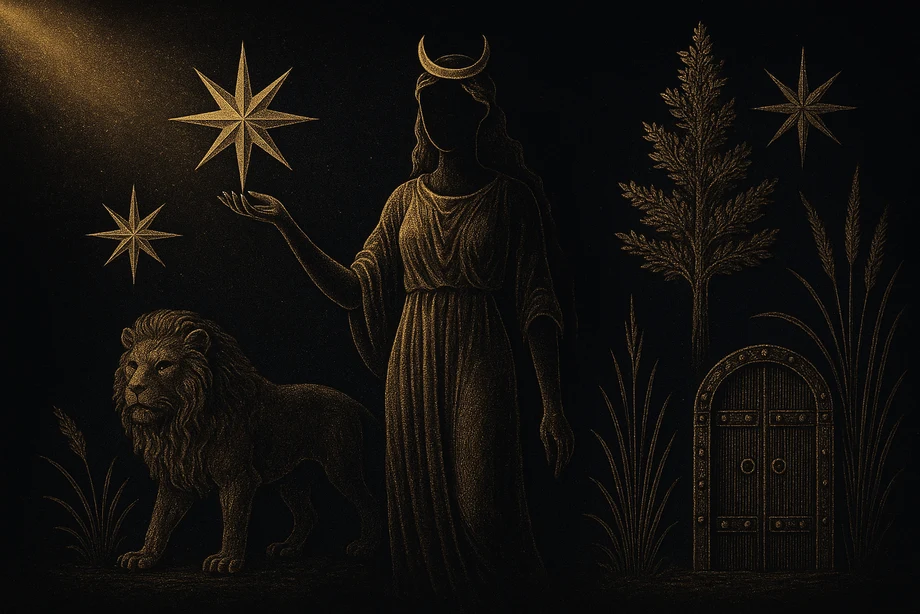
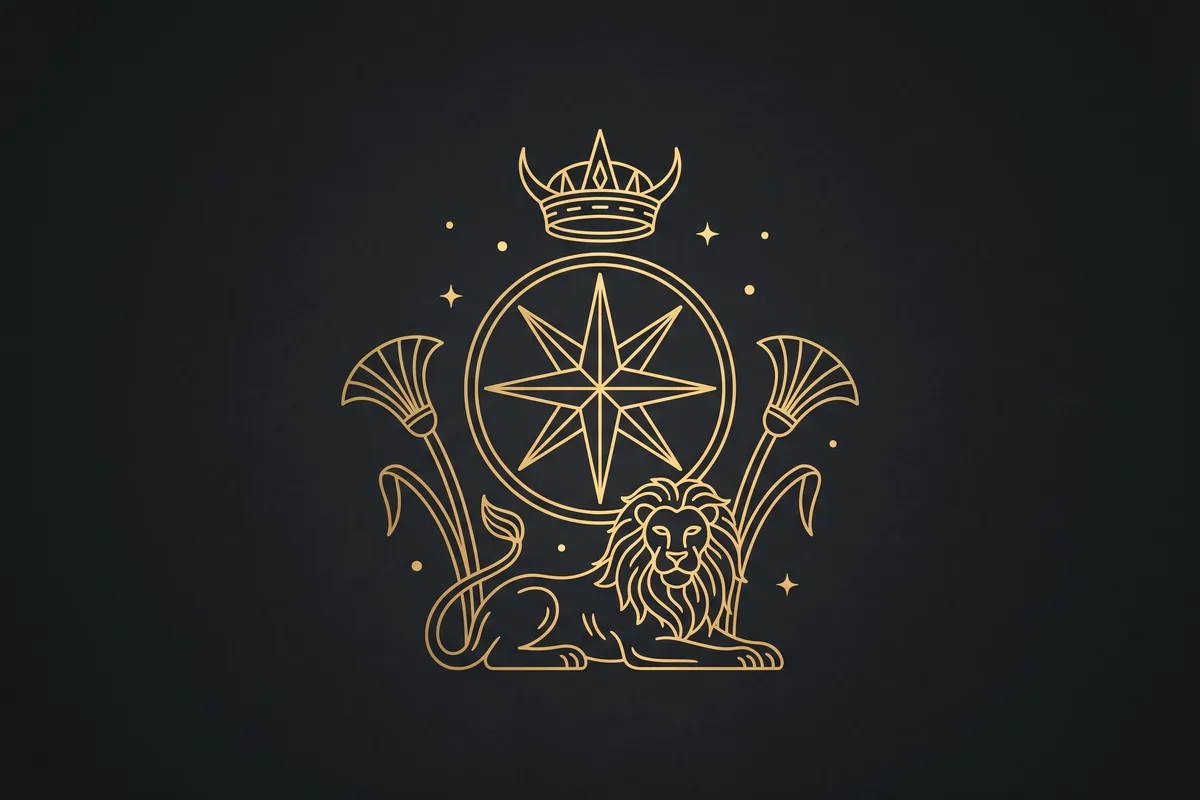
Inanna's symbols carry her tension. The eight-pointed star is the sign of Venus, and for centuries it marks her place on Mesopotamian cylinder seals. " The gatepost reed, the twin bundles of woven reed, stood at the facade of the Eanna temple in Uruk and symbolized the entrance into Inanna's house.
The cedar was sacred to her because it lives long and its sharp scent stays in the air like an unseen presence.
Her worship was not bound to Uruk alone. In Akkad, in Babylon, in the Assyrian city of Nineveh, great temples rose to her under the name Ishtar. The Nineveh temple of Ishtar from the reign of Sargon II (Emashmash) is named in inscriptions as the protective goddess of the empire.
What is striking is this: the same goddess was called upon as both a war goddess and a goddess of love. Babylonian soldiers sacrificed to her before going to battle, while in the same city a different class of priestesses carried out a sexual rite in the temple, the sacred marriage. This was not a contradiction but a wholeness.
Both edges of passion lay in the hands of the same god.
In the sixth tablet of the Epic of Gilgamesh, Inanna proposes marriage to him. Gilgamesh refuses, and harshly, listing one by one the bad fates that befell each of her former lovers. The queen rages and asks her father An for the Bull of Heaven, sending it down on Uruk.
The scene tells us her power is not to be taken lightly. Inanna refused is a wind, Inanna accepted is a river.
The one who can go from edge to edge
What does Inanna say to us today? Through her identification with Venus, she carries the language of relationship, value, and the field of attraction. But the Mesopotamian Inanna is a touch wider, a touch more contradictory, than the Greek Aphrodite. She rules love and war alike, she breaks and builds, she lives the descent and the return.
The Inanna within us is the capacity to travel from one edge to the other. The same person who can begin as boldly as the morning star and deepen as the evening star. An inner voice that can step forward bravely one day and pull back the next, that can set a limit and say no, and at the same time bind itself with great passion.
Inanna teaches us not to stand on a single shore. She has permission to enter both the light and the dark.
The real lesson of the myth is hidden in her descent. Inanna leaves her seven powers at the seven gates and arrives bare at Ereshkigal's throne. The queen above becomes no one below.
When she returns she takes everything back, but she is no longer the same person. Sometimes the great passages of life ask this of us: to lay down our roles, our authorities, our defenses, gate by gate. It looks like a descent, yet what is really happening is the falling away of an interior pretense.
At the exit only one thing stays in our pocket, the having recognized of ourselves.
The voice within
Aşk ve gücü aynı bedende taşıyan arketip. Kendi inişini göze alabilen, ölüp yeniden dirilen kraliçe. Modern derinlik psikolojisinde gölge entegrasyonunun en güçlü dişil sesidir.
"Yedi kapıdan geçti, her kapıda bir şey çıkardı, çıplak ve diz çökmüş ablasının huzuruna vardı." Inanna'nın Yeraltına İnişi, M.Ö. 18. yy tabletleri.
Sources: Enheduanna, Nin-me-šara (Inanna ilahisi, MÖ 23. yüzyıl) · Inanna'nın Yeraltına İnişi (Sümer şiiri) · İştar'ın İnişi (Akkad versiyonu) · Gılgamış Destanı, Standart Babil versiyonu, Tablet VI · Sümer kral listesi · Uruk Eanna tapınak yazıtları
You can ask a question about this reading
Hypatia (Bilge Astrolog) answers your questions about Inanna