
Atlı tanrı, ölüm sonrası, kurtuluş
Archetype: Göçebe kurtarıcı
A traveling god from Phrygia to Thrace
Sabazios was not the god of a single cult or a single shrine. His trace wanders through Phrygia, Thrace, Lydia, and the provinces of Rome. His oldest traces are on the Phrygian plateau, in the country near Pessinus and Gordion.
Greek sources often confused him with Dionysus, since both gods were known for ecstatic cult, music, dance, and mystery promise. Diodorus Siculus presents him as a version of Dionysus. Romans at times identified him with Jupiter.
Yet Sabazios was his own person. The exact etymology of his Phrygian name is debated; one theory links it to an Indo-European root meaning "free," another to local Anatolian tongues. Strabo and Greek ethnographers describe him as a horseman, foreign, and somewhat secretive.
In Athens his cult became visible in the fifth century BCE; the comic poet Aristophanes mocked it, since Sabazios rites in that period struck the Athenians as too loud and too crowded.
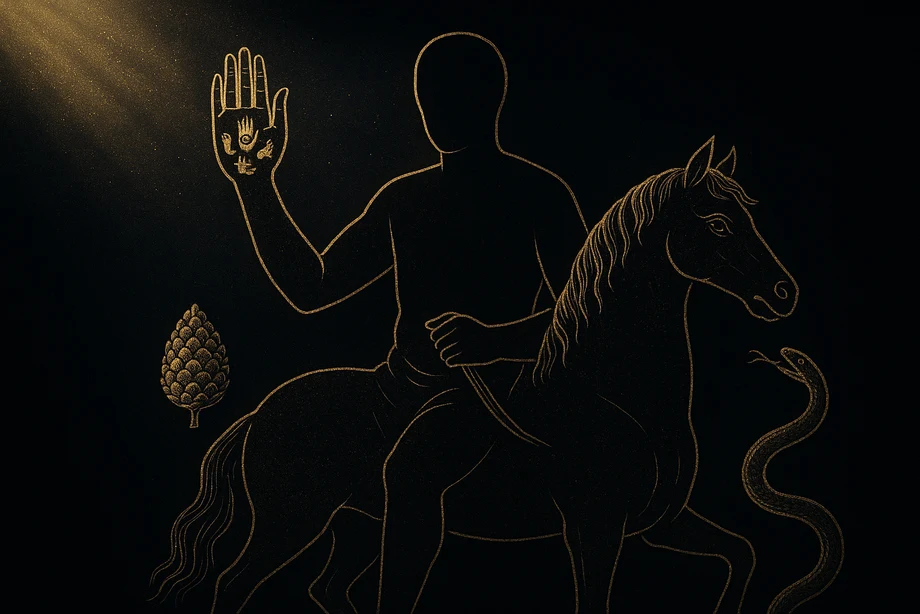
On the Thracian side there was a tradition of a horseman god: the so-called "Thracian Rider," a figure preserved in hundreds of grave reliefs. This riding god is most often shown with a spear, a hunting scene, and a tomb in the background. Many interpreters count Sabazios as a branch of this Thracian Rider tradition.
He is the protector of the one who keeps moving, of the crossing, of what stands between borders.
Mystery cults and the promise after death
Sabazios's cult communities were small, closed groups called thiasos. Members went through a kind of initiation, an entrance rite. Roman sources, especially writers of the Republic, sometimes spoke of this cult with fear; in one of Demosthenes's speeches there is a jab at his opponent's mother for joining a Sabazios rite.
These cults gathered behind closed doors, outside the official order of Greek and Roman worship.
The promise of Sabazios was this: a soul that has passed through the right rites moves into a more luminous place after death. This promise brings him close to the Eleusinian Mysteries, to Orphic cults, and to the Dionysian mysteria. In the Roman Empire, especially during the second and third centuries CE, the cult of Sabazios spread across Anatolia, Thrace, Rome, and the Danube provinces.
Votive inscriptions of some officers of the Praetorian Guard have been preserved.
These mystery cults of the ancient world hold an interesting place from a modern point of view: a spirituality that moved not through an organized institution but through small communities, advancing by way of ritual experience. A believer of Sabazios was not alone, yet there was no crowded church either. They joined a small group walking on the road behind a rider.
Mano pantea and votive hands
Sabazios's strangest and most memorable iconography is the bronze votive hands. Many examples from the Roman period stand in museums; the best known are in the collections of the British Museum and the Capitoline Museums. These hands are cast in bronze, the size of a real human hand.
The fingers form a gesture: the thumb, the index, and the middle finger are raised; the last two fingers are folded into the palm.
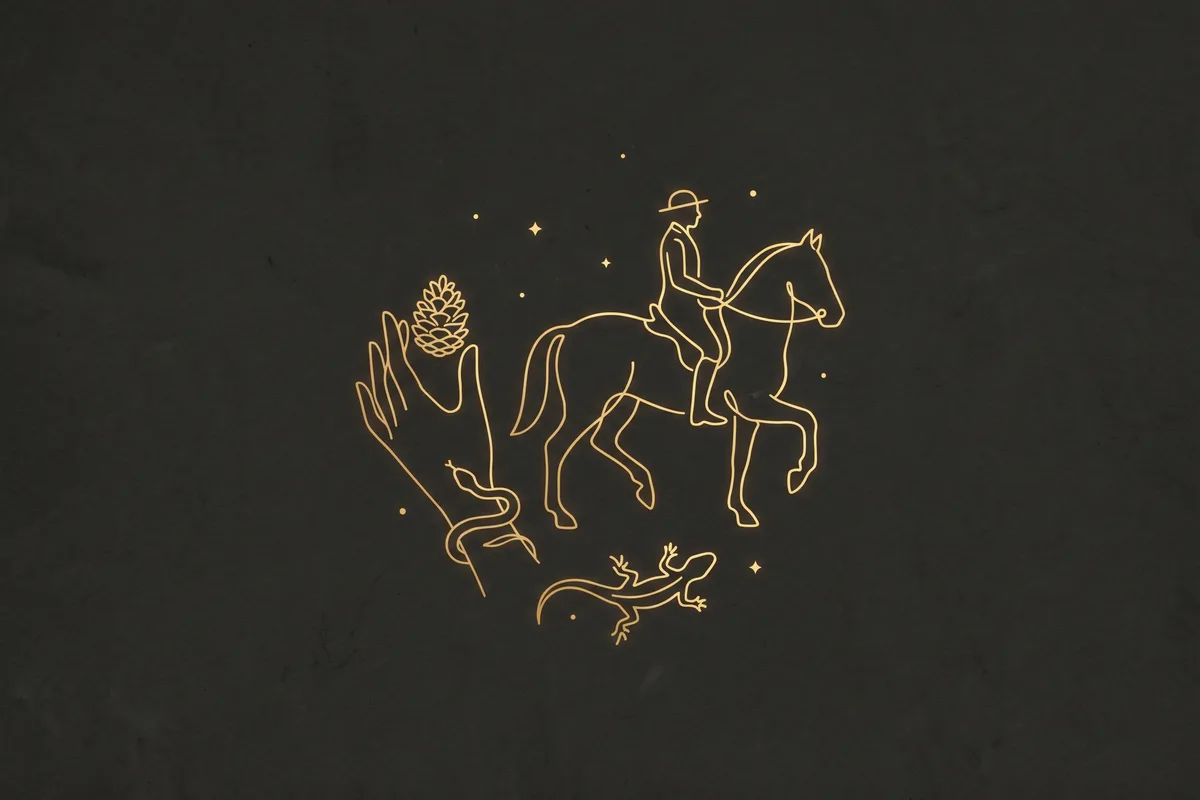
The hand does not stand alone. Above it, between the fingers, around the palm, small figures are placed. A serpent winds around the wrist.
A pine cone sits on the tip of the thumb. On some hands a small Kybele, an eagle, a frog, a lizard, an offering table, a scorpion, or a balance is seen. The votive hand is almost a small pantheon of the god, gathering all his symbols into a single bundle.
These hands were most likely displayed in homes or sanctuaries on a staff or pole as votive objects. They were used to turn the viewer's gaze to the god, and as a sign of protection and offering. What is interesting is this: the raised-finger hand survived into the Christian period.
In iconography, the position of the blessing hand carries the memory of the mano pantea. And in Anatolia today, the "Hand of Fatima" or hamsa hung beside the evil-eye bead is another inheritance of the same image.
The voice of the guide on the road
What does Sabazios say today? In astrology he touches the traveler face of Jupiter in Sagittarius, the forward-thrusting energy of Mars in Aries. But the myth points to something more subtle.
The Sabazios within us is the part that keeps moving. The soul that does not bind itself to one place, that keeps moving without settling into a city, a profession, a relationship, an identity. In the modern world this energy sometimes shows itself in migration, in changing jobs again and again, in moving from one country to another, sometimes in jumping inwardly from one subject to another.
Sabazios sees this movement not as a fault but as a nature.
The horse stands beside him, because the horse is the oldest companion of the road. The hand image is a sign of protection in the middle of motion, a mark of blessing. The road is long, the passage tiring, yet a hand is on you.
The real lesson of the myth is this: a traveling soul is not a lost soul. Sabazios is not a pagan cliché, nor a god of uncontrolled frenzy. He is rather the keeper of the passage, the protector of the threshold.
If you keep moving in your life, if you keep changing, if you cannot find a place to settle, Sabazios does not tell you to settle. He tells you to check the harness of your horse, to take a blessing in your hand, and to walk the road on your own route. Some gods bind us to a place; Sabazios binds us to the road.
The voice within
Hareketin, geçişin, durmadan yol alanın arketipi. Tek bir yere bağlı kalmayan ruhun ihtiyaç duyduğu rehber. Modern okumada içsel yolculuk dönemlerinin koruyucusudur.
"Sabazios'a ait el bronzdan, parmaklar şifa için kalkar, yılan onun bileğine sarılır." Roma dönemi adak yazıtları, M.S. 2. yy.
Sources: Strabon, Geographica · Diodorus Siculus, Bibliotheca Historica, IV · Demosthenes, De Corona · Aristophanes, Vespae ve Aves'te değiniler · Roma dönemi adak yazıtları (CIL koleksiyonu) · British Museum ve Capitolinus Müzesi Sabazios eli koleksiyonları · Trakya Atlısı mezar stelleri (Bulgaristan ve Trakya bölgesi)

You can ask a question about this reading
Hypatia (Bilge Astrolog) answers your questions about Sabazios