
Ay, kader, dünya cetveli
Archetype: Ay yargıcı
Anatolia's own moon god
Mên's name is short and mysterious: a single syllable, a small hammered figure. In Greek sources he is Mēn, in Latin inscriptions Men or Menis. The origin of his name reaches into the languages of Anatolia, possibly into a Phrygian root meaning "moon," and the same root is shared by the Greek word mēn (the moon in both sky and calendar).
His name, in other words, simply means moon.
Not as widely known as Sin of Mesopotamia, Hathor of Egypt, or the moon goddesses of Meso-America, Mên is still Anatolia's own moon god. His sanctuaries clustered above all in Pisidia, Phrygia, and Lycia. The most famous cult center was Antioch in Pisidia, near today's Yalvaç.
The cult there remained alive into the Roman period; in book XII of the Geographica, Strabo speaks of the worship of Men Askaenos at Antioch. "Askaenos" is a local epithet, probably from the name of a nearby village or sacred site.
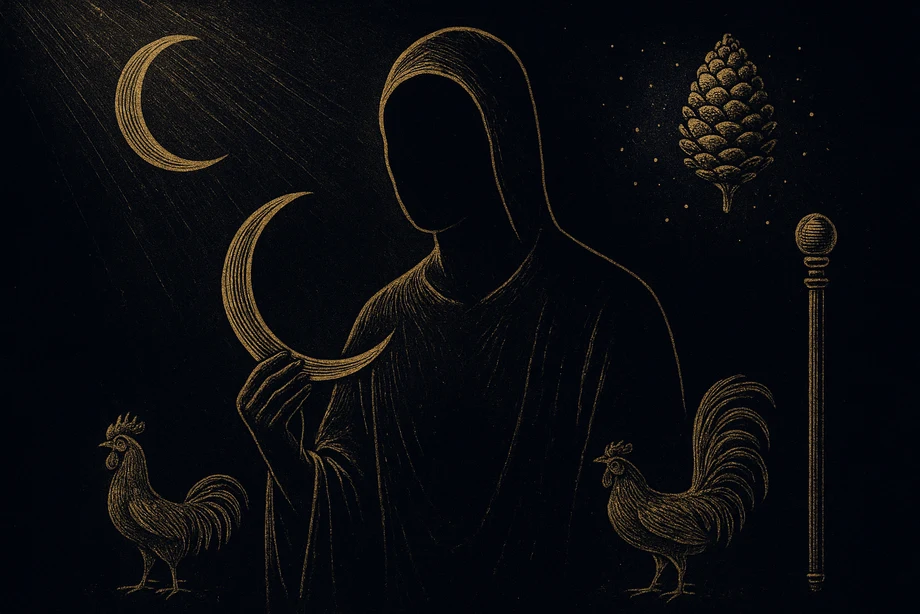
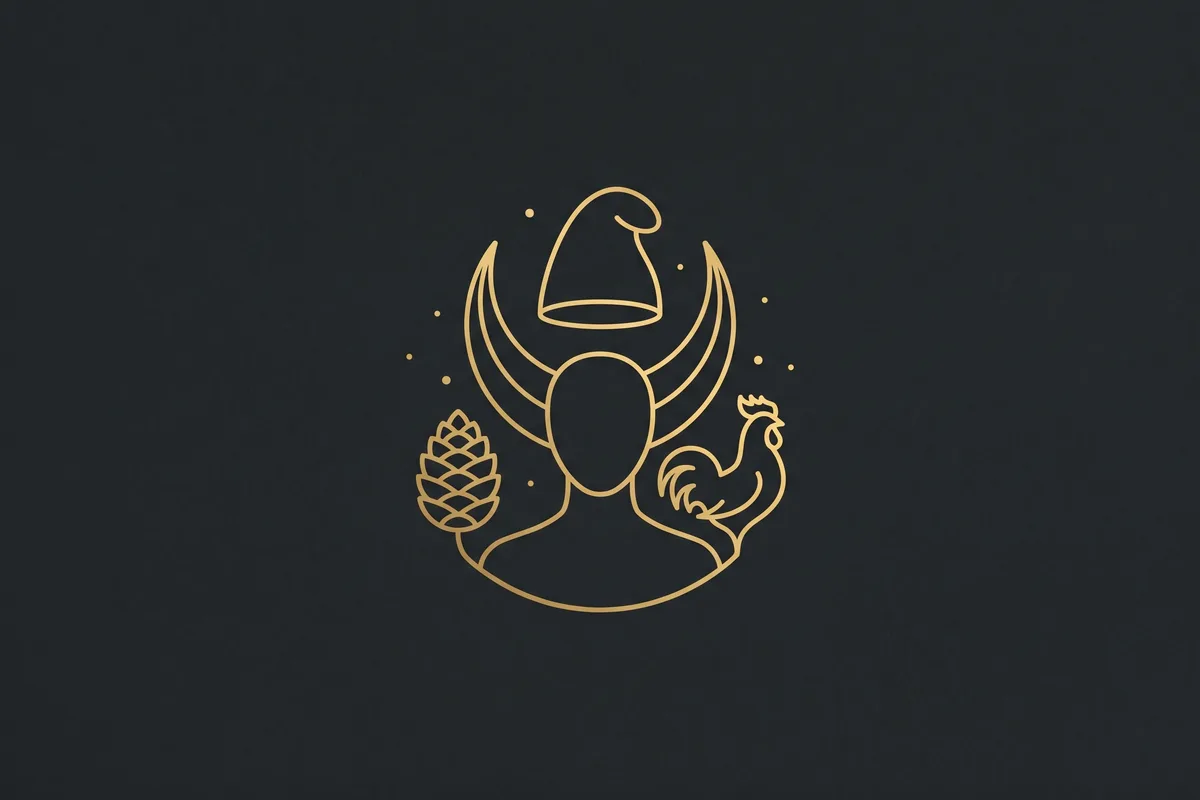
Here is the unusual side of Mên: in most ancient cultures the moon is feminine, yet in Anatolia the moon could also be perceived as male. This duality is not inconsistency but richness. Mên is a male moon god, in most depictions young, beardless, with a Phrygian cap on his head, and behind his shoulders the half of a crescent rises.
The crescent opens outward from the back of his shoulders almost like a wing.
The pine cone, the staff, and the rooster
Mên's iconography is built of a few signs. In one hand he holds a pine cone; the pine cone was for centuries in Anatolia the symbol of abundance, of continuity, of expansion from small to large. The same symbol appears in the hand of Sabazios, in the Kybele cult, in the procession of Dionysus.
The pine is one of the most steadfast trees of the Anatolian plateau; it endures the cold and stands for years.
In his other hand he holds a staff or a spear. The staff shows his ruling, measure-keeping side. In one relief Mên steps with his foot on the head of a bull or on a serpent; this shows his bond with the underworld, with the dead. For Mên was not only a moon of the sky; he was a watchman between the underworld and the surface.
A rooster is often depicted at his side. The rooster announces dawn, the border between moon and sun. The ancient world also believed the rooster guided the dead; it appears often on grave reliefs. When Mên and the rooster appear together, the emphasis that the god keeps account of the dead grows stronger.
" On the inscriptions one also reads the names of those who offered to Mên, the confession of their faults, and their apologies. Mên was a judge, but not a frightening one. He was the one who kept measure.
Most of the curious group called "confession inscriptions" in the ancient world belong to the cult of Mên.
Pisidia, Pessinus, and a silver moon
Mên's sanctuaries often stood on a hill looking out over a plain. The temple of Men Askaenos at Antioch was uncovered by excavation; small marble plaques offered there carry vows of devotion, prayers for recovery from illness, requests for cleansing from inherited harms. Mên was worshipped elsewhere in Anatolia too, in Tymandos of Phrygia, in Maionia of Lydia.
Mên's passage into Rome was limited, yet his trace did not vanish entirely. A few cult centers of Mên survived among the soldiers of the Anatolian provinces of the Roman Empire. On some coins his head appears surrounded by a crescent; these coins were struck in local Anatolian mints.
As Christianity spread, the cult of Mên gave way to other figures. One interesting passage is this: in Anatolia the cult of Saint Michael overlapped with the sites of Mên. Some mountain monasteries were built directly on top of older Mên sanctuaries.
Saint Michael too is a figure who stands between heaven and earth, weighing the evil, keeping the measure. In later centuries the crescent symbol passed into the flag tradition of Anatolia; the crescent we see on flags today is an extension of a very old trace.
The guide of the new month and the cycle
What does Mên say today? In astrology he is directly related to the Moon, but with a different emphasis from the "emotional flow" side that the Moon takes in classic tarot and modern reading. Mên is more the moon that keeps account, the moon that keeps measure, the moon that counts the calendar.
He stands on a line between the inner flow of Cancer and the structure-building firmness of Capricorn.
The Mên within us is the part of us that stays sensitive to the ebb and tide of life. The cyclical intelligence of the body: the monthly rhythm of the female body, the cycles of sleep and waking, the emotional swings sensitive to lunar phases, the energy that changes with the seasons. Modern life often pushes us to live a flat, cycleless, steady pace; Saturday like Monday, July like January.
Mên energy resists this flattening. One week you may be tired, another week you may fly, he says.
The tradition of the confession inscriptions tells us this: nothing was hidden before Mên, but the judgment was not harsh. People wrote out their mistakes, carved them into stone, and then were cleansed. This was almost an ancient practice of journaling: to speak what was lived, to set it down on record, and to draw a line over it.
In a modern reading, Mên is the voice of keeping your own moon cycle, of taking account at the new month, of dividing a year you have lived into small periods you can recognize. Every full moon can be a closure, every new moon a beginning. Mên left us as inheritance the crescent that became the flag of Anatolia; but his true inheritance is the art of keeping a consciousness sensitive to cycle.
The voice within
Döngünün, ritmin ve içsel ölçünün arketipi. Hayatın med ve cezirine duyarlı kalmanın sesi. Modern okumada hormonal döngü, ay takvimi ve zaman bilinciyle ilişkilidir.
"Mên'in tahtında oturduğu yerde gök ile yer arasında karar verilir." Pisidia Antiokheia'sı yazıtları, Roma dönemi.
Sources: Strabon, Geographica, Kitap XII · Pisidya Antiokheia'sı Mên Askaenos tapınak yazıtları · Anadolu itiraf yazıtları (Beichtinschriften) koleksiyonu · Eugene Lane, Corpus Monumentorum Religionis Dei Menis · Frigya ve Lidya Mên kabartmaları · Roma dönemi Anadolu yerel sikkeleri (Mên başlı)

You can ask a question about this reading
Hypatia (Bilge Astrolog) answers your questions about Mên