
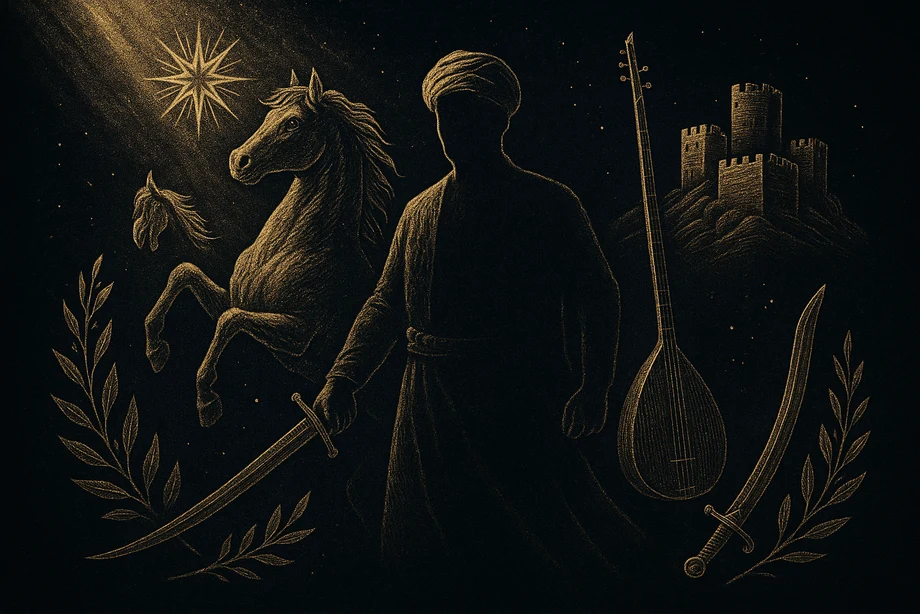
Adalet, halk, başkaldırı
Archetype: Halk için savaşan
A poor horse and two eyes put out
The opening of the Koroglu epic begins, in every branch, with the same wound. " The lord becomes angry, because he cannot bear that another should see worth in what looked low to his own eye. The punishment is heavy: the old stable master's two eyes are gouged out.
This scene remains almost the same in the Bolu branch of the epic, in the Tabriz branch, in the Tobol Turkmen version, and in the Paris manuscript. The name of the horse changes, the name of the lord changes, the name of the blinded father changes, but "two eyes taken out over a poor horse" stays as the kernel. Bahaeddin Ogel and the folk literature scholar Pertev Naili Boratav both say this kernel is a deliberate mythic construction: the lord represents the one who does not see, the father is the place where seeing is punished, and the son is the one who carries that overlooked sight forward.
The son's name at first is Rushen Ali, "Ali of light." But after his father's eyes are taken, his name changes. He becomes "Koroglu," son of the blind. The name carries before him an injustice and a debt. Koroglu enters a reckoning with his name before he is even fully grown.

Camlibel and the horse fed by hidden water
With his blinded eyes Yusuf explains the worth of the two foals to his son. "Wash them in the water of Surmeli, feed them for forty days in a cave without letting light reach them, stroke their manes at night, sing songs into their ears," he says. The son does exactly what his father said.
The foal grows up and is named Kirat, the most famous horse of Turkic epic. In one telling Kirat has two wings, in another there are no wings yet his foot is so light it seems to fly above the ground, and in a third Kirat runs for a day and a night even after his water and feed have run out.
Then Koroglu goes up to Camlibel. Camlibel is a mountain pass placed at various points between Bolu and Erzurum in Anatolian geography, yet in the epic it is more a symbol than a location. Among the pines a fortress, in the fortress forty brave men, before the fortress Kirat.
Around Camlibel it is told that everyone wronged by a cruel lord finds remedy there. One man's field has been seized, another's daughter taken by force, another crushed by tax. They all mount horses and turn toward the road to Camlibel. Koroglu welcomes them; what was taken is shared out, and the hearts of those who remain behind he settles with his saz.
The saz, the sword, and an epic shared by many peoples
Koroglu is not merely a warrior. He is also an ashik, a bard who hangs his saz around his neck and roams, improvising verse. Throughout every branch of the epic, sword and saz stand side by side.
A brave man sets out with his horse, returns with his saz, and sings his song in the square of the fortress. As Bahaeddin Ogel observes, this twinned image is particular to the Turkic heroic tradition. The hero is not a brawler; word and iron stand in the same body.
The saz is the voice of Koroglu's justice. When he sets out to raid a village, he plays his intention first. When he reaches a lord's palace, he stands before him with his saz.
The verse "at Camlibel I built a fortress, within it my brave men, outside it the cruel lords are afraid" is the summary of these speeches. Koroglu is brave not when he turns back from what he has said, but when he does what he has said.
The most extraordinary aspect of the epic is that the same hero is told in every corner of the Turkic world. In Anatolia Koroglu, in Azerbaijan Koroghlu, among the Turkmen Goroghli, among the Uzbeks Goroghli. The Paris manuscript is close to the Tabriz version, the Tobol version reaches as far as Siberia.
Events change, names change, but the honour of the brave men gathered at Camlibel is shared. Koroglu's epic belongs to no one people, and to all. It is a narrative layer that grew around a historical figure (Rushen Ali, the Koroglu of the 16th-century Celali uprisings) yet long ago surpassed its history.
The honourable warrior within us
What does Koroglu say to us today? His astrological echo is Mars and the Sun, one the planet of drive and action, the other of honour and identity. The match is fitting. Koroglu is a man of action, yet he acts through an identity, and that identity is being the son of a blinded father.
The Koroglu within us is the part that cannot hold its tongue before injustice, that reads personal pain past its own border. When his father's eyes were taken, Rushen Ali stood between two choices: to withdraw into solitude and grief, or to turn that grief into a fortress. The myth chooses the second and names it bravery.
Bravery is not anger; it is anger married to honour.
Its shadow is always pushing yourself toward the front line. When Koroglu energy loses its balance, it reads every situation as a scene of lord and oppression, multiplies fight with fight, forgets to play its saz, and turns only to its sword. Yet the subtle balance of the epic is this: bravery carries the saz and the sword on the same shoulder.
Knowing in which moment which has its turn is maturity. Camlibel is an open gate, not a cage; whoever wants to enter, enters, whoever wants to leave, leaves. Koroglu's true power is not that he fights, but that he can keep a fortress whose door stays open.
The voice within
Haksızlığa boyun eğmemenin, kişisel acıyı kolektif adalete çevirmenin arketipi. Babasının kör edilmesinden doğan bir öfkenin, bir başkaldırı kültürüne dönüşümü. Modern okumada içsel savaşçının onurlu sesidir.
"Çamlıbel'de bir kale yaptırdım, içinde yiğitlerim, dışında zalim beyler korkar." Köroğlu destanı, Bolu kolu, sözlü gelenek.
Sources: Köroğlu Destanı, Bolu kolu, sözlü gelenek · Köroğlu Destanı, Paris yazması ve Tebriz versiyonu · Köroğlu Destanı, Tobol ve Türkmen versiyonları · Bahaeddin Ögel, Türk Mitolojisi · Pertev Naili Boratav, Köroğlu Destanı Üzerine Çalışmalar · Dede Korkut Kitabı, karşılaştırmalı okuma için
You can ask a question about this reading
Hypatia (Bilge Astrolog) answers your questions about Köroğlu