
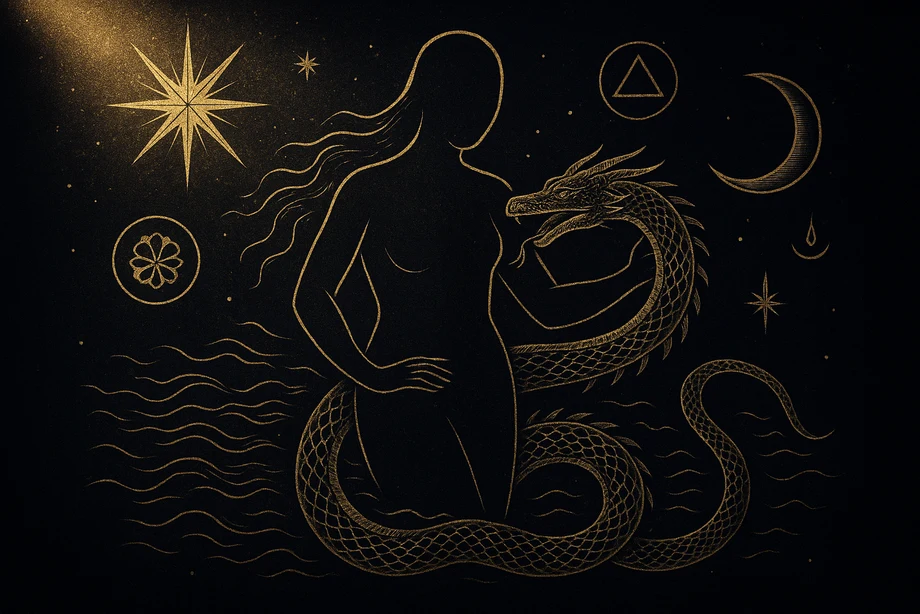
İlkel deniz, kaos, yaratım
Archetype: İlk ana, ilk kaos
The water of the unnamed
" This sentence was written near the end of the second millennium BCE and was read aloud every year in Babylon during the Akitu festival in the month of Nisan. Yet the moment it describes is older than every reading, every temple, every copied tablet.
" Her body is salt water. Apsû is fresh water, the source beneath the ground. When the two mingled, when salt and sweet met without a boundary, the gods began to be born.
First Lahmu and Lahamu, then Anšar and Kišar, then Anu the god of the sky, and from him Ea (the Sumerian Enki), the god of wisdom.
Something should be said at once. " The myth does not. " She is not evil, nor is she destruction.
She is the not yet shaped, the not yet bounded, the not yet named. Creation comes out of her body. What comes later is a different story.
The noise of the children and the patience of the mother
The newly born gods were young, noisy, dancing. Their movement set the inner waters of Tiamat into waves. Apsû could not bear it.
" Tiamat objected. Her words in the first tablet of Enuma Eliš are plain: "How can we ruin what we ourselves bore?
But Apsû had made up his mind. The moment the plan reached his ear, the wise Ea moved. With a spell he put Apsû to sleep, bound him, and built his own house upon the body of the fresh water, raising his son Marduk in that house. Fresh water had now become a place, the ground upon which the gods settled.
Tiamat did not react, not yet. Years passed. " This time Tiamat rose.
But the old myths have a subtlety. In some translations her rising is a revenge, in others it is the carrying of a grief and the keeping of an inner law. Tiamat does not build an army, she builds bodies.
She gives birth to eleven creatures: the mušḫuššu dragon, scorpion man, snake man, fish man, storm serpent. To lead them she calls Kingu, her second consort, and binds the Tablet of Destinies, the Tuppi šīmāti, to his chest.
Facing Marduk, and still there after him
The young gods grew terrified. Anu was tried, Ea was tried, none of them could approach Tiamat. At last Marduk stepped forward. He laid down a condition: if I prevail, I will be the chief god of the heavens. The gods assembled in the Upšukkinakku council and accepted unanimously.
The encounter is told in the fourth tablet of Enuma Eliš. Marduk takes the seven winds as weapons, fastens a net to his side, carries the lightning in his hand. When Tiamat opens her mouth, Marduk blows the evil winds into her, and her mouth can no longer close.
In that moment he looses his arrow and splits her. Then he opens her body like a flat fish into two halves. From the upper half he shapes the sky, the dome of stars, the firmament that holds back the upper waters.
From the lower half he makes the earth, the mountains, the sources of the Tigris and the Euphrates. From her eyes flow the Tigris and the Euphrates; from her saliva the clouds, from her tail the Milky Way.
This part is important and should be read with care. Tiamat is not a defeated enemy. Her body is the world we sit on.
The sky above us is her skin, the earth beneath our feet is her flesh. When Babylonians read Enuma Eliš every spring at the Akitu festival, they did not experience it as the proclamation of a victory but as a ritual of remembering. Cosmic order is inscribed onto Tiamat's body, not erected against it.
Kingu, meanwhile, is judged and his veins are cut. From his blood, mixed with clay, the human is made. So we are at once of earth and of the blood of a lost god. The Mesopotamian idea of the human carries this double origin at its heart.
A respect for the unbounded
What does Tiamat say to us today? A modern reader can easily misread her. For years we read her as "the chaos dragon," the monster that has to be defeated. But for a Mesopotamian, she is the water of the beginning. She is not feared, her greatness is acknowledged.
The Tiamat within us is the not yet formed. The seed of a thought, a feeling we cannot yet name, the unwritten first version of a project, an unnamed current in a relationship. She is before the boundary. The boundary comes, the form comes, the name comes, the decisions come, but everything first waits inside her.
In astrology this energy is close to the language of Neptune and the water beyond limits. Tiamat reminds us of the value of an unbounded space before the line is drawn. At the start of every act of creation there is a formless patience, and we mostly skip over it.
The myth says something deeper: Marduk's order stands on the body of Tiamat. Every structure we build, everything we name, every life we shape, owes itself to the unnamed underneath. To treat that as nothing weakens the structure itself.
To honor Tiamat is to honor our own beginnings.
The voice within
Henüz biçim almamış olanın, sınırsız yaratıcı potansiyelin arketipi. Korkulan değil, içinden her şeyin doğduğu prima materia. Modern okumada bilinçaltının uçsuz bucaksız okyanusudur.
"Yukarıda gök adlandırılmamışken, aşağıda toprak isim taşımazken, Apsu ile Tiamat sularını karıştırdı." Enuma Eliş, Tablet I, satır 1-5.
Sources: Enuma Eliš, Tablet I, IV (Babil yaratılış destanı) · Akitu bayramı ritüel metinleri, Babil · Berossos, Babyloniaca (fragmanlar, Yunan derlemesi) · Aššur ve Babil tapınak yazıtları
You can ask a question about this reading
Hypatia (Bilge Astrolog) answers your questions about Tiamat