
Bolluk, güzellik, talih
Archetype: Bolluğun tanrıçası
From the Sri Sukta to the Ocean of Milk
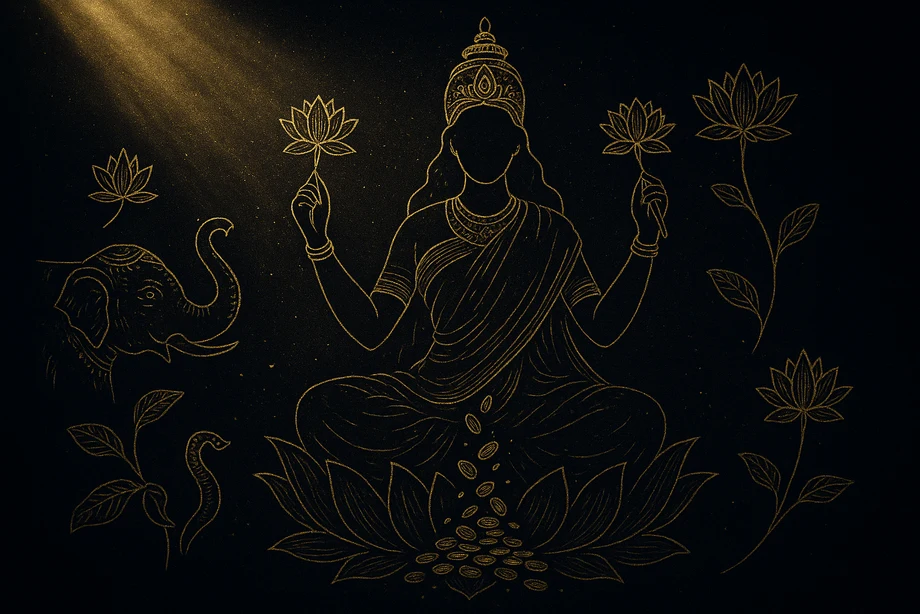
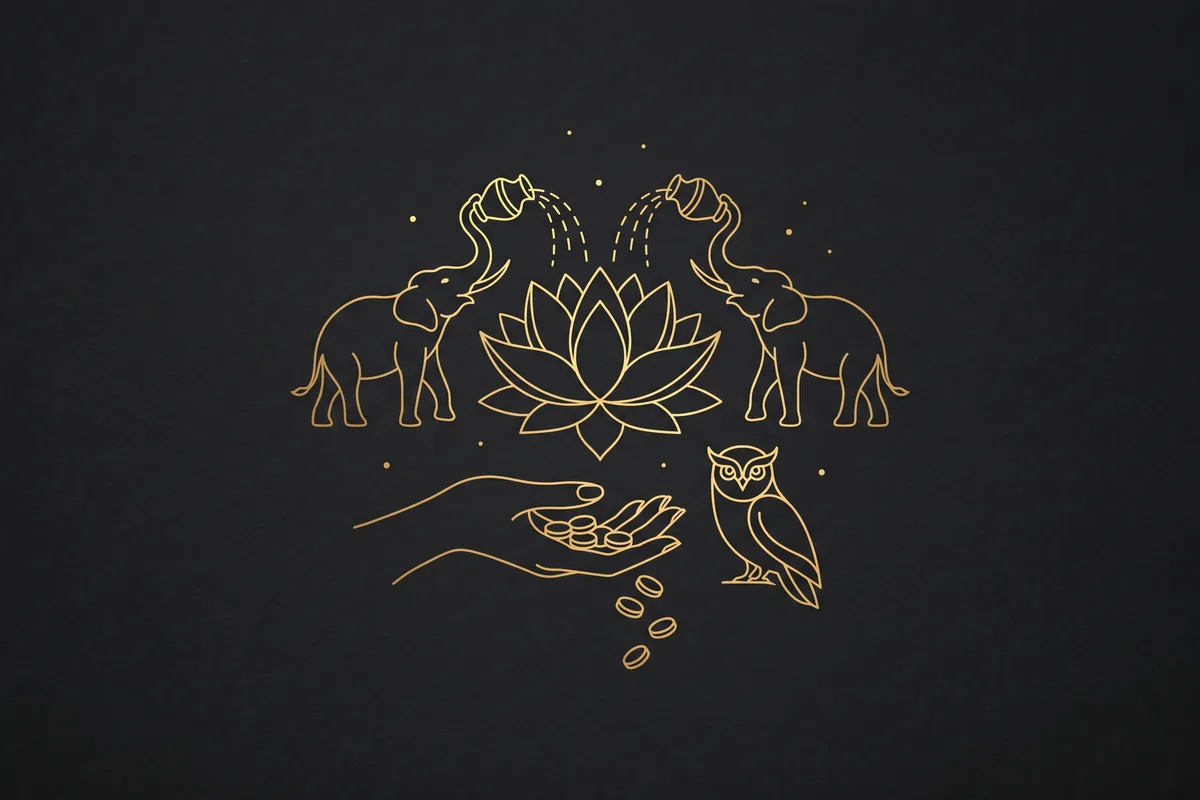
Lakshmi is named in the Sri Sukta, one of the appendices to the Rig Veda, in fifteen short and concentrated verses. In this small but dense hymn she is called Sri or Lakshmi: golden-skinned, seated on a lotus, with elephants pouring water over her, a goddess who lacks for nothing. The Sri Sukta is still recited today in thousands of temples and homes across India.
The Sanskrit word "sri" means brightness, radiance, grace; "lakshmi" comes from a root meaning trace, mark, sign. Together they make the goddess who gives value to life and who lets that value be seen.
In the Vedic period Sri and Lakshmi were sometimes named separately, and over the Puranic centuries they merged into a single figure. The goddess is now the eternal consort of Vishnu, and in each of his descents into form Lakshmi stands beside him in a corresponding form. When Rama is born she is Sita; when Krishna is born she is Rukmini and Radha.
The Bhagavata Purana and the Vishnu Purana describe this pairing in detail.
Her birth narrative is a cosmic service. In the scene of the Churning of the Ocean of Milk, told in the Adi Parva of the Mahabharata and in the Bhagavata Purana, gods and asuras churn the ocean together to obtain the nectar of immortality. First a poison rises (Shiva drinks it), then the healing god Dhanvantari, then the Moon, then the divine horse, then the divine elephant, and finally, from the sea's foam, Lakshmi rises seated on a lotus.
The moment she appears, all the gods bow. She chooses Vishnu and takes her place beside him.
The eight Lakshmis and standing beside, not behind, Vishnu
The Indian tradition did not leave Lakshmi with a single face. The Ashtalakshmi tradition, "the eight Lakshmis," counts eight different forms of abundance. Adi Lakshmi is the original form.
Dhana Lakshmi is the goddess of material wealth, Dhanya Lakshmi of agricultural yield, Gaja Lakshmi of royal power (brought by elephants), Santana Lakshmi of lineage and children, Veera Lakshmi of courage, Vijaya Lakshmi of victory, and Vidya Lakshmi of knowledge. These eight forms say that what we call "wealth" is not a single thing. Knowledge is also wealth; so is courage, lineage, even victory.
Her partnership with Vishnu is the most graceful side of the tradition. Many Indian texts call Lakshmi the "Shakti" of Vishnu, his active power. Vishnu is the passive sustainer; Lakshmi is the flow that turns his sustaining into action.
According to the Padma Purana, without Lakshmi, Vishnu's wealth remains invisible.
One myth shows a curious side of Lakshmi. In a scene from the Vishnu Purana, the goddess, having been slighted, leaves the heavens and withdraws into the ocean. To bring her back, the gods must wait for years and then call her forth again through the Churning of the Ocean of Milk.
A subtle message comes from this: Lakshmi is not something to chase. When she is not respected, she leaves, and she cannot be held by force. When she is invited with respect, she returns.
This is why Indian thought treats wealth almost as if Lakshmi were a presence in the house who needs to be tended to.
The lotus, the elephant, and the lamp of Diwali
Lakshmi's symbols tell her nature. The lotus on which she sits is the flower that opens out of mud yet is never stained by it; it stands for abundance that has stayed pure. The gold coins flowing from her hand are not an image of display but a picture of abundance that knows how to flow and does not pile up.
The two elephants beside her bless her, since the elephant is linked with both strength and rain, the abundance that feeds the earth. Her four arms hold the four goals of life: dharma and artha (the spiritual path and worldly livelihood), kama and moksha (desire and liberation).
Lakshmi's brightest day is Diwali. On the third night of this five-day festival of light, the night of Lakshmi Puja, the goddess is believed to walk from house to house. Families clean their homes, draw colored rangoli patterns at the threshold, and light lamps and candles, because Lakshmi enters only places that are clean, lit, and cared for.
This detail carries a symbolic lesson: abundance does not arrive on its own; a place is prepared for it.
" The Mahalakshmi temple at Kolhapur is another important center. In South India, Varalakshmi Vratam is a long day of fasting and prayer during which women invite the goddess into the household. The middle three nights of Navaratri are dedicated to her.
The grammar of flowing abundance
What does Lakshmi say to us today? In astrology she can be linked to Venus; the planet of value, aesthetics, abundance, and relationship speaks the same language as she does. She also connects to Jupiter, since both carry the energy of growth and blessing.
The Lakshmi within us is the voice that knows how to value. The capacity to notice the light on the rim of a glass, the trust in a handshake, the smell of an afternoon. To pass through life without seeing the small abundances is a kind of poverty, and Lakshmi energy comes online exactly there.
She teaches us that abundance is not only money. Knowledge is Lakshmi, so is health, so is friendship, so is the yield of a garden.
Her flowing nature is important. Her hand is always open downward; she does not grip what she holds. The myth says this: abundance multiplies not when it is held but when it flows.
If a person keeps their fist closed, nothing can enter it either. This is why generosity, dana, has almost the status of a ritual in the Indian tradition. The more you give, the closer you are to Lakshmi.
She has a shadow too. When Lakshmi energy hardens, value is externalized: how much do I have, how much am I seen, how much am I approved. This is not Lakshmi but a parody of her. The real lesson of the myth is this: to be valuable and to be priced are different things. The real Lakshmi lives in a gaze, not in a display.
The voice within
Maddi ve manevi bolluğun, hak ediş duygusunun arketipi. Almayı, sahip olmayı, çiçek açmayı utançsız yaşama kapasitesi. Modern okumada bolluk bilinciyle ilişkilidir.
"Lakshmi süt okyanusundan çıktı, lotus üzerinde ayakta, altı ışıkla parlayarak." Vishnu Purana, 1.9.
Sources: Rig Veda, Sri Sukta · Mahabharata, Adi Parva · Bhagavata Purana · Vişnu Purana · Padma Purana · Lakshmi Tantra

You can ask a question about this reading
Hypatia (Bilge Astrolog) answers your questions about Lakshmi