
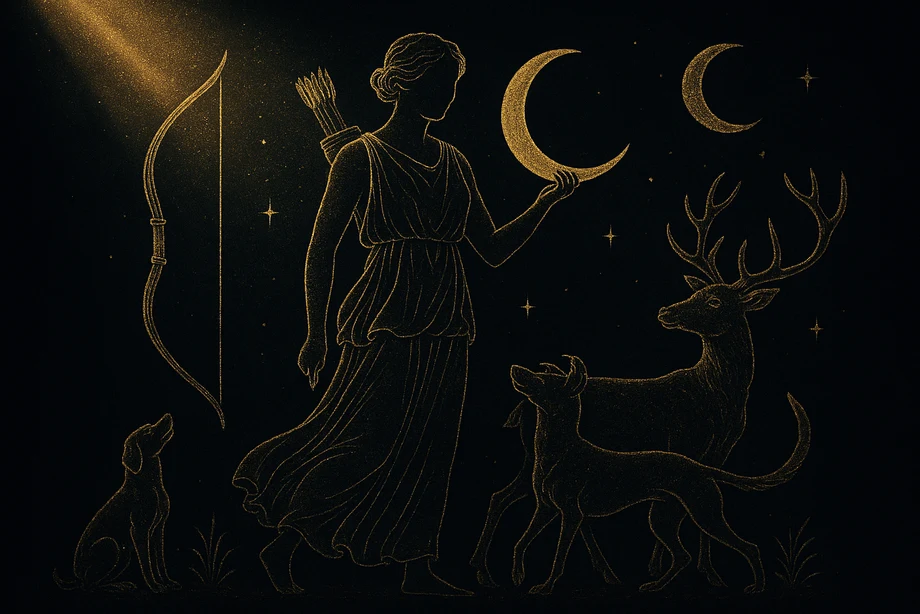
Ay, av, bakirelik, vahşi doğa
Archetype: Kendine ait kalan
Born first, then the elder sister
Artemis is the twin sister of Apollo, but a small detail of the myth says a great deal. In many accounts Artemis was born first, and the moment she was born she helped her mother Leto bring Apollo into the world. A newly born goddess, her very first act was to midwife a birth.
This is why Artemis is, as much as she is a goddess of virginity, also the protector of births and of newborn children. At first glance this looks like a contradiction. But the myth sees no contradiction: Artemis stands at the threshold of life, protecting what is newly begun, not yet stained, not yet given form.
Callimachus's Hymn to Artemis tells her childhood with affection. While still tiny, she sits on the lap of her father Zeus and asks him for her wishes. Zeus smiles at how clearly his daughter knows her mind, and grants them all.
The wish of a three-year-old
According to Callimachus, the little Artemis asked her father for these things: to remain a virgin forever, to carry many names, a bow and arrows, a hunting tunic that reached to the knee, a retinue of young nymphs to accompany her, all the mountains she could reach, and not a single city, since she would mostly live in the mountains.
This list of wishes is really a goddess drawing her own boundary. Artemis refused marriage, but this was not a deprivation. She chose her own domain: the wilderness, the forest, the mountain, the hunt.
With her nymphs she runs and hunts deer, yet she is also the protector of animals. Hunter and protector are the same person in her, because the balance of nature is built precisely by these two standing together.
Her boundary is sharp. The story of Actaeon, told in Ovid's Metamorphoses, shows this: the hunter Actaeon, in the forest, unintentionally sees Artemis bathing unclothed. The goddess transforms him into a deer, and Actaeon is torn apart by his own hunting dogs.
The story seems harsh, but its core is this: Artemis's boundary is not open to debate, and that boundary is the source of her power.
The silver bow, the crescent, and Ephesus
Artemis's symbols reflect her nature. The silver bow is her power to touch from a distance, silently, with precision. The deer, as the animal she both hunts and protects, carries that dual balance of nature.
Hunting dogs accompany her. The crescent moon became, in time, her best-known sign, because Artemis was identified with the Moon and Apollo with the Sun.
The most magnificent center of her worship was Ephesus. The temple of Artemis there, the Artemision, was one of the seven wonders of the ancient world. What is interesting is that the Artemis of Ephesus looked different from the slender, agile huntress of other parts of the Greek world: she was a figure tied to fertility, interwoven with a far older mother-goddess tradition of Anatolia.
The goddess had not one face but many.
At Brauron near Athens, young girls took part in a rite dedicated to Artemis, serving her as "bears." She was worshipped in Sparta, in the mountains of Arcadia, and along the Anatolian coast. Rome knew her as Diana. Everywhere the same core was preserved: the protector of the untouched, the wild, and the one who stays its own.
A domain of your own
What does Artemis say to us today? In astrology she is associated with the Moon, which suits her inward, intuitive, cyclical nature.
The Artemis within us is the capacity to remain your own. To exist without being anyone's property, extension, or mirror. To withdraw from the crowd into the forest, to draw your boundary clearly, to be able to say no. Her virginity is not a deprivation but a wholeness: a state of being that is self-sufficient and stands on its own axis.
In a modern reading, Artemis is the voice of inner sovereignty. She reminds us to claim our own space, our own silence, our own direction. Her shadow can be the boundary hardening into a wall, never allowing closeness at all.
But the balance of the myth is clear: Artemis is both hunter and protector, she both roams alone and is together with her nymphs. To stay your own is not to close yourself off from the world. It is to touch the world from your own center, by choice.
The voice within
Bağımsızlığın, sınırın ve kendine dönük yaşamın arketipi. Kimsenin malı olmamak, kalabalıktan ormana çekilebilmek, sezgiyle yön bulmak. Modern okumada içsel egemenliğin sesidir.
"Bana sonsuz bakirelik ver baba, dağları, oraya tek başıma çıkmak için." Kallimakhos, Artemis İlahisi, 6-7.
Sources: Kallimakhos, Artemis İlahisi · Hesiodos, Theogonia · Ovidius, Metamorphoses · Apollodoros, Bibliotheke · Pausanias, Hellas Tasviri
You can ask a question about this reading
Hypatia (Bilge Astrolog) answers your questions about Artemis