
Kader, ev, anne, bilen tanrıça
Archetype: Kaderi ören anne
Mother of Asgard, but no wanderer
Frigg is the figure Snorri describes in the Prose Edda as Asgard's "foremost goddess." Wife of Odin, chief queen of the Aesir. Her name comes from the Old Germanic root Frijjō; this root carries at once the senses of "beloved" and "one's own," running in the same vein as the modern English free.
Where Odin's nature is wandering, shape-shifting, moving by unseen paths, Frigg's nature is settled. Her hall is Fensalir, "the halls of the fen"; a place tied to water, to mists, to depths. In Gylfaginning 35 Snorri, listing the goddesses, says, "Frigg is the foremost of the goddesses," and at once names her handmaids, her duties, and the goddesses in her circle: Sága, Eir, Gefjon, Fulla, Sjöfn, Lofn, Vár.
Frigg sits in her hall, yet she knows everything. " In this brief exchange the core of Frigg is hidden. She is a goddess who sees everything, but who carries that seeing quietly.
Her power is in her not speaking.
The knowing mother and the mistletoe overlooked
Frigg's most intense moment in myth concerns her son Baldr, and this story is the saddest of all Norse myths. Snorri tells it in Gylfaginning 49, and the Poetic Edda's Baldrs draumar circles around the same event.
Baldr was the son of Frigg and Odin, god of light, the most beautiful, the most beloved. One day he began to have evil dreams. He saw his own death in them.
Odin raised a seer, a völva, from the dead and asked her, and the prophecy was confirmed: Baldr would die. Frigg then took an oath from every being on the earth, every tree, stone, animal, sickness, fire, water, metal, poison, that they would not harm her son. All swore.
The gods began a game in Asgard: they threw stones at Baldr, hurled spears, shot arrows; none of it touched him, all of it turned away.
Loki disguised himself as an old woman and came to Frigg. " he asked. " Loki found the mistletoe and cut a sprig.
" Höðr threw. Baldr fell.
Frigg's tragedy in this scene is subtle. The all-knowing goddess had counted one small detail as not worth bothering with. The myth teaches us the irony of fate: even the eye that sees everything cannot close every small overlooked thing.
Frigg then sent Hermóðr to the underworld to bring her son back. In the scene we told under Hel, when Hermóðr meets Hel and hears her terms, every being in the world wept for Baldr, except one giantess named Þökk in a cave, who was Loki. The mother both knew everything, and lost her son.
The distaff, the falcon cloak, goddess of the home
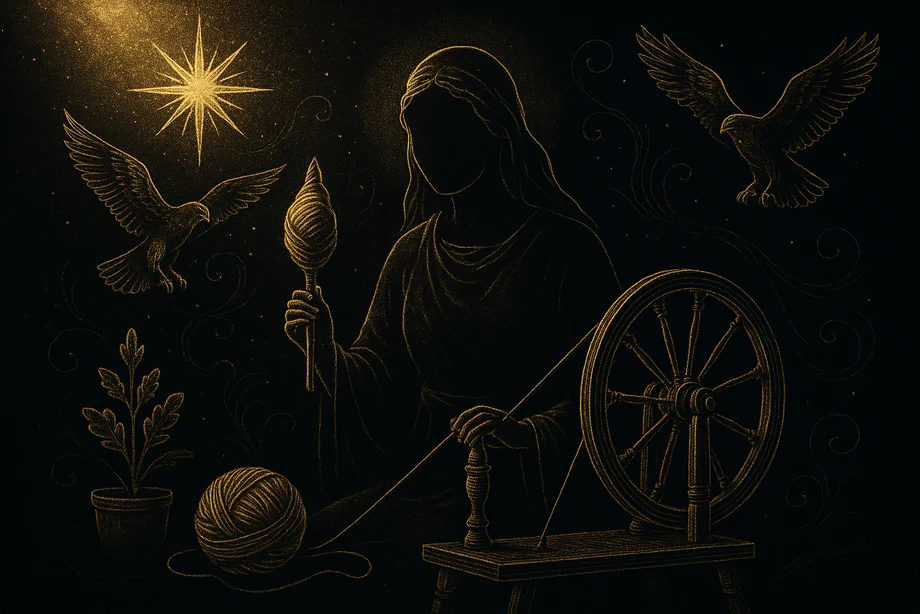
Frigg's most important symbol is the distaff, the spinning wheel. The women of Old Norse households spun wool, twisted thread, wove cloth; this work was at the center of daily life but was also a metaphor for fate. In Greek myth the Moirai, in Rome the Parcae, in the north the Norns wove fate as thread.
Frigg too is linked to the feminine line of this symbol. While her spindle turned, something else was turning as well. After Christianization, in Scandinavian folk tradition the three bright stars of Orion's Belt were called "Frigg's Distaff"; for a moment her work remained visible in the sky.
She also had a cloak of falcon feathers. Snorri mentions it in Skáldskaparmál; Loki borrowed it in several stories. The falcon is the bird that looks down from a height, that sees far, and this suits Frigg's prophetic nature. She does not wander, but she sees.
The line between her and Freyja is in fact not always clear, because the two goddesses were sometimes blended in the folk culture of the north. Scholars have long debated this. In some regions Frigg and Freyja are spoken of as two separate figures; in others, like two faces of the same goddess.
This blending is one reason why the origin of our Friday remains uncertain. Either goddess can claim that day.
Frigg's worship was tied to home, to childbirth, to marriage. Women who wished for a child prayed to her; women in labor asked her for an easy birth; households asked her for blessing. Snorri once calls her a "queen of the home," but this is not the same as domestic.
Frigg's home is another kind of center; from it she weaves threads, from it she sees, from it she protects. A quiet center, but a center.
To know, and not to tell
What does Frigg say to us today? In astrology she touches the relational grace of Venus and the inner knowing of the Moon. The settled wisdom of Taurus and the protective intuition of Cancer belong to her.
The Frigg within us is the voice that knows and is silent. In modern life the value of knowledge is often measured by how loudly it is shared: the fastest speaker, the most posting, the loudest claim. Frigg holds another kind of wisdom.
" This is not surrender, it is sovereignty. A word left unsaid remains in the hand of the one who could have said it.
There is another dimension, the quiet dignity of the lesson in Baldr's story. Frigg knew everything, took oaths from every being, but one small thing slipped past her. " No. The myth tells us something deeper: we cannot control every detail of life.
Even the most knowing goddess overlooked the mistletoe. When this is seen, Frigg's seated posture takes on a deeper meaning. She does not try to control everything.
She carries what she knows, when she cannot carry it she mourns, then she returns to her weaving.
Her shadow is here too. When the Frigg energy does not ripen, it can take shelter in the power of knowing and avoid feeling. She can withdraw into the role of "knowing mother" and neglect her own inner life.
Ripe, she carries the capacity to know and to love at the same time. She is sometimes compared with the Greek Hera, but Frigg does not carry Hera's scorching jealousy; her power is of another kind, quieter, longer in its breath. In a modern reading, Frigg says that inner knowledge can stand in its proper place even inside grief and love.
To know is not necessarily a burden; sometimes it is only the quiet turning of a wheel.
The voice within
Bilen ama söylemeyen, koruyan ama müdahale etmeyen anne arketipi. Kaderin ipliklerini sessizce ören el. Modern okumada içsel bilgelik ve sessiz hazırlığın sesidir.
"Frigg her şeyin geleceğini bilir, ama hiçbir şey söylemez." Lokasenna, 29.
Sources: Snorri Sturluson, Düzyazı Edda (Gylfaginning, Skáldskaparmál) · Lokasenna, Şiirsel Edda · Baldrs draumar, Şiirsel Edda · Vafþrúðnismál, Şiirsel Edda · Grímnismál, Şiirsel Edda · Saxo Grammaticus, Gesta Danorum (Frigg/Frea anlatımları)
You can ask a question about this reading
Hypatia (Bilge Astrolog) answers your questions about Frigg