
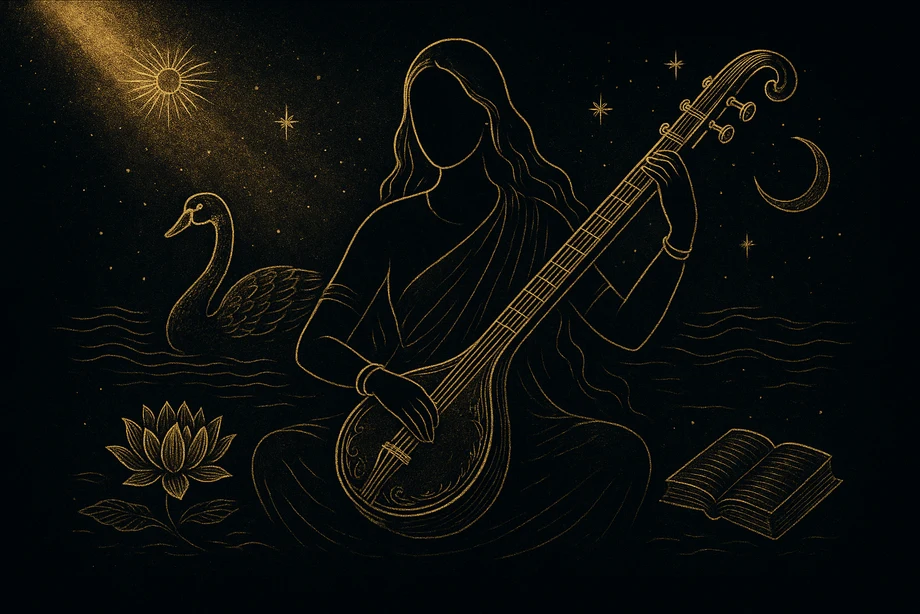
Bilgi, sanat, müzik, su
Archetype: Sanatın ve bilginin tanrıçası
From the most sacred of seven rivers to a goddess
Sarasvati's story begins not with a goddess but with a river. In the oldest layers of the Rig Veda, hymns dated to the late second millennium BCE, Sarasvati is called the goddess of three things: the earth, the seven rivers, and the power of speech.
Sarasvati was, in the beginning, a real river. In the Rig Veda she is described as a great river flowing between the Indus and the Ganga, on whose banks the first Vedic tribes lived and on whose shores the hymns were sung. Modern archaeology and satellite imaging have traced a river in northwestern India that flowed from the Aravalli mountains toward the Arabian Sea and dried up, withdrawing underground, around the second millennium BCE; many scholars believe this was the ancient Saraswati.
So a goddess was once a water on whose banks people actually sat.
The river's withdrawal underground shapes the rest of the myth. Sarasvati is now an invisible water that still continues to flow. In Indian thought, at the Triveni Sangam in Allahabad, where the Ganga and the Yamuna meet, the "invisible third river" Saraswati is believed to come up from below.
The water of wisdom is something like this: it flows unseen, always there.
When the Vedic period gives way to the Upanishads, Sarasvati passes from being the goddess of the river to the goddess of knowledge. In the Brihadaranyaka Upanishad and the Chandogya Upanishad, speech, sound, vac, is described as itself a cosmic power. Sarasvati becomes the name of that power.

Vac, the vina, and the consort of Brahma
In the oldest layers of the Vedic tradition, "Vac," speech, was a goddess in her own right. In one hymn of the Rig Veda, Vac speaks for herself: "Among the gods I walk; I bear them. Kings win by my means." This hymn tells us that speech, the word, the mantra, is not a tool but a cosmic being. By the late Vedic period Vac merges with Sarasvati.
In the Puranic age, Sarasvati is the consort of Brahma, the creator god. Many texts tell this union in the following way: when Brahma begins to create the universe, Sarasvati stands beside him as the first creating, the first form-giving power. Brahma sketches the plan of the cosmos; Sarasvati gives that plan language, measure, form.
" The Skanda Purana and the Brahma Purana describe this creative side at length.
The instrument Sarasvati holds, the vina, is one of her best-known symbols. The vina is among the oldest stringed instruments of Indian classical music, and Sarasvati keeps it constantly in tune. The detail seems small, but the myth says something: knowledge is not static, it asks to be tuned again and again.
A student's knowledge, like a string, must be tightened and loosened. In her other two hands she holds a book (the Vedas) and a string of beads (mala): one for the mind, the other for inner rhythm. She wears white and sits on a white lotus or a swan (hamsa).
The swan, in the tradition, is the bird said to be able to separate milk from water, the symbol of the faculty of discrimination.
One myth tells her nature well. In a scene in the Mahabharata, when a cosmic drought threatens to wipe out all knowledge, the sages Vaishampayana and later Vyasa pray to Sarasvati to remember the Veda again. The goddess returns the Veda to them. When knowledge is lost, it begins to flow again from her.
Vasant Panchami, Saraswati Puja, and the quiet of Kanchipuram
Sarasvati's brightest day is Vasant Panchami. Celebrated at the start of spring on the fifth day of the month of Magha (around late January or early February), this day is best known in Bengal and East India as Saraswati Puja. Students place their books, notebooks, instruments, even calculators in front of the goddess.
Nothing is read that day, because the book is in the goddess's hand. Yellow is the color of spring and of the goddess; people wear yellow, and yellow sweets are made.
The last three nights of Navaratri are dedicated to Sarasvati, and especially the final day, Vijayadasami, is the day on which children begin to read. In South India this day is called Saraswati Pooja, and the vidyarambham ceremony, in which a child is initiated into reading and writing, takes place that day. The child's finger writes its first letter on grains of rice; this small gesture blesses the whole path of learning ahead.
Among her centers of worship, Kanchipuram in Tamil Nadu holds a corner. Known as "the city of a thousand temples," Kanchipuram is a place where Shaiva, Vaishnava, and Goddess traditions stand side by side, and many scholars and poets were educated there. In the north, Sharada Peeth in Kashmir was the great historic seat of Sarasvati (under the name Sharada), and unfortunately survives today only in ruins; in the medieval period it was one of the most important academies of Indian thought.
In Karnataka, the Shringeri Sharada Peetham was founded in the eighth century by Adi Shankara and remains a living great center of learning.
Listening to the water flowing inside
What does Sarasvati say to us today? In astrology she speaks the same language as Mercury: thinking, speaking, writing, learning, music, the mathematics of language. She also has a tie to the inner waters of the Moon, since she is also the goddess of intuition.
The Sarasvati within us is a water flowing on the inside. The way a thought blends into the river of another thought, the way one subject links to another, the way a sentence falls into its right place. Sometimes this flow gets blocked.
In the Indian tradition, when learning gets blocked, when expression gets blocked, when creativity gets blocked, Sarasvati is invoked. Because she is not knowledge itself but the capacity for knowledge to flow.
Her white lotus stands for cleanness, but not in a hygienic sense. Mental clarity, the quieting of inner noise, the thinning of the layer of judgment. When Sarasvati energy arrives, the mind turns from a tool into an instrument.
The myth reminds us that the vina is always kept tuned: our minds, too, ask for daily care. A reading, a writing, a silence, a piece of music; all of these are small offerings to the goddess.
She has a shadow too. When Sarasvati energy cools, it leads to dry intellectualism, the turning of knowledge into a display, the loss of touch with the concrete tastes of life. The lesson of the myth is subtle: wisdom is not the accumulation of knowledge but its flowing.
A water that does not flow is not wisdom but a swamp. This is why Sarasvati is always remembered as a river. Even when she withdraws below the surface, she goes on flowing inside.
The voice within
İçsel ifadenin, yaratıcı disiplinin ve sözcüğün arketipi. Hem bilgi hem güzellik, hem akıl hem ilham. Modern okumada sanatçının ve öğrencinin koruyucu sesidir.
"Saf akan su, tüm sözcüklerin annesi, bilgiyi yıkayan." Rigveda, 6.61.
Sources: Rig Veda, Sarasvati ilahileri · Brihadaranyaka Upanişad · Chandogya Upanişad · Mahabharata, Vyasa anlatıları · Skanda Purana · Brahma Purana · Adi Shankara metinleri

You can ask a question about this reading
Hypatia (Bilge Astrolog) answers your questions about Sarasvati