
Üst dünya, yaratıcılık, ışık
Archetype: Yaratıcı baba
Drawing earth out of water
Ulgen's story also begins in the first minutes of the Altai creation epic. As he drifted with Erlik over the boundless water, Ulgen needed a handful of earth. Erlik dived in and brought it up, but he hid a piece of it in his mouth.
Ulgen began to spread the earth on his palm into a surface; he stretched it as a flat layer. Meanwhile the hidden earth in Erlik's mouth also grew, his jaw swelled, and he spat it out. " This is how the birth of the Altai mountains is told.
This small scene sums up Ulgen's character. He does not lose his temper, he does not take offense, he even turns betrayal into a form. As Bahaeddin Ogel notes in his compendium, Ulgen is not a typical "creator father"; he is a far calmer, far less personal figure. What is expected of him is to build the world without quarrel, to give it form.
Then he calls the trees, he calls the animals. In one kam hymn Anokhin collected in the Altai in the early 1900s, Ulgen first creates seven great pines, places an animal beneath each of them, then makes nine men, then their children, then the first mother. Creation is not the work of a single day but a sequence of steps.
Seven sons, nine daughters, seventeen layers
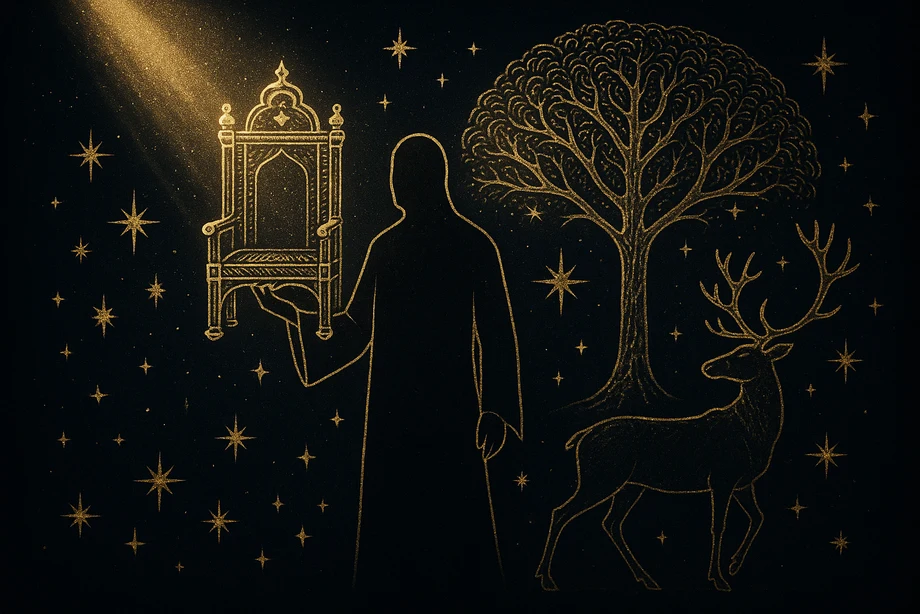
Ulgen's palace was above. In one telling he sat on the seventh layer of the sky, in another, older telling on the seventeenth. " A golden throne, the stars strung along his belt, a white reindeer at his side.
These images are not medieval iconography but details that emerged from the visions of the kams.
Bahaeddin Ogel says Ulgen had seven sons and nine daughters. The seven sons correspond to the seven directions and to seven stars; each one performs a heavenly task. The nine daughters are the guardians of mind, skill, and the arts; on the upward journey the kams call on some of them in particular.
This crowded family is not like the tangled kinship network of the Greek Olympus. It is more like a heavenly structure of offices, a bureaucracy of light.
Ulgen himself rarely intervenes directly. He has set up the structure and then taken his place. The kam's journey passes through this structure.
The seven layers, or seventeen, are crossed one by one; at each layer there is a gate, at each gate a payment: incense, milk, a horse hair, a piece of white silk. The kam who reaches the highest layer kneels before the golden throne.
The blacksmith cult and the maker's extension
In Turkic mythology the blacksmith was not merely a craftsman. In the epic of Ergenekon, it is the blacksmith who melts a mountain and opens a way out of the closed valley. In the epic of Oghuz Khan, the blacksmith forges the kagan's weapon and is also an instrument of the lineage's growth.
Bahaeddin Ogel says the blacksmith in Turkic-Altai tradition was counted as Ulgen's extension on earth. The blacksmith works with fire; fire is the light come down from the sky; the blacksmith gives that light a form.
As Eliade describes in detail in his "Blacksmiths and Alchemists," the blacksmith was placed in the same class as the shaman. Both stood between the visible and the invisible. As the kam called the spirit, the blacksmith called the ore.
Both gave form to what had none. This is why among the old Turks the smith's forge was something like a temple; words spoken and steps taken there followed strict rules.
The white reindeer stands beside Ulgen. The reindeer is one of the oldest animal companions of northern Eurasian shamanism; it was believed to be able to fly. In a vision the shaman takes the form of a reindeer and climbs the layers of the sky. To see one beside Ulgen's throne is also a picture of how the kam reached him.
From seed to fruit within us
What does Ulgen say to us today? His astrological echo is the Sun and Jupiter, one the ruler of essence, the other of growth. The match is fitting, because Ulgen is the very principle that governs the turning of a seed into a fruit.
The Ulgen within us is the capacity to give a form to an idea. To finish what was begun, to turn a draft into a structure, to bind a dream to a daily practice. Ulgen is not in a hurry; he carries the calm flexibility that knew how to turn Erlik's spat-out earth into a mountain.
Creative discipline is his domain. Inspiration is a moment, form is a process, and he is the bridge between the two.
His shadow is perfectionism and rigidity. When Ulgen energy hardens, it wants everything to be flawless enough to suit the golden throne, and cannot tolerate the raw, messy, mortal side of life. Yet the myth itself prevents this.
Ulgen is incomplete without his brother Erlik. The real ripening of creative discipline is not the attempt to make everything perfect, but the willingness to give form while accepting the form's limit. The golden throne suits someone who knows the boundary.
The voice within
Yapıcılığın, formlandırmanın ve hayata getirme kapasitesinin arketipi. Bir fikri tohumdan meyveye taşıyan iç güç. Modern okumada yaratıcı disiplinin koruyucusudur.
"Ülgen yukarıda altın tahtta oturur, yıldızları kuşağına dizmiştir, ışığı yere salar." Altay şaman ilahisi.
Sources: Altay Yaratılış Destanı, sözlü gelenek · A. V. Anohin, Altay Şaman Duaları Derlemesi · Bahaeddin Ögel, Türk Mitolojisi · Ergenekon Destanı · Oğuz Kağan Destanı · Mircea Eliade, Demirciler ve Simyacılar
You can ask a question about this reading
Hypatia (Bilge Astrolog) answers your questions about Ülgen