
Hayat suyu, dilek, gizli yardımcı
Archetype: Görünmeyen yardımcı
A servant from the Cave chapter, and the Hızır of folk life
Hızır's trace comes not from a single source but from three layers at once. The first is the Cave chapter of the Qur'an; in verses 60 to 82 the story is told of a "servant" said to have met the prophet Moses, whose name is not openly given. This servant will teach Moses things he does not know.
The classical exegetical tradition, beginning with Tabari and Razi, interpreted this servant as Hızır, but the Qur'anic text itself does not name him.
The story is short and surprising. Moses sets out with this servant. They pierce a ship, they kill a child, then they repair a wall.
Each time Moses objects, since everything he sees looks like injustice. In the end the servant tells the hidden reasons for the three events: the ship was pierced so it would stay disabled and a cruel king could not seize it; the child, when grown, would have hurt his parents; under the wall lay the treasure of two orphan children. The lesson of the story is this: everything that happens has an unseen side, and its reasons are not always what reason perceives.
The second layer is folk tradition. In the folk stories of Anatolia, the Balkans, Iran, and Central Asia, Hızır is the figure who helps a person in distress. A villager loses his way in a snowstorm and a man on a white horse appears; a sick person is hopeless and an old man comes, offers water.
Hızır is not recognized at the moment he is seen; he is understood afterward. With his green cloak, his white beard, his gentle gaze.
The third layer is the Hıdırellez tradition. The night of the 5th to the 6th of May is, in folk belief, the night when Hızır meets the prophet Elijah once again. On that night wishes are made, children leave their written wishes under a rose tree, people dance, and they jump over fires.
Hıdırellez is not only an Islamic practice; it is the common spring festival of Turkish, Kurdish, Roma, and Balkan peoples, and its root reaches into pre-Islamic spring traditions, even into the return rites of Tammuz in Mesopotamia.

The one who meets Elijah and tastes the water of life
At the center of the Hızır tradition stand two mysteries: immortality and meeting. Islamic mysticism and folk story say that Hızır drank from ab-i hayat, the water of life, and for this reason continues to abide within the flow of time. This motif is very old; the herb of immortality of Utnapishtim in the Sumerian epic of Gilgamesh, the nectar and ambrosia of ancient Greece, the amrita of the Indian tradition are different names for the same longing.
In one account Alexander the Great (Iskandar Dhu al-Qarnayn in Qur'anic naming) searches for the water of life; Hızır is his companion on the road. Both reach the water, yet only Hızır drinks. So Alexander dies and Hızır stays.
In Rumi's Mathnawi, in the divan of Yunus Emre, in the velayetname of Hacı Bektaş, there are countless references to Hızır. In Sufism he is the name of a rank, the symbol of the ripened sage who knows, senses, and helps the unseeing.
Elijah is another prophet, called Eliyahu in the Hebrew Bible; he too is said not to have died, because he was taken up into heaven. In Islamic folk tradition Hızır is the protector of the land and Elijah the protector of the sea. The two meet once a year on the night of the 5th of May.
The word Hıdırellez itself comes from the joining of Hızır and Elijah. In folk story the place they meet is under a rose tree, and the wishes left there are accepted.
This myth is not a dry legend but a practice alive in modern life. In Anatolian villages people rise early on the morning of the 6th of May, gather dew, sacrifice a lamb, visit the graveyard, write wishes on stones, paper, or leaves. Hıdırellez stands on the UNESCO list of Intangible Cultural Heritage.
The green cloak, the water, and the rose tree
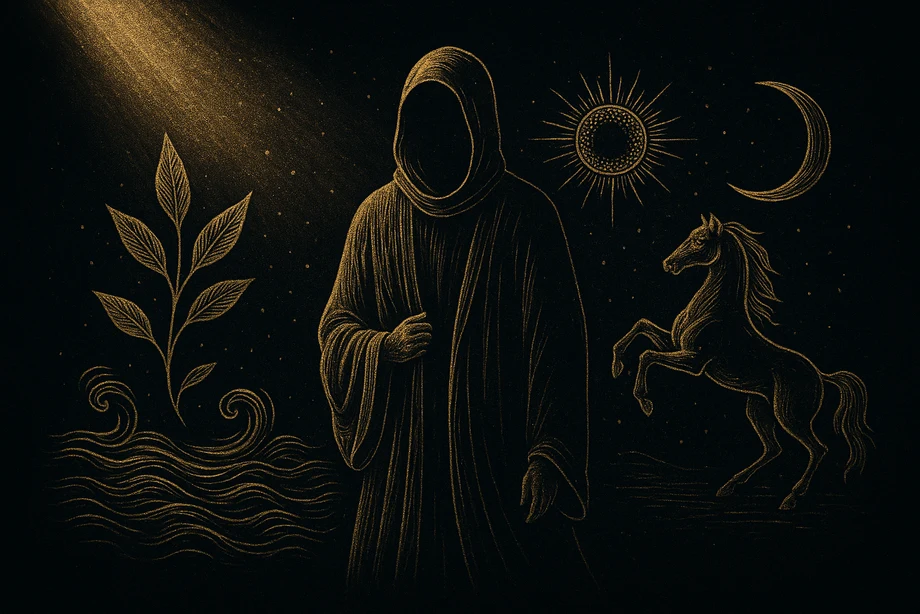
Hızır's symbols themselves carry a message. The green cloak is the color of spring, of the fresh leaf, of the earth that comes back to life. " Where he touches greens, the dried leaf sprouts, the barren ground gives yield.
In folk stories the grass is said to grow again where Hızır has sat down.
Water is his steadiest symbol. The motif of the water of life is bound up with him, yet beyond that, in folk tradition Hızır appears at springs, beside fountains, on riverbanks. In one tradition there is a saying that "Hızır taught an unlettered woman the Qur'an by the seashore." Water carries both life and knowledge.
The white horse is, in folk story, Hızır's mount. A villager lost in a snowstorm sees in the plain a rider on a white horse who unexpectedly draws near, and only after the night has passed does he understand that the rider was Hızır. The horse, as with Sabazios, is the animal of passage.
The rose tree is the center of the Hıdırellez night. In folk belief, wishes left on a branch of the rose that night come true. Across much of Anatolia until today, small wishes have been written on tiny papers and tied under the rose tree, and in some places small stones and symbolic objects have been placed at the root of the rose: someone who wants a house places a small model house, someone who wants to marry places a ring, someone who wants work places a coin.
The modern equivalent of the unexpected helper
What does Hızır say today? In astrology he touches the meaning-seeking face of Jupiter in Sagittarius, the intuitive flow side of Neptune in Pisces. But it would be unjust to bind him to a single planet; he is more a principle.
The Hızır within us is the intuitive faith that unexpected help will come. The name of the feeling that when one door closes another will open. Modern Jungian psychology has a very close equivalent for this: synchronicity, the meaningful coincidence.
When Carl Jung introduced this concept in 1952, what was he after? " The Hızır tradition can be read as the Anatolian form of synchronicity.
An important note: the Hızır tradition does not impose a single religious truth. In the Islamic layer he is a saintly figure, in Sufism a rank, in folk tradition a protector; in the Bektaşi and Alevi traditions he overlaps with Gabriel, with Ali, even with local ancestors. The question "who is he" is perhaps the wrong question.
The question "how does he act" is more accurate: he helps the one in distress, unseen, and then withdraws.
The real lesson of the myth is this: help does not always come in the form you expect. It may be a phone call, the glance of a stranger, a sentence rising from a book that opens to a page, a branch on which a bird alights. Hızır comes, is not recognized at the moment he is seen, is understood once he has passed.
In a modern reading, to be open to Hızır energy means to walk with eyes not closed. Sometimes help arrives, but we have to open a small door for it. Writing a wish under a rose tree on the night of Hıdırellez is still meaningful; a myth does not die, it only moves.
The voice within
Beklenmedik anda gelen yardımın, sezgisel rehberliğin ve umulmadık kavuşmanın arketipi. İnsan zorlandığında bir kapının açıldığına dair imanın sesi. Modern okumada synchronicity'nin Anadolu hâlidir.
"Hızır geçer hayat suyundan, bilen bilmeden, yeşil giyer, ak ata biner." Bektaşi nefesi, sözlü gelenek.
Sources: Kur'an, Kehf suresi, ayet 60-82 · Taberi, Câmiu'l-beyân (klasik tefsir) · Fahreddin Razi, Mefâtîhu'l-Gayb · Mevlana, Mesnevi-i Şerif · Yunus Emre Divanı · Velayetname-i Hacı Bektaş Veli · Anadolu Hıdırellez sözlü gelenek derlemeleri · UNESCO Somut Olmayan Kültürel Miras kayıtları, Hıdırellez · Carl Jung, Synchronicity: An Acausal Connecting Principle (1952)

You can ask a question about this reading
Hypatia (Bilge Astrolog) answers your questions about Hızır