
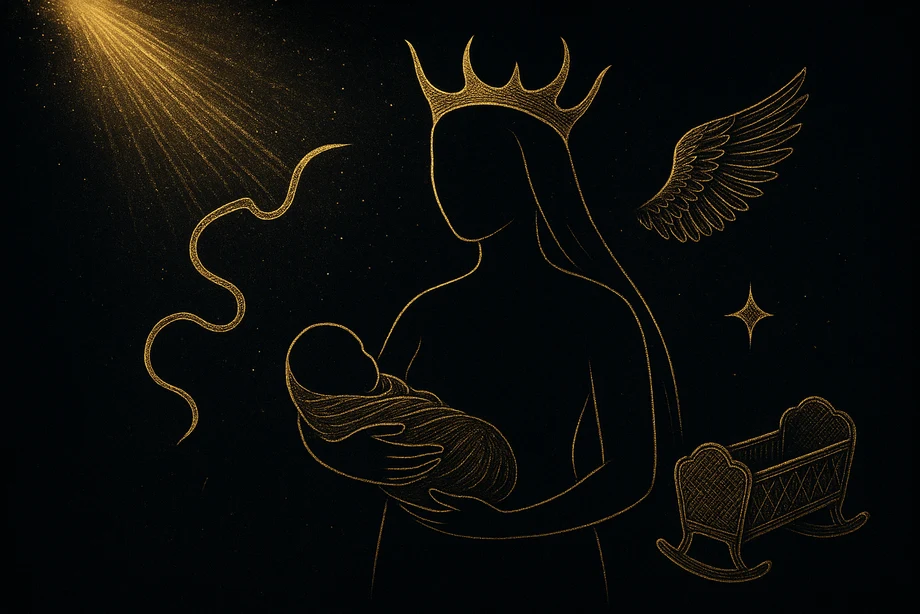
Doğum, çocuk, koruma, dişil bereket
Archetype: Koruyucu ana
Named beside Tengri
It is rare for a goddess's name to be carved in stone in the written sources of Turkic mythology. Umay's name is carved. " Tengri and Umay, the sacred land and water, granted favour to the kagan and the people.
In the 8th century a ruler announcing his victory names two together: Tengri and Umay.
As Bahaeddin Ogel notes in his compendium, this side-by-sideness is not a marriage but a completion. Tengri is the boundless span; Umay is the principle that flows out from within that span into the fresh form of life. To say that one is the sky and the other the womb leaves the mythic language too schematic.
More accurately, Umay is the interface where Tengri's blessing turns into a living body.
The word itself says it. In old Turkic, umay was also the name given to the afterbirth, the placenta still attached to the umbilical cord. The goddess shares her name with the very tissue that makes a birth possible. The myth hides a concept inside a body.
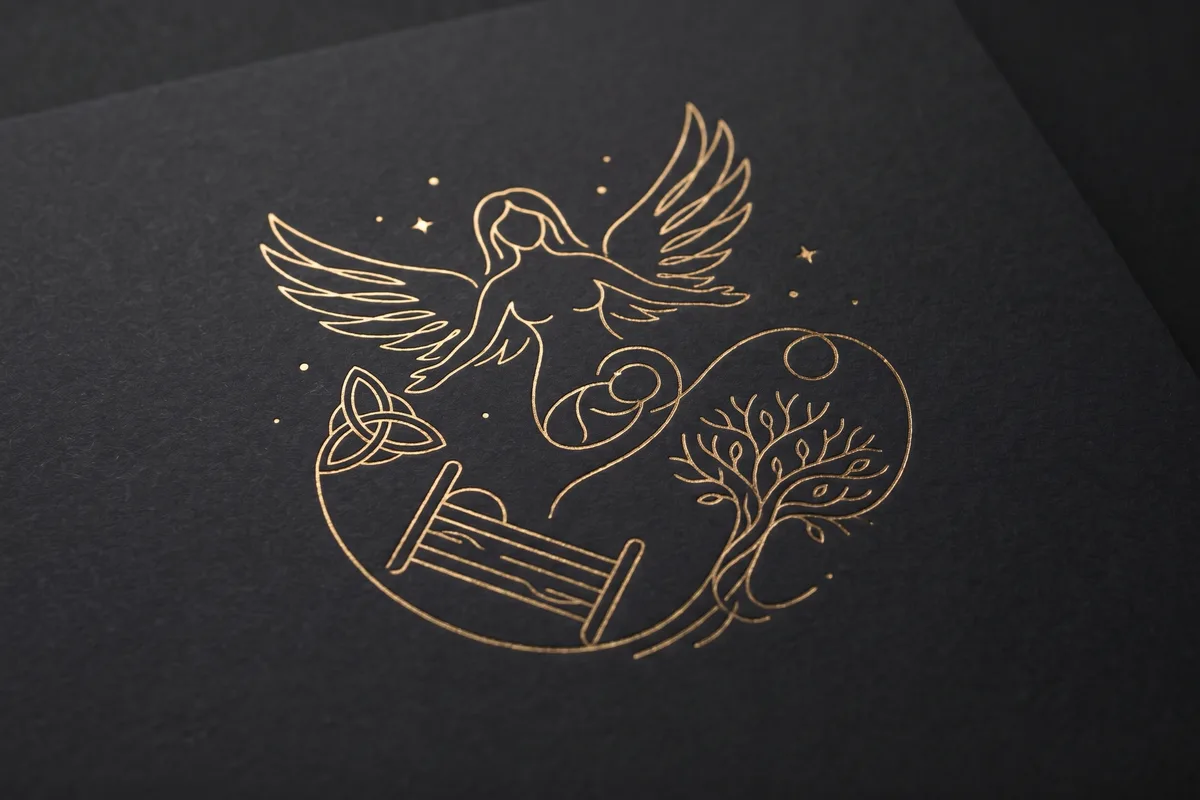
The mother at the head of the cradle
In folk telling Umay steps out of concept and suddenly stands at the bedside. In the Altai, Khakas, Tuvan, and Kyrgyz traditions, she is said to be beside a newborn child. If the baby laughs in its sleep, Umay is playing with it. If it cries, Umay has been hurt for a moment. For forty days she drives evil spirits out of the room.
" The three-horned crown is her special image, and she is often named alongside the figure of a bird. The bird's wing is the way souls come and go, and the soul of a child settles onto the body in the lightness of that wing.
In some versions of the epic of Manas, Manas's mother Chiyirdi calls on Umay during the pains of labour, and the hero's birth passes through her hand. " In one tale Dirse Khan's wife had been pleading for a child for years; the language of the prayer changed, the reflex remained.
On hilltops hung with cloth and on milk-coloured stones
The cult traces of Umay's worship have stayed in the open air. In southern Siberia, in the steppe of Khakassia, small swaddling cloths, pieces of a cradle, and white kerchiefs are still tied to milk-coloured rocks. By tradition a woman without children hangs a piece of white felt on this stone and asks Umay for her wish.
Eliade, in his "Shamanism," says that this kind of stone and tree cult is the oldest layer of the fertility principle, the one that comes before any institutional temple.
Another trace lies in the "ribboned hills" of every corner of Anatolia. Pieces of cloth tied to the branches of a wishing tree, the cradles rocking at a saint's tomb, the song of a grandmother counting a baby's first seven steps. After Islam most of these textures interlaced with Mother Fatma, Hizir, or with local saints.
Yet as Bahaeddin Ogel observes, the underlying layer of practice has remained surprisingly faithful to Umay: the protecting feminine energy, the prayer around the cradle, the wild rue burnt against the evil eye.
In the east of the Turkic world the transformation is less thick. In Kyrgyzstan, in the Altai, in the Republic of Tuva, Umay is still Umay. The little three-horned figure hung on the cradle of a newborn still carries an image a thousand years old, unbroken.
The soft hand within us
What does Mother Umay say to us today? Her astrological echo moves between the Moon and Venus, which is natural since one rules inner nourishment and the other value and aesthetics. But the myth points beyond planetary language.
The Umay within us is the capacity to extend a soft hand to oneself and to another life. The patience shown to a child, the hour given to someone who is ill, the silent touch placed on a wound. Self-compassion is another name for this energy: to stand without hardening before the fragile part of yourself, the part that has not yet taken form, the part that is still growing.
Her shadow is when softness slides into surrender. When Umay energy loses its balance, she approves every demand in the name of protection, places another's need above her own limit, confuses motherhood with self-erasure. The myth speaks more subtly.
In the inscription Umay stands beside Tengri, she is a principle that knows the span. To protect is to know the boundary. The soft hand is soft because it recognizes the frame.
The voice within
Doğurganlığın, koruyuculuğun ve içsel beslenmenin arketipi. Bir çocuğun gelişine eşlik eden, doğumdan sonra başucunda kalan dişil enerji. Modern okumada öz-merhamet ve içsel yumuşaklığın sesidir.
"Tengri Umay, kutsal yer-su, kağanı, milleti yarlıkadılar." Bilge Kağan Yazıtı.
Sources: Bilge Kağan Yazıtı, kuzey yüzü · Bahaeddin Ögel, Türk Mitolojisi · A. V. Anohin, Altay Şaman Duaları Derlemesi · Manas Destanı, Kırgız sözlü gelenek · Dede Korkut Kitabı, Dresden ve Vatikan nüshaları · Mircea Eliade, Şamanizm: İlksel Esrime Teknikleri

You can ask a question about this reading
Hypatia (Bilge Astrolog) answers your questions about Umay Ana