
Yeraltı, dönüşüm, yeniden doğuş
Archetype: Ölüp yeniden dirilen kral
The good king, the grain god
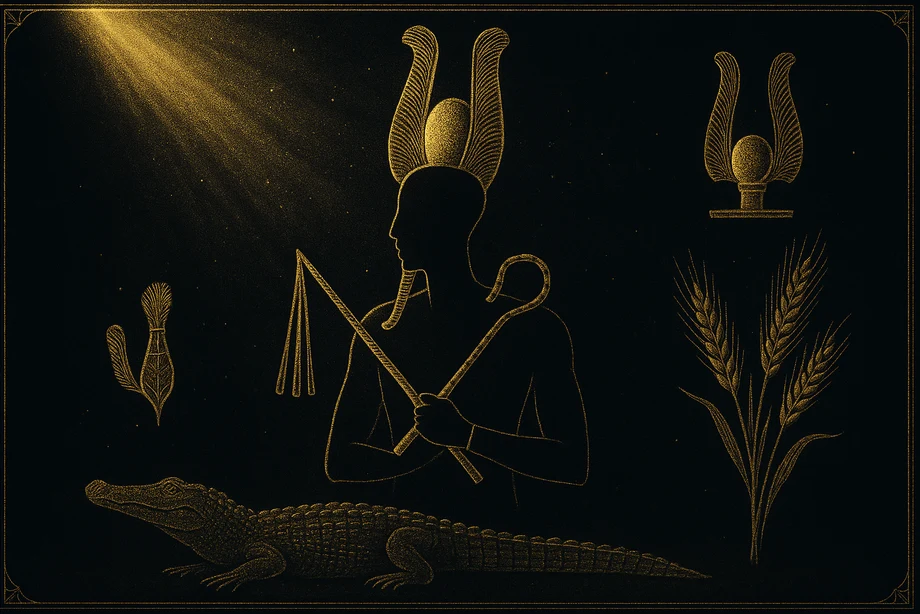
Osiris's Egyptian name, pronounced Wesir or Asar, has a meaning that is still debated. Many readings translate it as "the powerful one" or "the famous one." But for the Egyptian, his real name was grain.
In the second book of his Histories, Herodotus writes that the Egyptians held Osiris the greatest of the gods, and would not even speak his name openly. Diodorus Siculus, writing in the first century BCE, describes Osiris as a culture hero. By his account Osiris was the king who civilized Egypt.
He taught his people farming, showed them how to make wine from grapes and bread from wheat. He gave them law, worship, and music. Then he travelled the world with an army, but without weapons, teaching the planting of crops through music and song.
Something is worth noticing in this portrait. Osiris was not a war god. His throne was in the field, his word in the seed. For the Egyptian, the measure of a king was not how many borders he conquered, but what he made grow in his country.
Trapped in the coffin, scattered, gathered
Then the story turns into darkness. In the version Plutarch compiled, Set, his brother, grew envious of his success. He held a banquet and had a magnificent chest brought in, made of fine wood, sized to fit exactly one person.
Set issued a challenge to the guests: whoever fit the chest perfectly would own it. Several tried, none fit. When Osiris lay down the chest fit him exactly, because it had been made to his measurements.
Set and his men shut the lid, sealed it with lead, and cast it into the Nile.
The chest drifted out to sea, reached the shore at Byblos, and was lost there in the trunk of a tree. Isis found it and brought it back. But Set seized the body again, and this time cut it into fourteen pieces, scattering them across Egypt.
Isis and Nephthys gathered every piece. There is another reading of this story: because the pieces of Osiris were scattered across Egypt, each region of the country could be considered one of his tombs, with Abydos foremost among them.
The gathered body was embalmed by Anubis, and this is considered the first mummification in Egypt. When Isis breathed life into him with her wings, Osiris returned, but not to what he had been. He no longer reigned under the sun above, but in the land of the dead below, in the Duat.
This distinction matters: Osiris did not come back to life, he passed into another life.
Abydos and the one on the other side of the scale
The greatest temple of Osiris was at Abydos in Upper Egypt. The Egyptians believed this was the place where his head had been buried. For centuries many kings had their tombs or memorial monuments built as close as possible to Osiris, because to lie near him was a blessing in itself.
Each year a mystery play was staged at Abydos, with the death and resurrection of Osiris re-enacted by performers. This rite can be called the oldest theatre of Egypt.
Chapter 125 of the Book of the Dead describes the scene in the hall of Osiris. The heart of the dead person is placed on one pan of a balance, and the feather of truth of Maat on the other. If the heart is heavier than the feather, if the weight of a life has become unbearable, the heart falls into the jaws of Ammit.
" Osiris is the judge in this scene, but not a frightening one. He is the one who has himself walked the same path. He sits on his throne, above, but he understands the condition of the dead, because he too was once torn apart.
In his depictions as a mummy his skin appears green. Green, for the Egyptian, was the color of the shoot, the color of the seed. Osiris is green because he is the seed, the one who is buried and rises again.
Not the one who dies but the one who is sown
What does Osiris say to us today? His story is the oldest pattern of the "dying and rising god" in the ancient world, and from him a current flows toward Adonis and Dionysus in the Greek world, and toward Tammuz in the Near East. Frazer's Golden Bough discusses this motif at length. But Osiris is both the oldest and the most graceful example of the pattern.
The Osiris within us is the voice that reminds us what we thought was an end is in fact a transformation. When we feel that a relationship has ended, that a career has been cut short, that a dream has slipped from our hands, Osiris is at work. He does not tell us not to mourn.
He himself was torn apart, and his wife gathered him in long mourning. Grief is a part of his story.
But what he tells us is this: like a seed that is buried, what is lost can continue somewhere, in a different form. Osiris lost the kingdom above and gained the kingdom below. For us too, sometimes losing something means taking up the kingdom of something else. The green skin recalls it: decay is not an end, it is a soil, the preparation of a fresh shoot.
The voice within
Çürüme ve yeniden filizlenmenin arketipi. Bir kimliğin sona erdiği ve yenisinin tohumunun atıldığı eşik anı. Modern okumada burnout, boşanma, büyük kayıp gibi yeniden yapılanma süreçlerinin sembolüdür.
"Çürümeyeceğim, dağılmayacağım. Buğday gibi yeniden yeşil olacağım." Ölüler Kitabı, Bölüm 154.
Sources: Plutarkhos, Isis ve Osiris Üzerine · Ölüler Kitabı, Bölüm 125 (Kalbin Tartılması) · Piramit Metinleri · Diodorus Siculus, Tarih Kütüphanesi I · Heredot, Tarihler II · Abydos Tapınağı yazıtları

You can ask a question about this reading
Hypatia (Bilge Astrolog) answers your questions about Osiris