
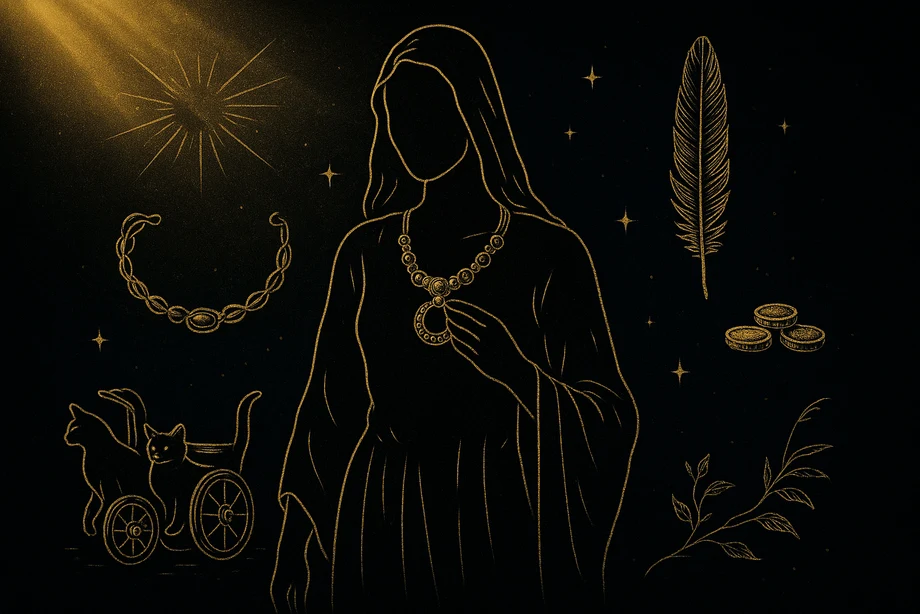
Aşk, savaş, seiðr büyüsü, ölüler
Archetype: Sınır tanımayan dişil güç
Vanir blood at the Aesir's table
The old Norse pantheon was not made of a single family. There were two: the Aesir and the Vanir. As Snorri tells in Gylfaginning and Skáldskaparmál, and the Poetic Edda echoes in Völuspá, the two families fought a war and then made peace.
The peace was sealed with hostages. The Vanir sent their own gods, the sea-god Njörðr and his twin children Freyr and Freyja, to live among the Aesir.
Freyja thus belonged to two worlds at once. She carried Vanir blood, which meant she came from the gods of abundance, sea, and old earth. Yet she lived in Asgard among the Aesir.
" Centuries later, when Christian missionaries tried to be rid of her, the title lived on in everyday speech: German Frau, Old English Frowe.
Whenever Snorri mentions her he adds a note: "Freyja is the most honored among the goddesses," he writes in Gylfaginning. People prayed to her at weddings, at births, in matters of love. But these were not her only domains.
Brisingamen, Sessrúmnir, half of the slain
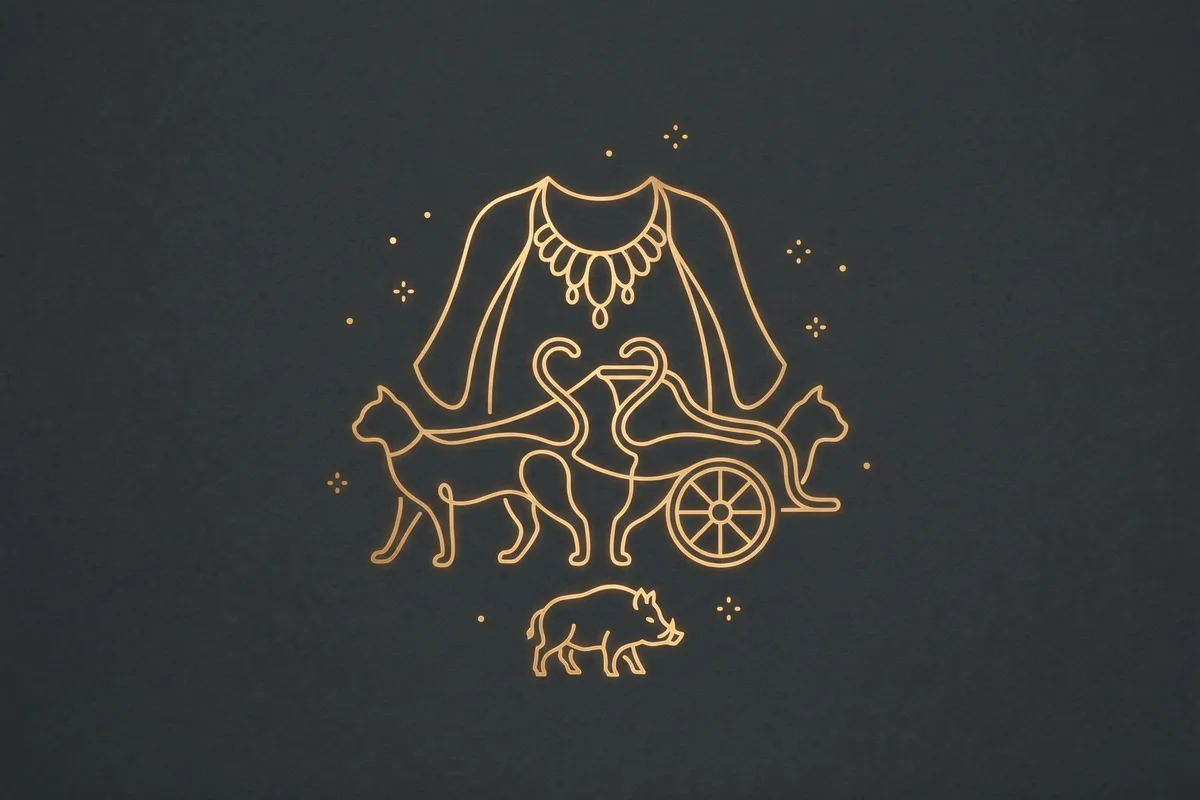
Freyja's most famous jewel was Brisingamen, a gold necklace forged by four dwarves. Snorri, and the later Sörla þáttr, tell how she came to own it. The goddess wanted the necklace no matter the cost, and she struck a deal with the dwarves.
The myth does not carry a judging tone here. Freyja is willing to pay any price to reach what she truly desires, because in her world claiming your own desire is nothing to be ashamed of.
She traveled the skies in a chariot pulled by two cats. Snorri gives this detail in Skáldskaparmál. She owned a cloak of falcon feathers that turned its wearer into a falcon; Loki borrowed it once. The name of her hall was Sessrúmnir, "the wide-seated."
Here is a less known but very important turn of the myth. " Valhalla is not, as is often imagined, the only destination for those who fall in battle. Half go to Odin's hall, half to Freyja's Sessrúmnir.
The figure we remember as a goddess of love is also the mistress of half the warrior dead. If this troubles us, the problem is not with the myth but with our own habit of separating love from war.
Freyja was also the master of the magic called seiðr. In Ynglinga saga, the opening of Heimskringla, Snorri says it was she who taught the Aesir this magic. Seiðr had to do with prophecy, with fate, with steering of souls, and was traditionally the domain of women.
Even Odin learned it from her, though for a male god to practice seiðr stood at the edge of taboo; in Lokasenna, Loki mocks Odin for exactly this. Freyja thus links to an older line of female knowledge, a shamanic feminine thread.
Crocus, cat, and Friday
The concrete evidence of Freyja's worship is hidden in place names. Scores of villages, farms, and groves in Scandinavia carry her name, concentrated especially in southern Sweden. For scholars of place names this proves her worship was widespread. Snorri also lists the titles by which she was invoked: Hörn, Mardöll, Gefn, Sýr, each naming a different face.
Her symbols are graceful but sharp. The cat is not the animal of softness; it is the animal of feminine wildness that walks alone. Gold is at once her wealth, and according to Snorri her tears turned to gold, because when her husband Óðr disappeared she searched for him across the world, and every fallen drop was made of it.
The poem Hyndluljóð recalls this grief. The myth shows the goddess of love not only as a lover, but as a woman who has known loss and search.
The Scandinavian week carries her name. Old English Frigedæg, Old Norse Frjádagr, modern English Friday. Scholars argue whether the name comes from Frigg or Freyja; it is certain the two were sometimes blended in popular practice.
Through the Christianization, priests tried to demote her by turning her into a witch. They did not succeed. The folk did not forget her.
Owning your own desire
What does Freyja say to us today? In astrology she answers most directly to Venus, but her Venus has more than one layer. The concrete bodily pleasure of Taurus and the intense, life-and-death pull of Scorpio both belong to her. Goddess of love, yes, but also the figure who takes half of the slain, who works magic, who fights.
The Freyja within us is the part that can own its own desire. The voice that knows what it wants, is not ashamed to say so, and is willing to pay the price. Read with modern eyes the Brisingamen story might seem morally questionable, but the morality of the myth is not ours. The myth says: the one who pays the cost of desire is the one who owns the desire.
A warning travels with her too. Freyja's grief is real. When she lost Óðr she walked the world and wept tears of gold.
To own your own desire does not mean to avoid loss. On the contrary, the one who truly desires also learns how to truly mourn. In modern reading, Freyja recalls an older wholeness belonging to women, and to the feminine in any body: love, war, knowledge, grief, can all stand in the same person.
We do not have to pick one and cut off the others. The myth does not cut them off.
The voice within
Aşkı, savaşı ve büyüyü aynı bedende taşıyan dişil arketip. Hem zarif hem güçlü, hem cömert hem talepkâr. Modern okumada kendi arzusuna sahip çıkan kadının sesidir.
"Freyja savaşta ölenlerin yarısını kendi salonu Sessrumnir'e götürür, diğer yarısı Odin'e gider." Snorri, Düzyazı Edda, Gylfaginning 24.
Sources: Snorri Sturluson, Düzyazı Edda (Gylfaginning, Skáldskaparmál) · Snorri Sturluson, Heimskringla (Ynglinga saga) · Völuspá, Şiirsel Edda · Hyndluljóð, Şiirsel Edda · Lokasenna, Şiirsel Edda · Þrymskviða, Şiirsel Edda · Sörla þáttr (geç dönem İzlanda metni)
You can ask a question about this reading
Hypatia (Bilge Astrolog) answers your questions about Freyja