
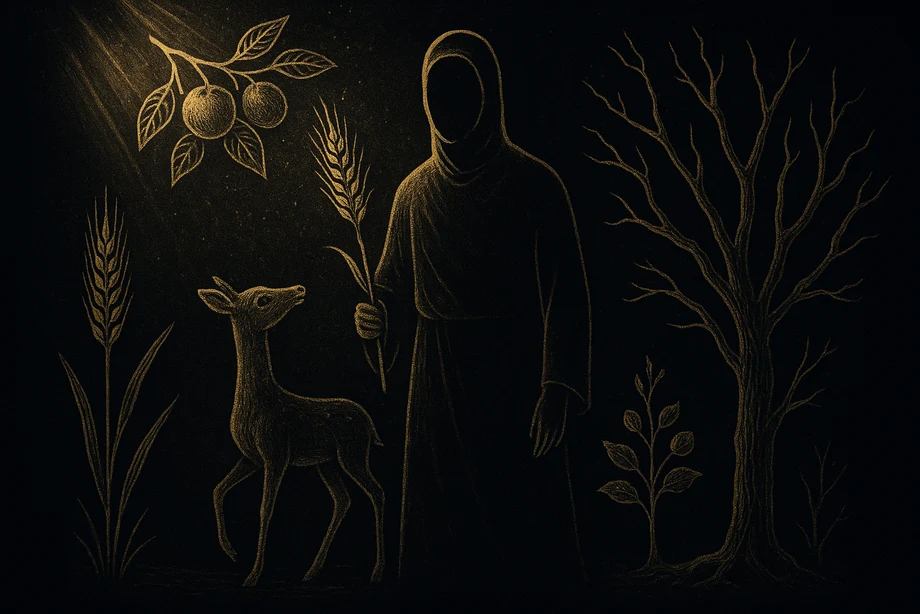
Tarım, mevsim, kayıp ve dönüş
Archetype: Kaybolan ve geri dönen yaşam
A myth lifted from the tablets of Hattusa
Telipinu's story comes to us in writing through the cuneiform tablets found at Boğazköy, the archives of ancient Hattusa. The tablet dates to the fourteenth century BCE, the mature period of the Hittite Empire. Written in the Hittite language, it is catalogued today as KUB XVII 10 with parallel fragments. In academic usage it is called the Telipinu Myth.
Telipinu is, in the Hittite pantheon, the son of the storm god Tarhunna. Tarhunna is the god of thunder and rain, protector of the land. Telipinu is the god of agriculture, of grain, of the seasonal yield. Father and son together keep life going: one sends down the rain, the other greens what the rain touches.
The myth begins in an unusual way. The tablet says that one day Telipinu rose up in anger. Why he grew angry is not entirely clear, because that part of the tablet is broken.
Perhaps an offering had been forgotten, perhaps some disrespect had been shown. What matters is this: the god stood up, in his haste put his sandals on the wrong feet, and walked out. Right sandal on his left foot, left sandal on his right.
The departure was so hurried that even his footing was not measured.
The drying of the earth and the bee's finding
After Telipinu withdrew, everything came to a halt. The tablet describes this with a poetic repetition. Wheat did not put forth ears, barley did not ripen.
Wood smoked in the hearths but the warmth inside them was gone. Flocks did not give birth; those that gave birth would not look at their young. Human mothers did not nurse their children.
Even the gods could not be filled at their own tables. Life seemed to continue, but its inside was empty.
The gods gathered and set out to look for Telipinu. First the sun god sent an eagle. The eagle scanned every mountain and every plain; it did not find him.
Tarhunna, his father, went out himself; he too did not find him. At last the great goddess Hannahanna, the "Great Mother," called a bee. The gods looked down on the bee.
Hannahanna held her ground: the small sometimes reaches what the great cannot.
The bee flew long, and finally found Telipinu sleeping in a meadow near Lihzina. The bee stung the god on his hand and his feet and woke him. When Telipinu woke, his anger flared anew; he stopped the rivers, threw down houses, brought down an even greater calamity.
The bee had only made him worse. The problem was that forcing a withdrawn god back did not work.
Kamrusepa's rite, the right kind of call
Here the tablet does something extraordinary: while telling a myth it turns into a recipe for a rite. The goddess Kamrusepa, the Hittite goddess of magic, healing, and purification, steps in. To take away Telipinu's anger she prescribes a rite. For a modern reader this rite is almost a choreography of therapy.
Kamrusepa first sets sweet things before the god: honey, grapes, figs, dates. " Then a resin-burning cauldron is lit; the god's ill mood is poured into the cauldron and sent under the earth.
Then Telipinu's sandals are placed on the right feet. Right sandal on the right foot, left sandal on the left. This small detail is perhaps the most beautiful moment in the myth: once he has answered the call, the god is realigned.
In the end Telipinu calms and returns. The tablet tells his return this way: an eagle beat its wings, Telipinu gave life back to the king and the land; the earth greened, flocks gave birth, hearths grew warm again.
In Hittite ritual this myth was most likely recited in times of drought, in seasons of famine. The myth was not a story but a recipe: the choreography of calling back life that had withdrawn.
The lesson of a god with sandals on backward
What does Telipinu say today? In astrology he touches the order-making face of Mercury in Virgo, the root abundance of Venus in Taurus. But the myth itself carries a very modern psychology.
The Telipinu within us is the feeling that at some point life pulls itself back. The name for depressive withdrawal, for lost motivation, for the inner drought whose reason cannot be named. In modern language we call it burnout, or mild depression, or creative block.
The myth does not judge this state. Telipinu is not a guilty god, only a withdrawn one. Sometimes life puts its sandals on the wrong feet and walks out.
The real lesson of the myth is in the method of return. Forcing does not work. His father searched and could not find him, the eagle searched and could not find him, the bee found him but made things worse by stinging.
The return came only through the right rite, through Kamrusepa's soothing ceremony. Offer your life honey, the tablet said. Realign what is out of place.
Do not hurry.
In a modern reading this means: when you withdraw, do not chase yourself. Make room for sweet things. Return to the rhythm of your body.
If your sandals are on backward, first notice them, then correct them. Like Telipinu, you too come back when you hear the right call. The earth sulks as much as it sulks, and then it wants stubbornly to green again.
That is what a Hittite tablet has been saying for three thousand years.
The voice within
Çekilmenin, küsmenin ve geri dönüşün arketipi. Bazen yaşam kendini geri çeker, toprak verim vermez, içsel bahar gecikir, ama doğru çağrıyla yine döner. Modern okumada depresyon ve yenilenme döngüsünün sesidir.
"Telipinu öfkelendi, sandallarını ters giydi, gitti. Buğday büyümedi, sürüler doğurmadı, tanrılar aç kaldı." Telipinu Mitos'u, Hitit tableti, M.Ö. 14. yy.
Sources: Telipinu Miti, Hitit tableti KUB XVII 10 · Hattuşa (Boğazköy) çiviyazılı arşivi, M.Ö. 14. yy · Kumarbi Döngüsü, karşılaştırma metinleri · Harry A. Hoffner, Hittite Myths (akademik çeviri) · Yazılıkaya kabartmaları, Hitit panteon ikonografisi

You can ask a question about this reading
Hypatia (Bilge Astrolog) answers your questions about Telipinu