
Yeraltı, ölüm, denge
Archetype: Alt dünyanın efendisi
Two brothers from the same water
In the most widespread Altai creation epic, in the beginning there was only a boundless water. No earth, no sky, no direction. Two beings moved across that water.
One was called Ulgen, the other Erlik. They were brothers. In one telling they came from the same egg, in another from the same drop of water, in another Ulgen looked into the water and drew Erlik out of his own reflection.
What all three versions share is that the two brothers exist from the very beginning. Erlik is not an enemy who appeared later to oppose a good god. He has been there since the first moment of being.
In the creation narratives V. M. Verbitsky and A.
V. Anokhin collected in the Altai in the 19th and early 20th centuries, the story continues. Ulgen asks for a handful of earth from the water, and Erlik dives down and brings it up.
Ulgen makes the surface of the world with this earth, lays down the mountains, plants the trees, calls the animals. Erlik does not stand idle either. He goes beneath the earth and builds his own world.
He descends nine layers, raises his own palace there, feeds his own horses, gathers his own men.
As Bahaeddin Ogel observes, this pairing resembles the Zoroastrian dualism of Ormazd and Ahriman, yet it works by a different logic. Erlik is not evil; he is below. His being is the precondition for there being an above.
The one who intervened in the making of the human
The most delicate moment of the creation epic comes in the shaping of the human being. Ulgen carves a body out of clay, but he cannot give it breath. In one telling, Erlik comes up beside him at that moment and says, "I will give it"; he blows a breath into the body.
But this breath is not pure; it carries the seed of death. In another telling Erlik is jealous of the body and spits on it before any breath has been given, and the body's mortality and limitation pass through that spit. In a third telling Ulgen cannot find the breath, goes to Tengri, and gets it from him, but on the way home Erlik secretly turns the body upside down, and that is why the human being lives sometimes by mind and sometimes by instinct.
All three versions say the same thing. The human came out of the cooperation and the struggle of two brothers. The upper side is Ulgen's, the lower side is Erlik's.
This is why a person is neither pure light nor pure shadow. Clay and breath, form and limit, life and death always lie side by side. The Turkic-Altai creation myth births the human not out of a mistake but out of an agreement of balance.
This is why Erlik also takes the human's life. From the beginning part of the body has already been his. Death is not a punishment, it is a recall.
The shaman's descent and the nine-layered earth
Mircea Eliade, in "Shamanism," describes how the Turkic-Altai kam travels in two directions. He climbs upward along the trunk of the tree toward Ulgen. He also descends downward toward Erlik, beneath the nine layers. Both are parts of the same ritual, because if only one is done the cosmos remains incomplete.
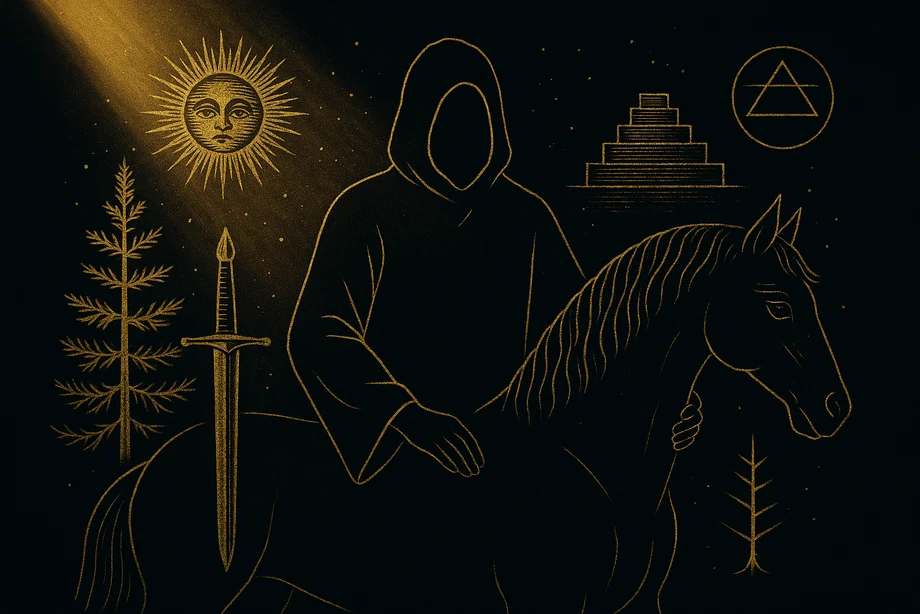
The downward journey is usually for saving someone who is ill. The patient's soul has been diminished; either an evil spirit has taken it, or it has lost its way, or Erlik has called for it. The kam, on a black horse, beneath a black pine, passes nine gates as he descends.
At each gate there is a guardian, at each gate an offering is given: milk, white felt, silver, horse hair. At the very bottom Erlik's black tent rises. He sits there beside his black horse, with his iron sword.
The kam bargains with him. " If Erlik accepts, the soul is returned. If he does not, the kam comes back empty-handed and the patient leaves this world.
The kam's work is not a fight, it is a serious negotiation. This is why Erlik is not frightening but serious. One speaks to him gently and with the right words.
The shadow that holds the balance within us
What does Erlik say to us today? His astrological echo is Pluto and Saturn, one the ruler of deep transformation and the other of limit and time. The match is fitting, because Erlik represents exactly what is refused yet indispensable.
The Erlik within us flows from the same bed as what modern depth psychology calls the shadow. Jung's concept alone does not say enough here. Erlik adds something more.
The shadow is not merely a repressed fragment, it is the second brother who holds the balance. Our fears, our anger, the appetite we cannot accept, our knowledge of mortality, all belong to his tent. To deny this leaves a person flat, shallow, fragile.
To recognize it ripens them.
The myth teaches us not to defeat Erlik but to approach him with the right words. When a loss happens, when anger rises, when a refused desire lifts its head, the kam within us is making his descent. We have to call out gently to the figure seated beside the black horse, offer our gift, recognize the boundary.
Erlik does not frighten. The one who is frightened is the one who refuses to listen to him.
The voice within
Bilinçaltı, gölge ve kabul edilmemiş olanın arketipi. İçimizdeki "ne olmamalı" diye reddedilen parça, ama dengenin onsuz kurulamadığı yer. Modern okumada gölge çalışmasının yöneticisidir.
"Erlik aşağı dünyanın hanıdır, dokuz katın altında oturur, ölüleri o teslim alır." Altay yaratılış destanı, sözlü gelenek.
Sources: Altay Yaratılış Destanı, sözlü gelenek · V. M. Verbitski, Altaylılar Üzerine · A. V. Anohin, Altay Şaman Duaları Derlemesi · Bahaeddin Ögel, Türk Mitolojisi · Mircea Eliade, Şamanizm: İlksel Esrime Teknikleri
You can ask a question about this reading
Hypatia (Bilge Astrolog) answers your questions about Erlik