
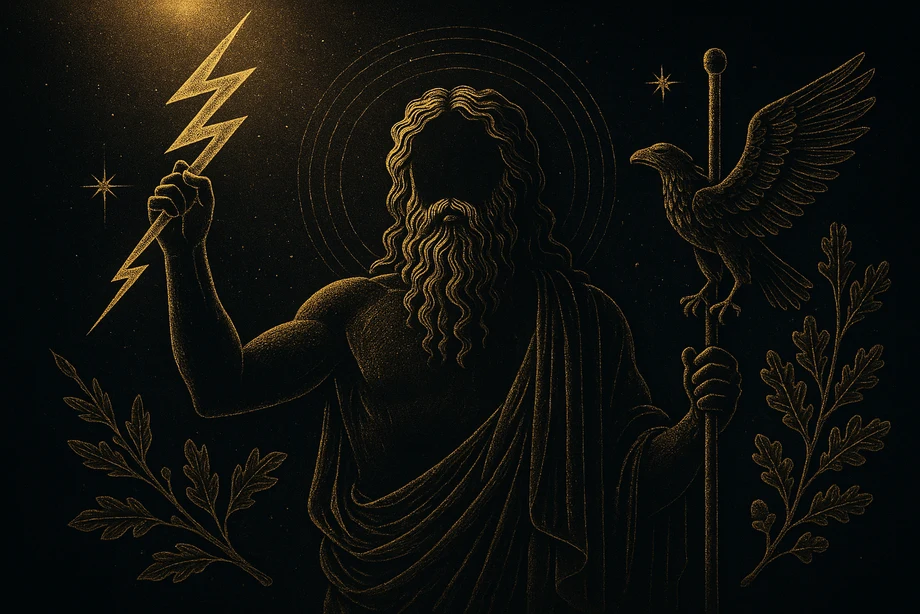
Gök, yıldırım, kozmik düzen
Archetype: Düzen kuran baba
The child who escaped being swallowed
It all begins with a fear. In Hesiod's Theogony, the Titan Kronos had overthrown his own father Uranos, and a prophecy that the same fate awaited him gnawed at him from within. So each time his wife Rhea bore him a child, he swallowed it. Hestia, Demeter, Hera, Hades, Poseidon, one after another they vanished into their father's darkness.
When Rhea was pregnant with the sixth child, she could bear it no longer. On the advice of Gaia, the Earth herself, she went to Crete and secretly gave birth to Zeus there, in a cave on Mount Dikte or Mount Ida. To Kronos she handed a stone wrapped in swaddling clothes. The father of the gods swallowed a rock without noticing a thing.
Zeus grew up in that cave. In one account the goat Amaltheia nursed him, while warriors called the Kouretes clashed their shields together to drown out the baby's cries so Kronos would not hear. The god of order began his life hidden behind a noise.
Ten years against the Titans, then the lots
When Zeus came of age, he first made his father disgorge what he had eaten. Through a trick (in some versions a drug given by Metis), Kronos brought everything back up: first the stone, then Zeus's siblings, all of them fully grown. The siblings were now an army.
Then came the Titanomachy, the ten-year war between the Olympians and the Titans. On Gaia's advice, Zeus descended into the depths of the earth, to Tartarus, and freed the Cyclopes and the hundred-handed giants who lay chained there. In return the Cyclopes gave him the greatest of weapons: the thunderbolt.
From that day, thunder was the voice of Zeus and lightning the tip of his finger.
The Titans fell. What came next is perhaps the most graceful moment in the myth. Zeus did not take the cosmos he had won for himself alone.
The three brothers cast lots: the sky fell to Zeus, the sea to Poseidon, the underworld to Hades. The surface of the earth and Olympus remained shared. Order began in the hands of a power that knew how to divide what it had.
God of law, with his hidden chaos
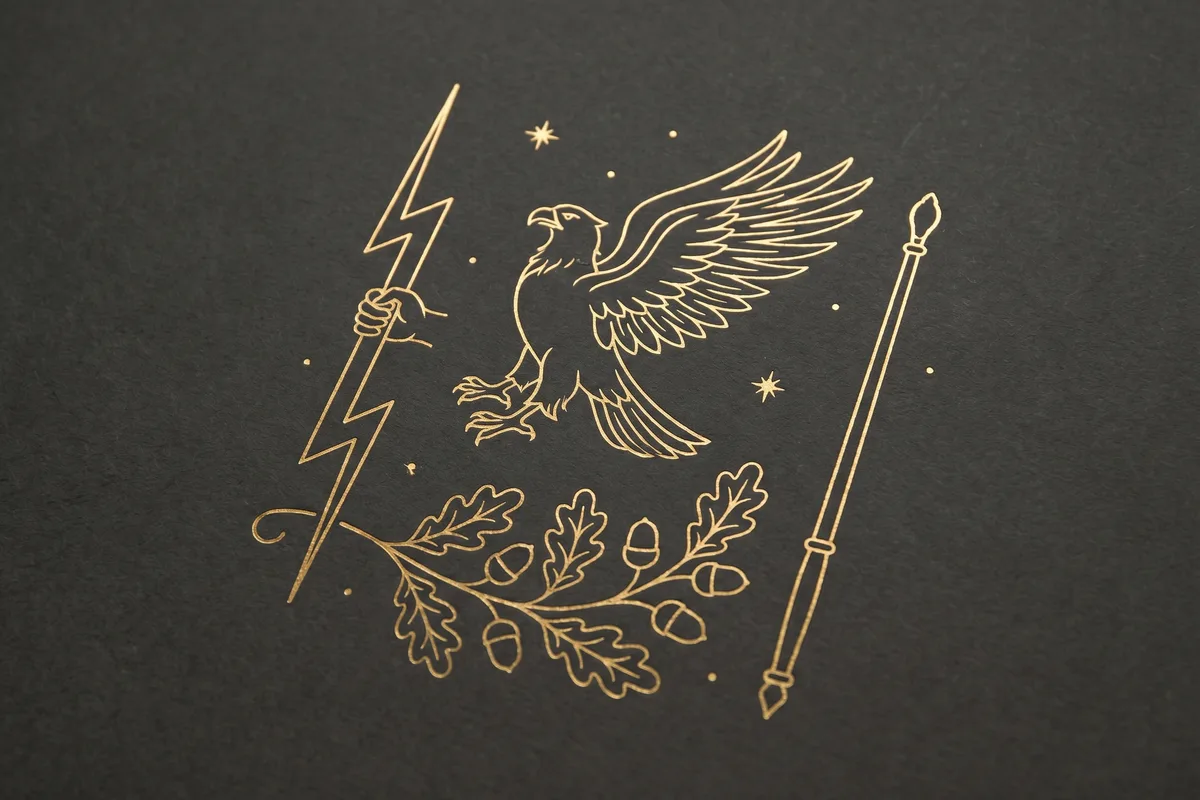
Zeus's symbols say plainly what he is. The eagle, the bird that rises highest in the sky, is his gaze. The oak, the tree whose roots reach deepest, is his steadiness. The scepter is the extension of his authority. The thunderbolt is both punishment and the light that reveals the truth in a single instant.
In ancient Greece, the most magnificent worship of Zeus took place at Olympia. The colossal gold and ivory statue made by Pheidias was one of the seven wonders of the ancient world, and the Olympic Games, held every four years, were run in his honor. At Dodona, priests read his will from the rustling leaves of a sacred oak.
Above all he was Zeus Xenios, protector of the guest and the stranger, because the true measure of a civilization is how it treats those who do not belong to it.
Yet the myths never let him off easily. This same Zeus unites with countless mortals and goddesses, constantly draws the anger of his wife Hera, and stands at the center of stories full of jealousy and deceit. Here lies the honesty of the myth: the very power that builds cosmic order is not itself free of desire, passion, or the urge to cross every boundary.
The order-maker within us
What does Zeus say to us today? It is no accident that the planet Jupiter carries his Roman name. He is the energy of expansion, of meaning, of seeing the larger picture. But the myth whispers something subtler.
Zeus is the voice within us that sets limits and gives meaning. The force that gives a life its structure, draws a frame around chaos, and can say "this far and no further." His light is generosity, protection, holding the scales of justice steady. His shadow is domination, the urge to control everything, the belief that power stands above the law.
The real lesson of the myth is this: whoever builds order must also be willing to see the chaos inside themselves. Zeus's lightning punishes and illuminates at the same time. When the Zeus within us matures, it learns to use its power not to crush another but to build a roof that shelters.
The voice within
Otorite, görünür güç ve kapsayıcı düzenin arketipi. İçimizdeki sınır koyan, anlam veren, hayatı genişleten ses. Gölgesi tahakkümdür, ışığı cömertliktir.
"Kronos'un oğlu, gökten yıldırımı atan, en büyüğü tanrıların ve insanların babası." Hesiod, Theogonia, M.Ö. 7. yy.
Sources: Hesiodos, Theogonia · Homeros, İlyada · Apollodoros, Bibliotheke · Pausanias, Hellas Tasviri · Kallimakhos, Zeus İlahisi

You can ask a question about this reading
Hypatia (Bilge Astrolog) answers your questions about Zeus