
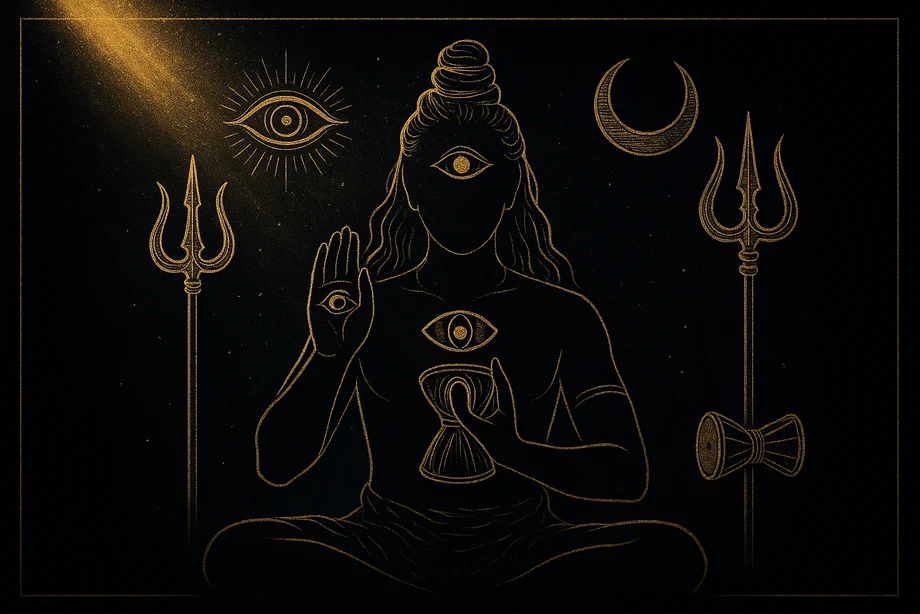
Yıkım, dönüşüm, meditasyon
Archetype: Dönüştürücü zahit
From the roar of Rudra to Maheshvara
Shiva's first form is not Shiva at all. " The Vedic hymns sing of this god as one who wanders the mountains, whose arrows can both send disease and call it back, a power hidden inside the storm. Rudra is feared yet also implored, because the same hand that destroys is the one that can hold the destruction back.
At the heart of the Yajur Veda lies a long hymn known as the Shri Rudram. There Rudra is called upon by a hundred different faces: hunter, herdsman, lord of thieves, master of the mountains, protector of roads and passes. " Over centuries this adjective will become the god's own name.
The Upanishads draw Rudra one step deeper inward. In the Shvetashvatara Upanishad, Rudra is no longer a personal deity but Brahman itself: the deepest truth of the cosmos, the one being behind every appearance. In the Puranas, Shiva stands in the deepest corner of the great triad, together with Brahma and Vishnu.
Brahma creates, Vishnu sustains, Shiva dissolves and begins again. This third movement is not an ending in the way we fear it. It is a moment of breathing out.
The fire of Sati and the Halahala poison
One of Shiva's deepest myths begins with his wife Sati. As told in the Shiva Purana, Sati was the daughter of king Daksha and had married Shiva against her father's wishes. Daksha never stopped belittling his son-in-law; he could not stomach this barefoot ascetic, ash-smeared, forest-dwelling figure as kin to his royal house.
When he held a great sacrifice, he invited every god but pointedly excluded Shiva and Sati.
Sati went to the rite anyway. When she heard her father's insults against her husband she made a decision. She kindled the fire of yoga within herself and let her body go in that fire.
The moment Shiva learned of it is one of the most stirring scenes in all the myths. The god takes his wife's burned body onto his shoulder and roams above the world until his grief turns into a dance of dissolution. In the end Vishnu intervenes, and Sati's body falls piece by piece to the earth.
Wherever it falls becomes a sacred center, a Shakti Pitha. Kalighat, Kamakhya, and many other temples still carry the geography of this myth.
Another myth is the story of a cosmic service. In the scene of the Churning of the Ocean of Milk, Samudra Manthana, told in the Bhagavata Purana and the Mahabharata, the gods and the asuras churn the ocean together for the nectar of immortality. Before the nectar, however, a poison rises called Halahala, so fierce that even its scent would burn the cosmos.
No god dares touch it. Shiva takes it into his hand and drinks. His wife Parvati holds his throat so that the poison will not go down.
It stays in his throat and stains it blue. " The myth says something deep: the god of transformation is the one who can hold in his throat what the cosmos cannot swallow.
The lingam, Nataraja, and the river at Kashi
Shiva's symbols whisper his nature. The lingam is the most misunderstood and, in truth, the most refined. As told in the Skanda Purana and the Linga Purana, when Brahma and Vishnu argued over which of them was greater, a boundless column of light rose between them.
Brahma went up, Vishnu went down; neither could find its end. The column is a sign of Shiva as formless, beginningless, endless. The lingam is the symbol of that column, not a crude bodily image.
The figure of Nataraja is Shiva dancing. One foot presses down on the dwarf of ignorance, the other lifts upward. In one hand he holds a drum, the rhythm of time and creation; in another, fire, the force of transformation.
A third hand says "do not fear," a fourth points to the raised foot below, the direction of liberation. The whole cosmic cycle is gathered into a single figure.
The heart of his worship is Varanasi, also called Kashi. " The cremations at the Manikarnika Ghat remind us that death is not an end but a passage. From the Kashi Vishwanath temple to Chidambaram in the Tamil lands, from Kedarnath in the north to Somnath in the west, across the twelve Jyotirlinga temples Shiva is remembered with different faces.
The month of Shravan, roughly July to August, is his month, and Mahashivaratri is the long night when the god is kept awake.
Transformation inside stillness
What does Shiva say to us today? Astrology has no direct planetary equivalent for him, but his energy speaks the same language as the depth of Saturn, the transformative pull of Pluto, and the inner waters of the Moon.
The Shiva within us is the voice that can let the old go and knows we cannot begin the new without first letting it go. At some point in life all of us reach the end of a form: a relationship, a career, an identity, a story. Shiva energy comes online at that threshold.
He does not destroy in order to destroy; he clears a space so that a new breath can be drawn. His barefoot, ash-smeared seat is not a renunciation. It is the calm of a being who knows nothing he owns defines him.
In the yoga tradition Shiva is remembered as the first yogi, Adi Yogi. The one who can sit motionless for hours, yet sees everything within. Inside the constantly producing, constantly moving rhythm of modern life, Shiva offers something strange: sometimes the strongest move is the ability to stop.
To take a breath all the way in and let it all the way out. The god told in ash and a blue throat says that transformation is possible without moving at all.
The voice within
Eskiyi serbest bırakma ve yeni hâle alan açma kapasitesinin arketipi. Yıkım yıkım için değil, alanı açmak içindir. Modern okumada radikal sadeleşmenin ve içsel boşaltma süreçlerinin sesidir.
"O Mahadev'dir, dans edendir, kâinatı bir tek hareketinde yıkıp yeniden kuran." Şiva Sutra, sözlü gelenek.
Sources: Rig Veda, Rudra ilahileri · Yajur Veda, Şri Rudram · Svetasvatara Upanişad · Mahabharata, Süt Denizinin Çalkalanması · Şiva Purana · Linga Purana · Skanda Purana

You can ask a question about this reading
Hypatia (Bilge Astrolog) answers your questions about Şiva