
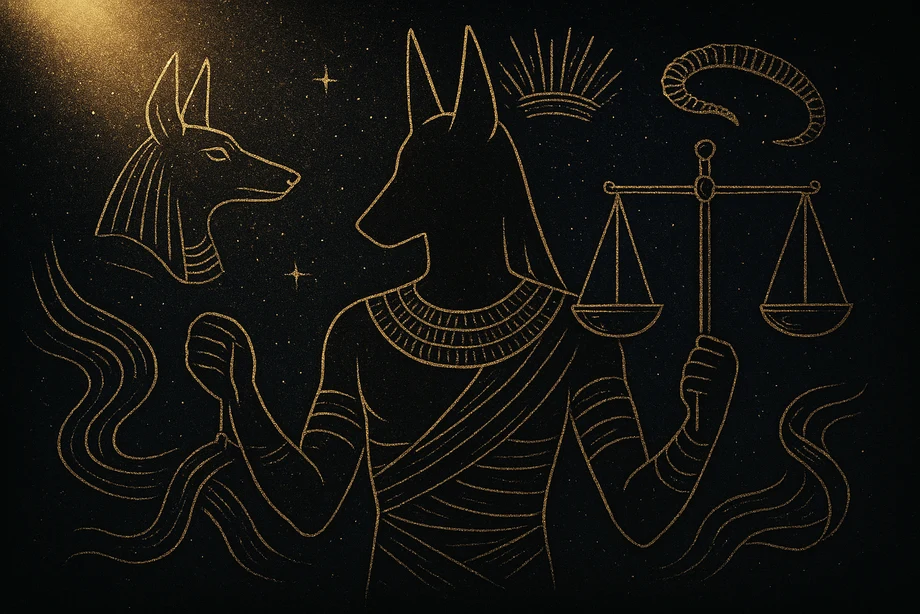
Ölüm rehberi, mumyalama, terazi
Archetype: Eşiklerin yol göstericisi
Jackal-headed, Egypt's god of the threshold
Anubis's Egyptian name was Inpu or Anpu, written by the Greeks as Anubis. He was most often depicted as a man with the head of a jackal, or as a jackal itself. The choice of this animal was not by chance.
In Egypt, jackals were animals that roamed at the edges of the cemeteries on the desert margin; to hear their calls at midnight near the tombs was, for the Egyptian, an echo of the world of the dead.
But the Egyptian did not see this animal as something to fear. The jackal was at the edge of the cemetery, yes, but precisely because of that it stood beside the dead. The role of Anubis as a god was the same.
He was not a figure to dread because of decay, but the wisdom of the threshold between decay and life. Anubis was not at the gate of death; he was at the threshold of death, the god who knew the passage there.
In the early Old Kingdom, before the cult of Osiris spread, Anubis was considered the chief god of the realm of the dead. In the Pyramid Texts he is the god who accompanies the pharaoh into the underworld. Later, as Osiris rose, Anubis served him in a secondary role, but he never lost his own place.
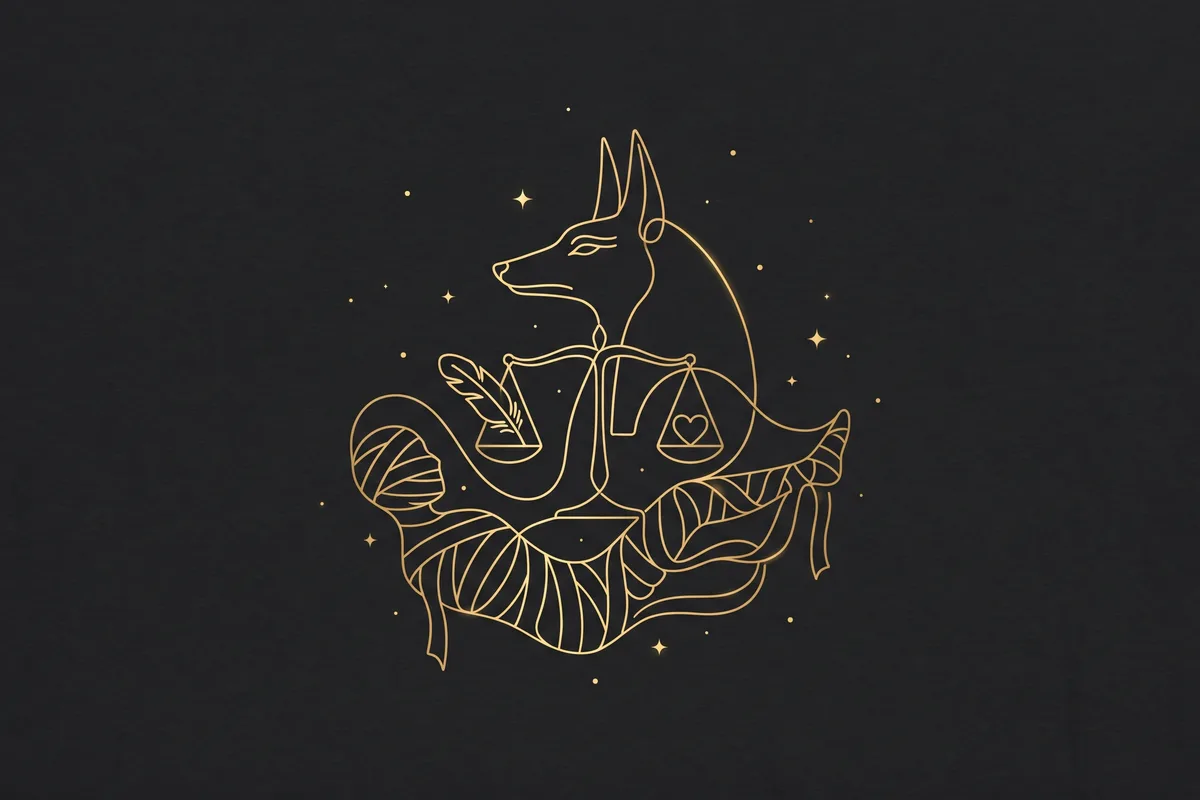
The first embalming, on the body of Osiris
One of the most beautiful scenes in Egyptian mythology takes place in the hands of Anubis. When Set tore the body of Osiris into fourteen pieces and scattered them across Egypt, Isis and Nephthys gathered each piece. But even gathered, the pieces were a corpse, something that could rot. It was at this point that Anubis stepped in.
Myth says that the art of embalming was invented by Anubis, and that his first practice was on the body of Osiris. In the Coffin Texts, Anubis is described in a choreography of rubbing the skin of Osiris with natural resins, placing the organs in jars, wrapping the body with linen bands. This is a rite in which decay is halted, in which the body is prepared for eternity.
After this touch of Anubis, when Isis beat her wings and gave breath, Osiris returned.
In historical practice, Egyptian embalmers often wore a mask of Anubis while they worked. So when the art was performed, Anubis was considered physically present. Embalming was not a medical procedure but a religious rite; each motion, each binding, repeated the order the god himself had performed. To prepare the body was to give it a form after death.
The weighing of the heart, and what it means to witness
Chapter 125 of the Book of the Dead is the most mature expression of Egyptian religious thought. Here the dead person is brought before the hall of Osiris. In the hall there is a balance. On one pan is placed the heart of the dead, on the other the feather of truth of Maat. The one who operates the balance is Anubis.
At this point in the story something is worth noticing. Anubis is not a judge. He does not deliver the verdict.
He only makes sure the balance works correctly, that the weighing is done justly. The result is recorded by Thoth on papyrus in the corner. The verdict is given by Osiris and his council of thirty-two judges.
The work of Anubis is to witness, to weigh, to accompany, but not to pronounce.
This role is extremely important for modern readings. The Egyptian chose, as the instructor of death, not a god who judges but a god who accompanies. A person confronts their past, sees the weight of their heart, but a jackal-headed companion stands beside them.
That companion does not comment, does not accuse, does not praise. He only ensures that the weighing is correct. If the heart is light, the person passes on to the green fields of Osiris.
If it is heavy, it is eaten by a creature called Ammit. But Anubis is not the one who decides this outcome, only the one who oversees it.
We are not alone at the thresholds
What does Anubis say to us today? In modern thought the jackal-headed god is often pictured as a frightening figure; this is a misreading. For the ancient Egyptian, Anubis was not a god to be feared but a god to be trusted. Without him the dead were alone; because of him the passage was orderly.
The Anubis within us is a wisdom that accompanies threshold moments. In life we pass through many thresholds: the end of a relationship, the close of a job, the leaving behind of an identity, the acceptance of a grief. The fear we feel at these thresholds often comes from feeling alone.
The message of Anubis is this: in these passages you are not alone, and the passage itself is not something that judges you, it is a wisdom that walks beside you.
This myth also teaches us to weigh the weight of the heart honestly. Not to say "my heart is light" in denial, nor to say "my heart is too heavy to bear" in needless guilt. Only to stand before the balance and look at the true weight.
When the Egyptian embalmer wore the mask of Anubis, he looked upon the dead with a gaze that did not judge. At the thresholds of our own lives we can look at ourselves with the same gaze: not judging, but attentive, but honest. Anubis does not frighten, he only accompanies.
The voice within
Bitişlerin onurlu rehberi. Bir şeyi gerçekten gömebilme, hak ettiği törenle uğurlayabilme kapasitesinin arketipi. Modern psikolojide yas işleminin koruyucusudur.
"Bu kalp doğru tüy kadar hafiftir." Ölüler Kitabı, kalp tartım sahnesi, Bölüm 125.
Sources: Piramit Metinleri · Tabut Metinleri · Ölüler Kitabı, Bölüm 125 (Kalbin Tartılması) · Plutarkhos, Isis ve Osiris Üzerine · Mısır mumyalama papirüsü (Boulaq 18)

You can ask a question about this reading
Hypatia (Bilge Astrolog) answers your questions about Anubis