
Ana tanrıça, dağ, doğa, doğurganlık
Archetype: Toprak ana, dağın efendisi
A land that knew her through a stone
Kybele's story does not begin with a statue but with a stone. In the inner highlands of Phrygia, in the rocky country that lies today between Eskişehir and Afyon, her cult reaches into one of the oldest layers of Anatolia. In Hittite texts her name appears as Kubaba, shown in Karkamış seated on a throne, holding a mirror and a pomegranate.
The Phrygians called her Matar Kubileya, mother of the mountain, and this title later passed into the Greek world as Kybele.
Pessinus was her holiest city. Strabo, in book XII of the Geographica, speaks of Pessinus, its priestly class, its great temple, and a black stone believed to have fallen from the sky. This stone was not a carved figure; it was a rough, faceless piece of meteor. The goddess had not taken refuge in a form, but in nature itself.
During the Second Punic War, Rome, on the advice of the Sibylline oracles, brought this black stone of Kybele from Pessinus to Italy by ship. In 204 BCE it was placed on the Palatine hill. For the first time in its history, Rome adopted an Anatolian goddess into its official pantheon. From that day she was called Magna Mater, the Great Mother.
Attis, the pine, and the mourning
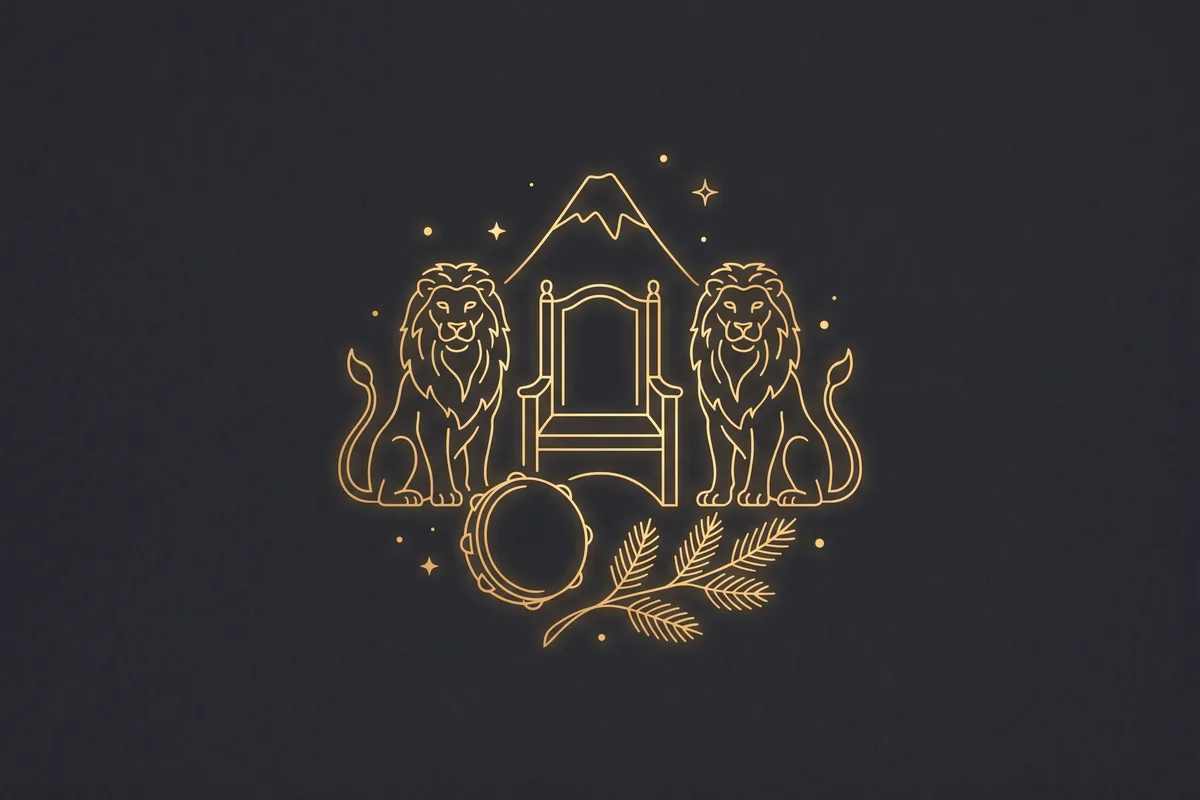
At the center of Kybele's myths stands a young shepherd, Attis. Diodorus Siculus and Pausanias give different versions, but the spine is the same. Attis was a young mortal whom the goddess loved. In one account he was born beside a river near Pessinus, in another he sprang from the fruit of an almond tree.
The goddess asked him to remain hers. But Attis either ventured to marry the daughter of a king or gave his heart to a nymph, depending on the source. Kybele did not rage; she mourned.
Attis could not contain himself and wounded his own body; he died beneath a pine tree. The goddess let him stay there: the young man's body became a pine, and violets grew from his blood.
This story was remembered every spring with rites. At the end of March in Rome the Hilaria festivals were held, first the mourning, then the joy of Attis's return. The priests called Galli were consecrated to the goddess; with drums, cymbals, and flutes they came down from the caves to the cities.
The rite built a bridge between Anatolia's local rhythm and Rome's official calendar.
The lion, the tower, and the mountain
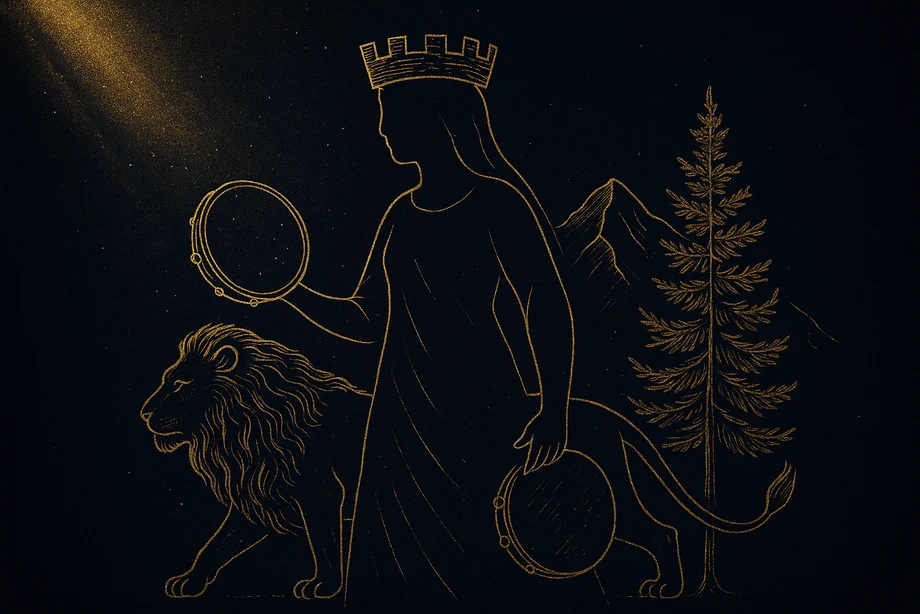
Kybele's symbols say plainly what she is. The lion is the animal of nature that cannot be tamed; the goddess is depicted with her chariot drawn by two lions. In book II of De Rerum Natura, Lucretius describes this image at length: the lions, he writes, were tamed by the goddess's power, because the mother softens everything.
The crown on her head has the shape of a city wall or a fortress. It is called corona muralis, the mural crown. Kybele protects not only the mountain but the city built at its foot. She is the foundation of settled life; a city being founded asks her consent. This is why Rome saw her as both mountain goddess and mother of the empire.
Not at Yazılıkaya but at many of Anatolia's rock sanctuaries, in niches carved into the stone, Kybele is shown seated: a lion at each side, a tower on her head, a drum in one hand and a pomegranate or a bowl in the other. Aslantaş, Yılantaş, and the rocks around the Midas Monument on the Phrygian plateau are her open-air sanctuaries. Before a temple was built, the mountain itself was the temple.
The wisdom of returning to roots
What does Kybele say today? She is not a planet, she is a direction. The direction of body and earth. In astrology she touches the Taurus face of Venus, the home-side of the Moon, but more than that, she is the invisible root line beneath the chart.
The Kybele within us is our relationship with the place we belong to, with our body, with our lineage. She recalls not a concept but a smell: the kitchen smell of childhood, the courtyard of a grandmother, the wind of the city you were born in. Modern life often pulls us away from our roots; when Kybele energy weakens, a person feels placeless, homeless, unbound.
Her call is gentle but clear. Remember your body, she says. Remember your place.
Remember that you are a part of nature, and always have been. The lion sits beside her, because the raw is also embraced; you do not have to civilize everything. The real lesson of the myth is this: when Attis ran from himself he died, but Kybele kept him beside her always as a pine.
A root knows how to hold even what was lost.
The voice within
Kök, beden ve yerin arketipi. Ait olduğun coğrafyayla bağ, soydan gelen güç, doğanın ham hâli. Modern okumada beden bilgeliği ve toprağa bağlı şifa süreçlerinin sesidir.
"Tanrıların büyük anası, kuleli tacı, aslan koşumu, dağdan iner şehre girer." Lucretius, De Rerum Natura, II.598-643.
Sources: Strabon, Geographica, Kitap XII · Lucretius, De Rerum Natura, II.598-643 · Diodorus Siculus, Bibliotheca Historica · Pausanias, Hellas Tasviri · Frigya kaya kült anıtları (Aslantaş, Yılantaş, Midas Anıtı) · Karkamış Kubaba kabartmaları, Hitit dönemi
You can ask a question about this reading
Hypatia (Bilge Astrolog) answers your questions about Kibele