
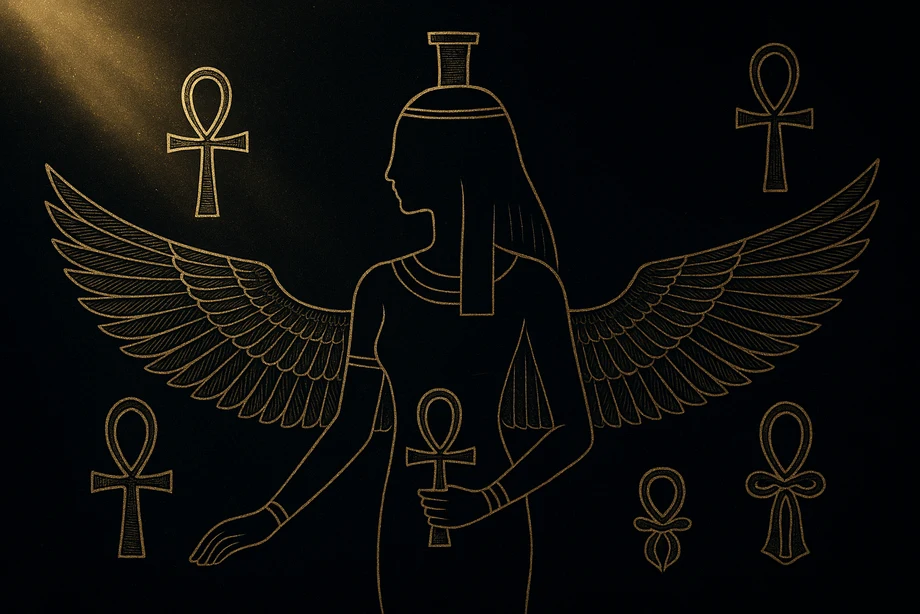
Anne tanrıça, sihir, koruma
Archetype: Şifa veren ana
The veiled goddess of Sais
At a temple in Sais in the Egyptian delta, an inscription read: "I am that which is, that which has been, and that which shall be. " Plutarch records this line in his first-century essay On Isis and Osiris. He was already describing a cult more than a thousand years old, an outsider Greek looking in, but the essence of the goddess shows plainly in a single sentence.
Her Egyptian name, pronounced Aset or Iset, meant "throne." Whoever sat on the throne sat in her lap. This is why a throne sign appears in the hieroglyphic cartouche of the pharaoh, because every king was the son of Isis. Her headdress was also a throne, which she carried on her head like a small pedestal.
Myth makes her the daughter of Nut, the sky, and Geb, the earth. Her siblings were Osiris, Set, and Nephthys. It is said she loved Osiris while they were still in the womb. To tell what came next, one must first walk around a murder.
The wing that gathered a scattered body
In the version Plutarch compiled, Osiris was the good king of Egypt. His brother Set grew jealous, trapped him at a banquet by a clever ruse inside a coffin, and cast the coffin into the Nile. The coffin drifted to the sea, reached the shore at Byblos, and there a tamarisk tree grew around its trunk.
Isis set out to find her husband. Not like a queen, but as a woman in mourning, hair cut, she walked through Egypt and then along the Syrian coast. At Byblos she found the coffin and brought it back.
But Set did not stop. He seized the body, cut it into fourteen pieces, and scattered the pieces across Egypt. Isis, with her sister Nephthys, set out again.
They gathered each piece, one by one. Only one was missing, the piece swallowed by the fish of the Nile. In its place Isis cast a replacement in gold, and the body was made whole.
Then Isis beat her wings and leaned over her dead husband, giving him a brief breath. In that breath Horus was conceived.
This story is scattered through the Pyramid Texts, the Coffin Texts, and the Book of the Dead. Plutarch tells it as a whole, but its core is far older. Here Isis is not a wife, she is a surgeon.
The capacity to gather what is scattered, to call back what is dead, to fill what is missing rests in her hands. For the Egyptian, to love was exactly this: to gather the pieces back.
The wise one who learned the secret name of Ra
Another myth shows Isis from a different angle. In a story preserved on a Turin papyrus, Isis wants to learn the true name of Ra, the sun god. In Egyptian thought a being's hidden name is the power to command it.
Ra had grown very old, and his saliva dripped from his mouth. Isis mixed that saliva with earth, shaped it into a serpent, and placed the serpent on the path of Ra. Ra was bitten.
The pain was unbearable.
No god could heal him. Isis came and said, "I can heal you, but you must tell me your true name." Ra resisted, then, unable to bear the pain any longer, whispered his name to her. From that moment Isis was the goddess who carried the power of words.
This myth lifts her out of being only mother and beloved. Isis is also the one in charge of magic, medicine, and hidden knowledge. Egyptian healers called on her name in illness. Many healing formulas began with "Isis said," because the word from her mouth carried the cure.
From Philae to the world, and from there inward
The worship of Isis reached its full bloom at the temple on Philae, an island near Aswan in southern Egypt. This temple remained one of the last active pagan temples of the ancient world, closed only in the sixth century by the Byzantine emperor Justinian. The cult of Isis went on for a thousand years after the Library of Alexandria had burned.
In the Hellenistic age her cult crossed the borders of Egypt. In the novel The Golden Ass by Apuleius, the main character is at last initiated into the mysteries of Isis, and the goddess appears to him in a scene that is one of the most moving religious texts in ancient literature. Temples of Isis have been excavated in Pompeii, in Rome, in London.
The Hellenistic world adopted her as a universal mother figure.
What does Isis say to us today? The Isis within us is the ability to gather what has been scattered. To put yourself back together after grief, to collect the pieces after a disappointment, to patiently mend what has broken in another person.
She is not a savior, because she had to search for each piece with her own hands. Her message is this: love is not a passive feeling but an active search. It is a creativity that can cast a golden replacement where a piece is missing.
And knowledge, if it is real, is not cold, it is another name for love.
The voice within
Yas, sebat ve sihirsel toparlanmanın arketipi. Parçalanmış olanı sevgiyle birleştirme kapasitesi. Modern okumada kendi yaralı parçalarını derleyen iç anneye işaret eder.
"Ben olmuştum, olanım, olacağım. Hiçbir ölümlü peçemi kaldıramadı." Sais'teki Isis tapınağı yazıtı, Plutarkhos'tan aktarım.
Sources: Plutarkhos, Isis ve Osiris Üzerine · Ölüler Kitabı (Per em Heru) · Piramit Metinleri · Turin Sihir Papirüsü · Apuleius, Altın Eşek (Metamorphoses) · Heredot, Tarihler II

You can ask a question about this reading
Hypatia (Bilge Astrolog) answers your questions about Isis