
Bilgelik, tatlı su, hayat ve hile
Archetype: Yaratıcı bilge
Lord of Eridu, depth of the fresh water
Enki in Sumerian means "lord of the earth," with en for lord and ki for earth. The Akkadians named him Ea, "the house of water." His body is fresh water, the Apsû, the deep source running beneath the surface of the earth. Every well, every river, every vein of fresh water swelling with spring rain showed his presence.
His city was Eridu. " So for a Mesopotamian, Eridu was the first known city of humankind. Today in southern Iraq, the mound excavated as Tell Abu Shahrein shows temple layers going down to the fifth millennium BCE.
Eridu's E-abzu temple was Enki's house, and beneath the temple, in an excavated pool, the symbolic waters of the Apsû were kept.
Enki's birth story is debated. In some poems he is the son of the sky god An and the earth goddess Ki. In Enuma Eliš he is the son of Anu (the Akkadian form of An) and surpasses his father in wisdom.
His power is not raw; it usually appears as a trick, a redirection, a door opened a different way. " Because he was not only water, he was the intelligence that knew which way the water should flow.
The voice that bent toward Atrahasis's ear
Enki's most charged myth is the Atrahasis Epic. This three-tablet epic from the eighteenth century BCE tells the time from creation to the great flood. After the human is made, humans multiply, their noise rises, they fill the earth.
Enlil, the god of wind and decision, can no longer sleep. Enlil sends first a plague, then a drought, then a famine. Each time, Enki bends behind a reed wall toward the ear of his hero Atrahasis (whose name means "exceedingly wise") and tells him which god to sacrifice to.
Each time humankind is saved.
In the end Enlil takes the final step and sends the great flood. An oath has been sworn among the gods, no one will warn humankind. Enki does not exactly break the oath, because he is a sage.
He speaks to the wall of Atrahasis's hut, he tells the wall the news, but Atrahasis is listening behind the wall. "Wall, hear me. Tear down the house, build a boat.
Leave the goods, save life. " Then Atrahasis gathers a pair of every living thing into the boat, and the waters wash the earth for seven days and seven nights. After the waters recede, Atrahasis offers a sacrifice, the gods, smelling the scent, gather around it like flies.
This scene is retold much later in the eleventh tablet of the Epic of Gilgamesh by the mouth of Utnapishtim, and is undoubtedly the basis of the later Hebrew story of Noah. The name that bridges these three traditions is the voice of Enki. Because Enki is not neutral toward the human.
He is the god of wisdom, but he is also a friend of the human. Even a council decision of the gods does not entirely stand before the subtlety of his mind.
Two rivers, the goat-fish, and the me tablets
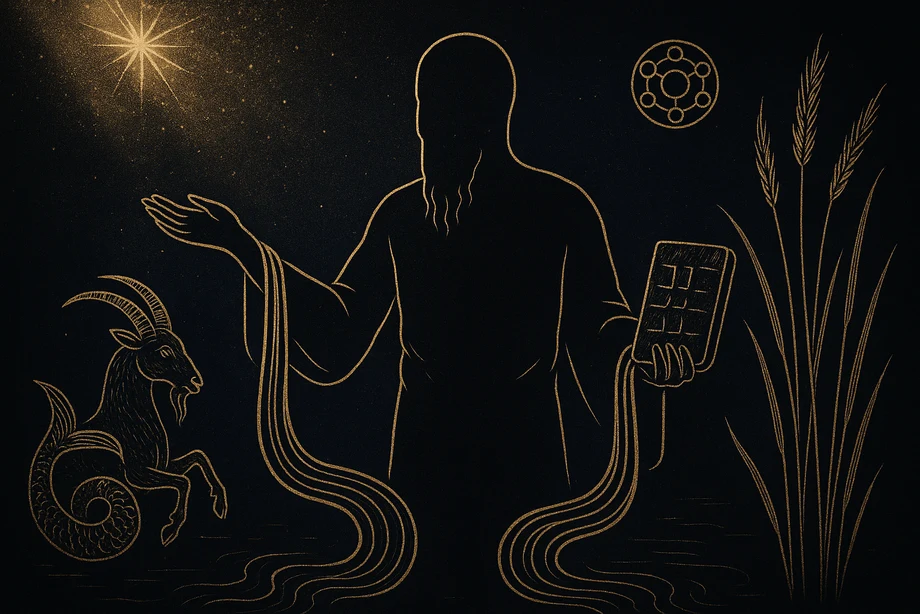
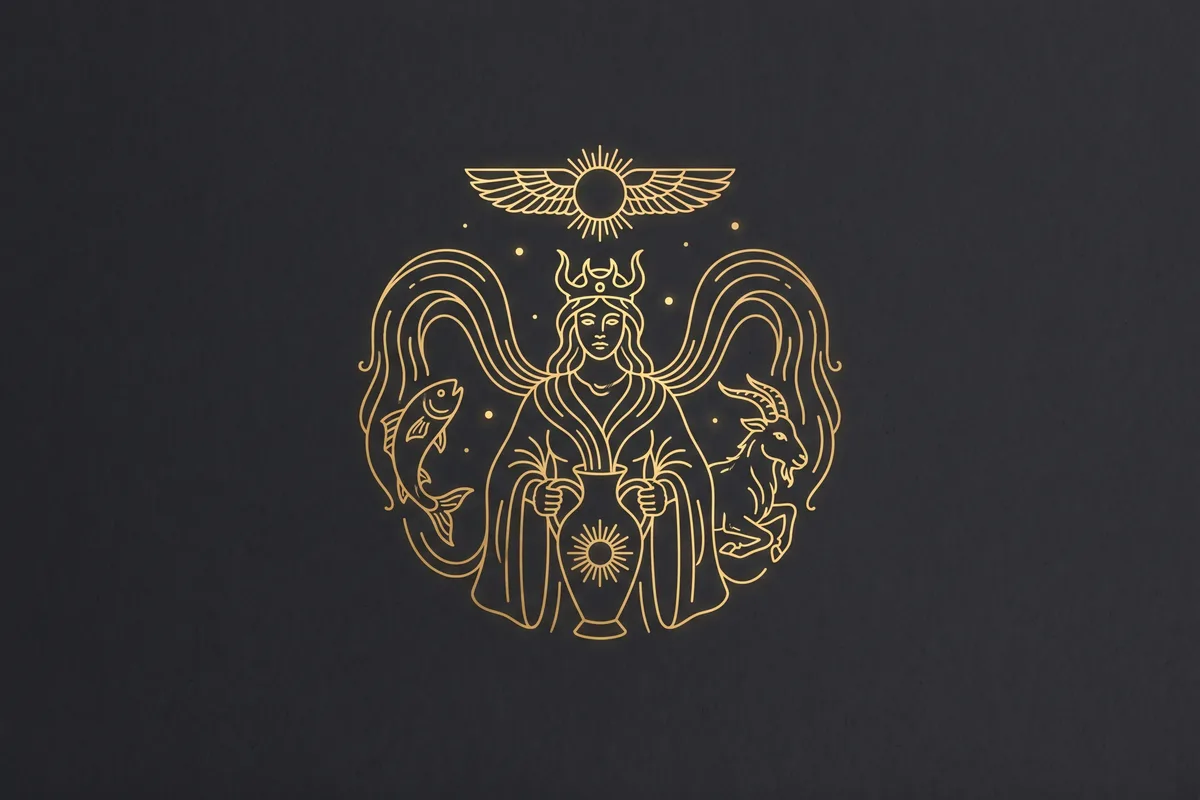
Enki's symbols speak his nature one by one. On Mesopotamian cylinder seals he is often shown with two rivers flowing from his two shoulders, the Tigris and the Euphrates. This water is not an abstract sign, these are real rivers, the vein of civilization.
Another of his symbols is the suḫurmašû, the goat-fish. Front of a goat, back of a fish, this creature later passed into the Greek tradition of astronomy as the sign of Capricorn. The Babylonians linked the constellation of Capricorn to Enki, and so in astrology, on one side of Capricorn lies a practical wisdom drawn from the depths, and on another side the depth of fresh water.
It is a good example of how traditions bridge each other.
The most important objects he holds are the me tablets. " There is the me of the throne, the me of priesthood, the me of war, the me of love, the me of music, the me of laughter, the me of mourning, even the me of lying. These are kept in the depths of the Apsû in Enki's Eridu.
In the poem "Inanna and Enki," Inanna comes to Eridu, softens Enki with drink, has him hand her the me one by one, and then escapes to Uruk by boat. When Enki sobers up, he sends his rough creatures after her, but Inanna has already brought the me to Uruk. The story tells of Enki's gift, but it also tells of how civilization is carried from one place to another.
Wisdom does not stand still in one place, it can be transferred, and the one who carries it is often a young goddess.
The mind of the water
What does Enki say to us today? In the Greek and Roman tradition he has no exact match; one side of him carries the wit of Hermes, another the waters of Poseidon, another the friendship of Prometheus toward humans. This combination makes him especially interesting to a modern reader.
The Enki within us is the intelligence that produces solutions. The side that, when faced with a problem, solves it not with brute force but with an angle, a detour, a door no one had expected. " This is not deceit, because Enki speaks not for himself but for the human.
That is the important detail of the myth: his intelligence is not selfish, it is protective.
In astrology he touches the domains of Mercury, and also of Neptune and Pluto, because he represents intelligence and water and depth at once. For the Sumerian, Enki's Apsû was the vein of fresh water running beneath the earth; for us, his counterpart is that intuition flowing under the surface, that voice that finds a solution, that practical wisdom. When a council of life says "you cannot," there is an Enki within us that speaks to the wall, and behind the wall someone listens.
The real lesson of the myth is this: wisdom is not greater than the rule, but it keeps life above the rule. Water is not harder than the hard, but it goes around the hard and carries life to the sea.
The voice within
Yaratıcılığın, ustalığın ve kuralı esnetebilen zekânın arketipi. Tıkandığında alttan dolaşan akıl. Modern okumada problem çözücü, sezgisel zekâya işaret eder.
"Ben Enki'yim, suların efendisi, me'leri elimde tutan, insanlara bilgiyi öğreten." Enki ve Dünya Düzeni, Sümer tableti.
Sources: Atrahasis Destanı (Eski Babil tabletleri, MÖ 18. yüzyıl) · Eridu Genesis (Sümer tufan şiiri) · Enki ve Ninhursag (Sümer şiiri) · Enki ve Dünya Düzeni (Sümer şiiri) · Inanna ve Enki (Sümer şiiri) · Gılgamış Destanı, Tablet XI (Utnapiştim'in tufan anlatımı) · Eridu E-abzu tapınak yazıtları ve arkeolojisi

You can ask a question about this reading
Hypatia (Bilge Astrolog) answers your questions about Enki