
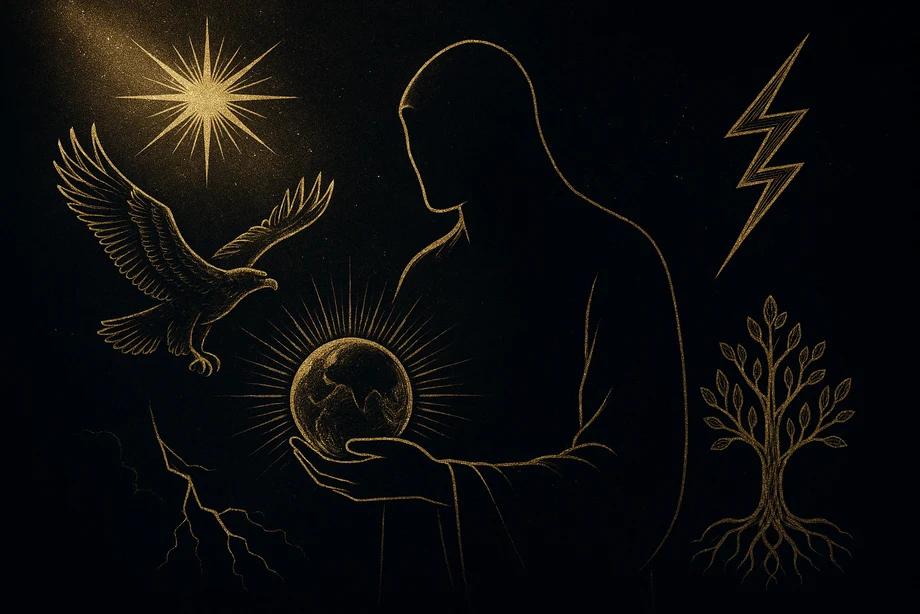
Üst gök, kozmik ilke, en yüce
Archetype: En yüce ilke
The blue sky above, the brown earth below
The opening sentence of Turkic mythology is carved into stone. " When the blue sky above and the brown earth below were created, between the two the son of man was created. It is the oldest and clearest cosmology the Turkic world ever wrote in its own language.
In a single breath this sentence draws the map of a three-storey universe. Sky above, earth below, the human in between. What strikes the ear is the name of what is above: Kok Tengri, the blue sky.
There is no god seated on a cloud here. There is no throne, no palace. Sky Tengri is the limitless blue above us, itself.
Turkic cosmology parts ways with the anthropomorphic gods of other traditions right here: the highest principle is not a form but a span.
As Bahaeddin Ogel points out in his compendium "Turkic Mythology," in old Turkic the word tengri carries at once the visible sky and the principle behind that sky. The two meanings are inseparably folded into the same word. The blue sky is not a symbol of the god; it is the god itself.
The voice that grants the kagan his authority
In the Orkhon inscriptions, Bilge Kagan speaks in the first person and keeps returning to the same formula: "Tengri yarlikaduki uchun," because Tengri commanded it, I succeeded, I won, I gathered the people. In the smaller inscriptions of the Yenisei basin, a lord or a hero takes his strength not from himself but from this voice. Tengri grants kut, a kind of sacred authority, an invisible seal.
When that kut is withdrawn, the kagan goes too.
The Tonyukuk inscription makes this pattern unmistakable. The old wise minister, recounting his military victories, never stops remembering the approval from above. Decision, plan, battle, all of it passes through human hands, yet legitimacy descends.
A principle of Turkic political thought is hidden in this: the ruler is not absolute, he is a trustee. Kut can be taken back.
This is why Tengri is neither male nor female. The moment he was confined to a gender, he would be limited. He is what cannot be bounded. Even the pair "Tengri and Umay," named side by side in the inscriptions, is not a husband and wife. Tengri is the span, and Umay is the current of motherhood and birth that flows within that span.
The eagle at the top of the world tree
The shamanic tradition gave Tengri's abstract span a concrete architecture. The three worlds are bound by a single tree: its roots reach into the lower world, its trunk rises through the middle world of human beings, and its crown touches the upper world, the domain of Tengri. In the shaman prayers Anokhin collected in the Altai in the early 20th century, this tree appears again and again, sometimes a birch, sometimes a pine.
A bird sits at its summit, most often an eagle.
Mircea Eliade, in "Shamanism: Archaic Techniques of Ecstasy," shows that this eagle belongs not only to Turkic shamans but to a much wider Eurasian line of imagery. When the kam, the shaman, sets out on an ecstatic journey, he climbs the trunk of the tree, passes through nine or seven layers, and at the summit meets the eagle, the messenger of Tengri. Lightning is his sign as well: a light coming down from the sky to the earth is the most direct touch from the most high to the middle world.
Banners of blue felt, garments in the colour of the sky, the bodies of sacrificed horses released toward the sky, all of these are attempts to make the span tangible. The kam prays facing upward, not downward. The old Turkish oath "may the blue sky come crashing down on us" is still that ancient reflex.
The sky falling on you is the heaviest curse for someone who breaks a vow.
The span within us
What does Sky Tengri say to us today? The astrological echo is clear: the breadth of the Sun, the wide vision of Jupiter. But the myth points beyond planetary symbolism.
The Sky Tengri within us is the capacity to see from the whole rather than from a fragment. To look at an issue not only through its closest detail but through its larger frame. In a relationship, in a decision, in a loss, to be able to hold the whole context rather than fixate on a single piece.
What the Turkic inscriptions called kut flows from precisely this: that quiet sense of authority that settles into you when you sense a task has been placed in your hands.
The shadow of all this is when span becomes arrogance. The ruler who imagines himself to be the sky loses his kut, because Tengri belongs to no one, he only passes through someone. The myth says this plainly: kut is a trust, not a possession.
The same applies today. When you build a roof over a life, count yourself not as the roof itself but as a part of the emptiness that holds the roof up. The real lesson of Sky Tengri is this: you cannot represent the boundless, you can only lean on it.
The voice within
Kapsayıcı bütünlüğün, tek olan kaynağın arketipi. Belirli bir form değil, her şeyin üzerinde yayılan kapsam. Modern okumada bütünsel bilinç, transpersonal bilinçlilik ile ilişkilidir.
"Yukarıda Mavi Gök, aşağıda Yağız Yer yaratıldığında, ikisi arasında insan oğlu yaratıldı." Bilge Kağan Yazıtı, M.S. 8. yy, doğu yüzü.
Sources: Orhun Yazıtları (Bilge Kağan, Kül Tigin, Tonyukuk) · Yenisey havzası yazıtları · Bahaeddin Ögel, Türk Mitolojisi · Mircea Eliade, Şamanizm: İlksel Esrime Teknikleri · A. V. Anohin, Altay Şaman Duaları Derlemesi
You can ask a question about this reading
Hypatia (Bilge Astrolog) answers your questions about Gök Tengri