
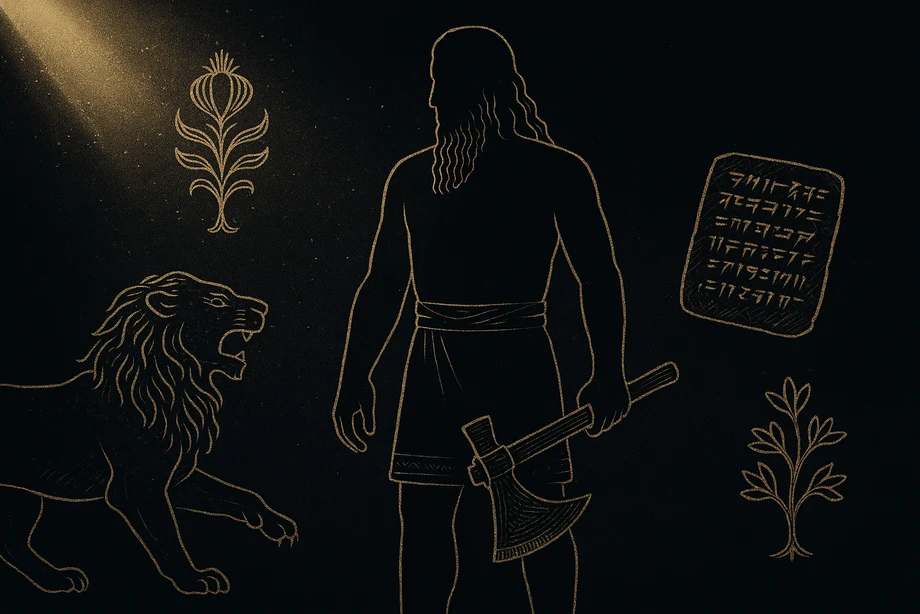
Krallık, dostluk, ölümlülük arayışı
Archetype: Ölümlülüğüyle yüzleşen kahraman
King of Uruk, builder of walls
Gilgamesh appears in Sumerian as Bilgames; the Akkadians made him Gilgameš, and English settled on Gilgamesh. According to the Sumerian king list he was the fifth king of Uruk, said to have lived around 2700 BCE. So he is in part a historical figure, in part a legend. The epic that gathered around him grew larger than either.
The most complete form that reached us is the Standard Babylonian Version of the Epic of Gilgamesh. It was compiled in twelve tablets by a Babylonian scribe named Sin-leqi-unninni, who lived in the thirteenth or twelfth century BCE; his name appears at the opening of the epic, which makes him the first known editor of an epic by name. Older Old Babylonian tablets, the versions held at the museums of Pennsylvania and Yale, go back to the eighteenth century BCE.
" So the epic was not written in one sitting, it grew over a thousand years.
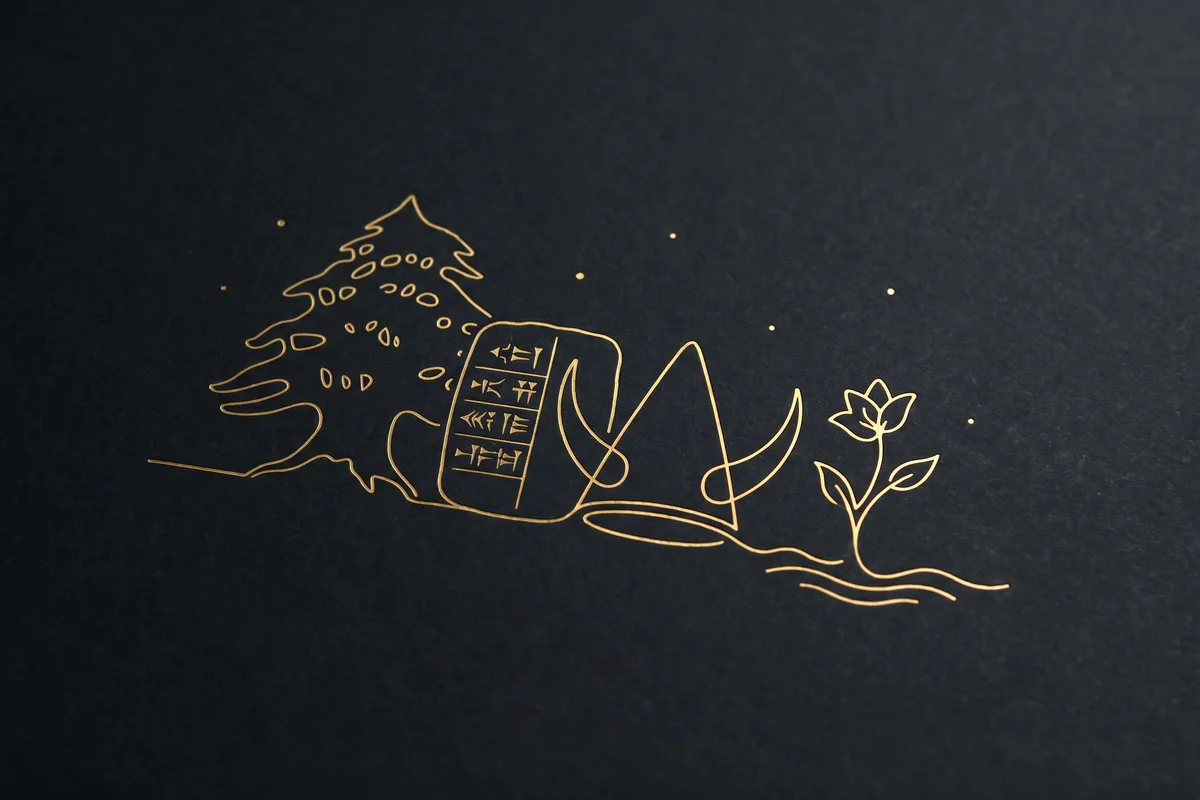
The opening lines introduce Uruk. " The walls of Uruk are his work, and he invites every reader to climb upon them and touch their fired brick. The epic places its own tablet into the same picture, the story is stored in a lapis lazuli box beside the gate of the wall.
This is a literature aware of itself, one of the oldest examples.
It begins with Enkidu and ends with him
At the start of the story Gilgamesh is two thirds god, one third human. His mother is the goddess Ninsun, his father Lugalbanda. This excess of divinity does not give him peace, it does the opposite.
He weighs so heavily on the people of Uruk that he drives the young men into forced labor and calls the brides into his bed. The city groans. The people pray to the gods.
Aruru shapes Enkidu out of clay. Enkidu lives wild, his body covered in hair, fed by the winds, running with the herds of gazelle. A hunter sees him and brings the news to Uruk.
A temple priestess named Shamhat is sent. After Shamhat is with him for seven days and seven nights, Enkidu is no longer the same. The animals run from him, but he now understands human speech, he has gained mind and feeling.
Shamhat tells him of Uruk and of the strife there.
Enkidu goes to the city, he clashes with Gilgamesh, and after a wrestling of their own kind, each of them recognizes the strength of the other. In that moment they become friends, and the following tablets tell how the friendship widens and deepens. Together they go to the Cedar Forest, they defeat the giant guardian named Huwawa.
Inanna proposes marriage to Gilgamesh, he refuses, the Bull of Heaven is sent against them, the two defeat it as well. The gods do not leave this pride unpunished. They reach a decision: one of the two must die.
Enkidu falls into bed and for twelve days he melts away.
This is where the epic becomes something other than an old hero story. Gilgamesh grieves, and inside the grief he meets death for the first time. His own mortality knocks at the door.
Utnapishtim, the plant of life, and the snake
Gilgamesh does not leave the side of Enkidu's body, until a worm falls from his nose. In that moment he breaks. He puts on a lion's pelt, he lets his hair grow, he walks out into the wastelands.
Not as a king but as a lone mourner, he sets out. He has a single destination: Utnapishtim. The Mesopotamian counterpart of Noah, this old sage was honored by the gods with the gift of immortality because he survived the great flood.
He lives at the farthest place on the earth, beyond the waters.
Gilgamesh crosses mountain passes, goes through the gate of the sunrise guarded by the scorpion men, runs through a pitch-black tunnel of twelve double-hours. He reaches the garden of the gods, where the trees bear branches of jewels. By the shore of the sea he meets the alewife Shiduri.
She tells him this, and in the Old Babylonian version it is perhaps the loveliest passage of the epic: "Gilgamesh, where are you running? You will not find the life you seek. When the gods made the human, they reserved death for the human and kept life for themselves.
Fill your stomach, mind your day, let your night be merry, make a feast each day. Wear clean clothes, wash your head, let yourself be rinsed in water. Look at the child in your lap, make happy the wife in your arms.
Gilgamesh does not listen. He crosses the waters and reaches Utnapishtim. The old man tells him the story of the flood, how Enki warned him, how he built the boat, how the waters washed the world for seven days and seven nights.
In the end he sets Gilgamesh a test, stay awake for six days and seven nights. Gilgamesh falls asleep. " Gilgamesh dives, he plucks the plant.
On the road home he stops to rest by a pool. The water is sweet, he bathes. At that very moment a snake catches the scent of the plant, swallows it, and right before his eyes sheds its skin and is young again.
The snake takes not immortality but renewal.
The walls that remain
Gilgamesh comes back empty-handed. But he comes back a different person. The epic closes the way it opened, by returning to the walls.
Sin-leqi-unninni writes: "Climb, climb upon the walls of Uruk, walk upon them. Examine the foundation, touch the fired brick. Is its brick not fired brick?
" The story begins with a hero's search for immortality, and what remains is the wall of a city.
This small turn gives the epic its mind. Gilgamesh did not find a way to live forever with his own body. But the walls of Uruk are still standing.
The city he leaves behind, the bricks he walked upon, the people who belong to him, these are another kind of continuity. For the Mesopotamian, immortality is the domain of the gods. What is allotted to the human is to leave a mark.
What does Gilgamesh say to us today? The Gilgamesh within us learns to admit that we are living. At first we imagine ourselves endless, then a loss comes, the door is knocked.
Grief enlarges us, if we let it. In a modern reading the epic teaches two things at once. First, real friendship transforms, and without Enkidu, Gilgamesh was a tyrant who troubled his city; with Enkidu, he became a person who could think about death itself.
Second, accepting that we are mortal does not imprison us, it sets us free. Shiduri's word is the plainest wisdom the Babylonian left us: look at the child in your lap, make happy the partner in your arms, mind your day. The walls are built for this.
The voice within
İnsani büyümenin, kayıp ve kabul üzerinden olgunlaşmanın arketipi. Sonsuz olmayacağını öğrendiğinde gerçekten yaşamayı öğrenen kahraman. Modern okumada midlife crisis ve kabul süreçlerinin sesidir.
"Her şeyi gören, her şeyi bilen, derinin sırrını öğrenen, yorulduğunda bu hikâyeyi taşa kazıdı." Gılgamış Destanı, Tablet I, açılış.
Sources: Gılgamış Destanı, Standart Babil versiyonu (Sin-leqi-unninni, Tablet I-XII) · Eski Babil Gılgamış tabletleri (Pennsylvania ve Yale) · Sümer şiirleri: Bilgames ve Huwawa, Bilgames ve Cennetin Boğası, Bilgames'in Ölümü · Sümer kral listesi · Atrahasis Destanı (tufan paraleli)

You can ask a question about this reading
Hypatia (Bilge Astrolog) answers your questions about Gilgameş