
Bilgelik, şifa, sır
Archetype: Yer altı bilgesi
The shared story of seven cities
Şahmaran's story does not belong to a single city. Tarsus claims her, Mardin claims her, Şirvan claims her; Hakkari, Şanlıurfa, and Diyarbakır carry their own local twists of the tale. Her passage from oral tradition into writing also came through more than one route.
The best-known written version goes back to the Persian Camasb-name tradition; this work entered some manuscripts of the One Thousand and One Nights, and from there spread into Anatolia.
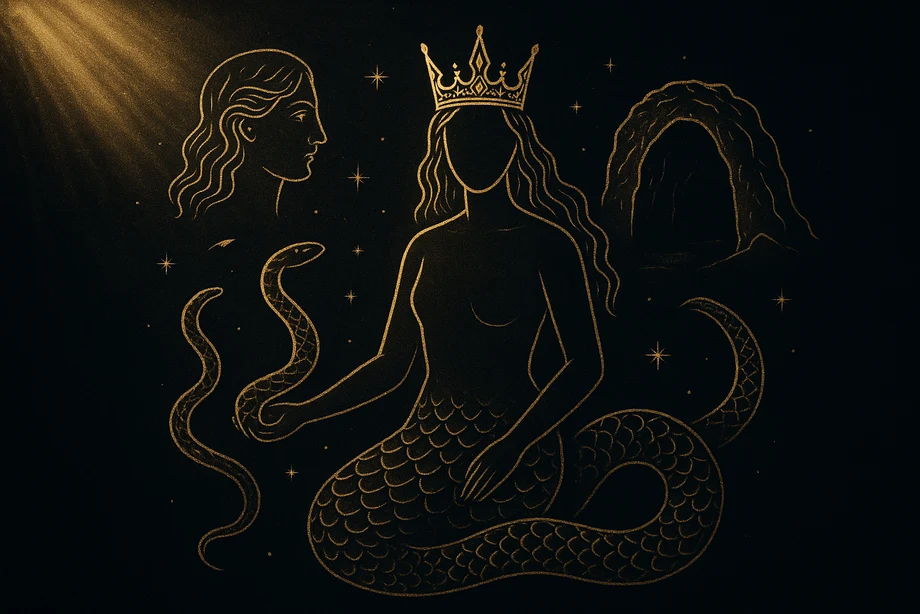
" Yet notice this: Şahmaran is not the "king" of serpents but their "shah," a sovereign, a carrier of wisdom rank. Half her body is a woman, half a serpent; a crown sits on her head, her eyes shine like two stars. In the old reverse-glass paintings of Anatolia, in the head corner of houses, her image always stands in the same posture: arms open, smiling, waiting.
In many cities this image was a protective talisman of the home. In the stone courtyards of Mardin, in the old neighborhoods of Tarsus, the picture of Şahmaran was believed to protect against the evil eye and against illness. What the viewer was reminded of was this: she does not mourn for the one who harms her home, only for the one who harms her.
Camasb, the cave, and the language of herbs
In the most widespread account a young man, in some versions named Camasb or Cemşid, climbs down into a well with his friends to gather honey. Once his friends lift the honey out, they forget him and do not pull him back up. Left alone, the young man passes through a crack in the well and reaches a shining garden underground.
There, on a white throne, surrounded by countless serpents, he sees Şahmaran.
She does not harm him. She receives him as a guest, warms him, feeds him. For years the young man lives there; Şahmaran teaches him what every plant is for, which herb closes which wound, which root quiets which ache. The cave is not a death but a school. The young man becomes a healer underground.
One day he asks to go home. Şahmaran lets him, on one condition: he will never tell anyone, not even the king, where she is. For the cruel king has fallen ill, and the physicians have said the only cure is a broth made from Şahmaran's flesh.
The king's men inspect the back of everyone who bathes, because they say whoever has seen Şahmaran will carry a scale-mark on their back. Camasb is caught at the bath.
He tells the king the way to the underground. Şahmaran is hunted. Yet before she dies she says: "Cut me in three.
" It happens as she said. The king's illness lifts but those who eat with him are poisoned; her head flows away in the water; and Camasb, who eats the tail, becomes the wisest healer in the world.
The serpent, the crown, and reverse-glass paintings
Şahmaran's symbols name a paradox. The serpent is a many-layered animal in Anatolia. In Hittite texts the great serpent Illuyanka is a raw power defeated by the storm god; yet in the same land, when the cult of Asklepios spread, the serpent became the sign of healing.
The snake winding around Asklepios's staff is still on the emblem of hospitals today. Şahmaran feeds from exactly this double vein: both the depth of the underground and the knowledge of healing.
The crown announces that she is a sovereign, but a sovereign of a very different kind from the Greek or Roman gods. Her kingdom is not a palace but a cave. Her subjects are herbs, roots, and the silent creatures that know them.
For centuries the reverse-glass painters of Mardin's narrow streets multiplied her image in bright colors; hung in the head corner of a home, the Şahmaran picture was a talisman believed to protect those within.
In folk tradition a serpent, especially a house snake, was not killed. "The snake that enters the house is its owner," people said; if you harm it, Şahmaran is offended. This belief was alive in many Anatolian villages until the middle of the twentieth century.
The serpent is the animal not of death but of secret; it knows how to shed its skin, how to renew itself.
The cost of shared knowledge
What does Şahmaran say today? In astrology she touches the transformative line of Pluto, the healing face of Mercury, the crossing of Scorpio and Virgo. But the myth itself points to something very particular.
The Şahmaran within us is the quiet wisdom carried by the body's knowledge and intuitive understanding. The touch a therapist earns after years, the protection a parent never puts into words, the warmth that is hard to describe in the hand of a healing practitioner. That knowledge does not come from books but from the cave, from depth.
The aching part of the story is the moment of sharing. The instant Şahmaran's secret is told, she is hunted. Bringing intuitive knowledge into the open often demands a price.
Because those who came before us stayed silent, because the body was taken lightly, because women's minds were belittled, many lines of healing remained underground. Hanging Şahmaran on the walls was for this reason not a simple charm; it was a silent delivery.
The real lesson of the myth may be this: when Şahmaran was cut in three, each piece did something different. Her head reached the water, her body turned into death, her tail gave wisdom to the young man. Intuitive knowledge moves the same way; part of it returns to nature, part of it is wasted, but part of it always reaches the right hand.
The cave is still there.
The voice within
Sezgisel bilginin, beden hafızasının, paylaşıldığında kıymetlenen sırrın arketipi. Yılan eski bir şifa sembolüdür, Asklepios'tan beri. Modern okumada beden bilgeliği ve gizli yaranın iyileşmesidir.
"Cemşid mağaraya indi, orada yılanlar şahını gördü, başı kadın, kuyruğu yılan, gözleri iki yıldız." Tarsus halk hikâyesi, sözlü gelenek.
Sources: Camasb-name, Fars-Anadolu el yazma geleneği · Tarsus, Mardin ve Şirvan sözlü halk anlatıları · Anadolu cam altı resmi koleksiyonları (19-20. yy) · Asklepios kült tarihi, Bergama ve Epidaurus · Hitit İlluyanka Miti (KBo III 7) karşılaştırma kaynağı · Binbir Gece Masalları seçme el yazmaları

You can ask a question about this reading
Hypatia (Bilge Astrolog) answers your questions about Şahmaran