
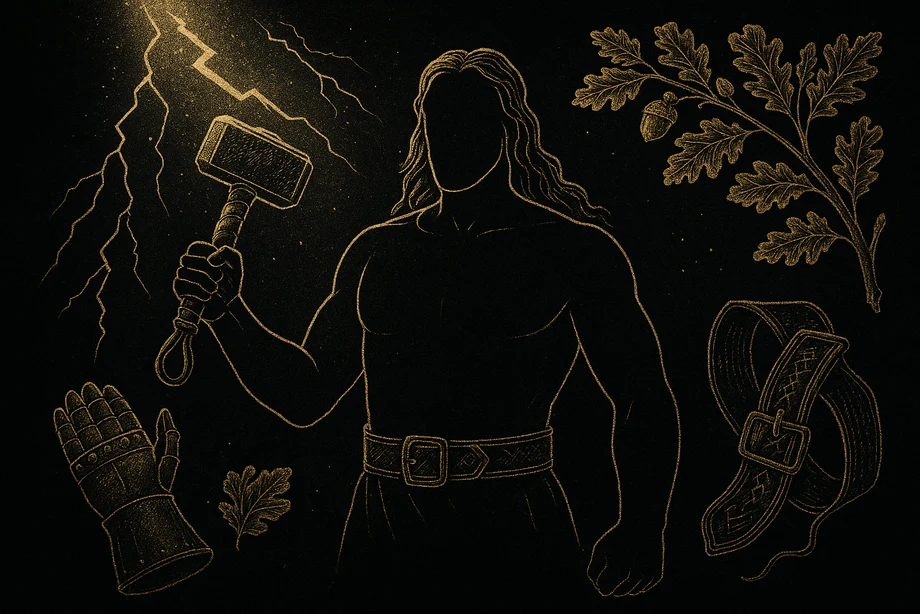
Yıldırım, koruma, güç
Archetype: Halkın koruyucusu
Son of Odin, protector of the folk
Thor was the son of Odin; his mother was Jörð, the Earth. " He is made of a different clay than his father. Odin moves by secret roads, in disguise, playing games.
Thor is direct. If he meets a giant he fights the giant; if he meets a question, more often than not he answers by breaking something.
This difference matters, because worship reflected it. The everyday Norse folk, the farmers, the fishermen, the sailors, the ordinary people, prayed to Thor more than to Odin. Odin was more the god of kings, of poets, of the warrior elite.
Thor was the god of the folk. In runic inscriptions, his is the most frequently named god. On grave stones, on protective amulets, on ship prows, the mark of Thor's hammer appears again and again.
Late in the 11th century, when Adam of Bremen describes the temple at Uppsala, he says it is Thor who sits in the middle, between Wodan (Odin) and Frikko on either side. " Christian missionaries in the north perhaps had to wrestle with Thor more than with any other god, because he answered the daily fears of the people.
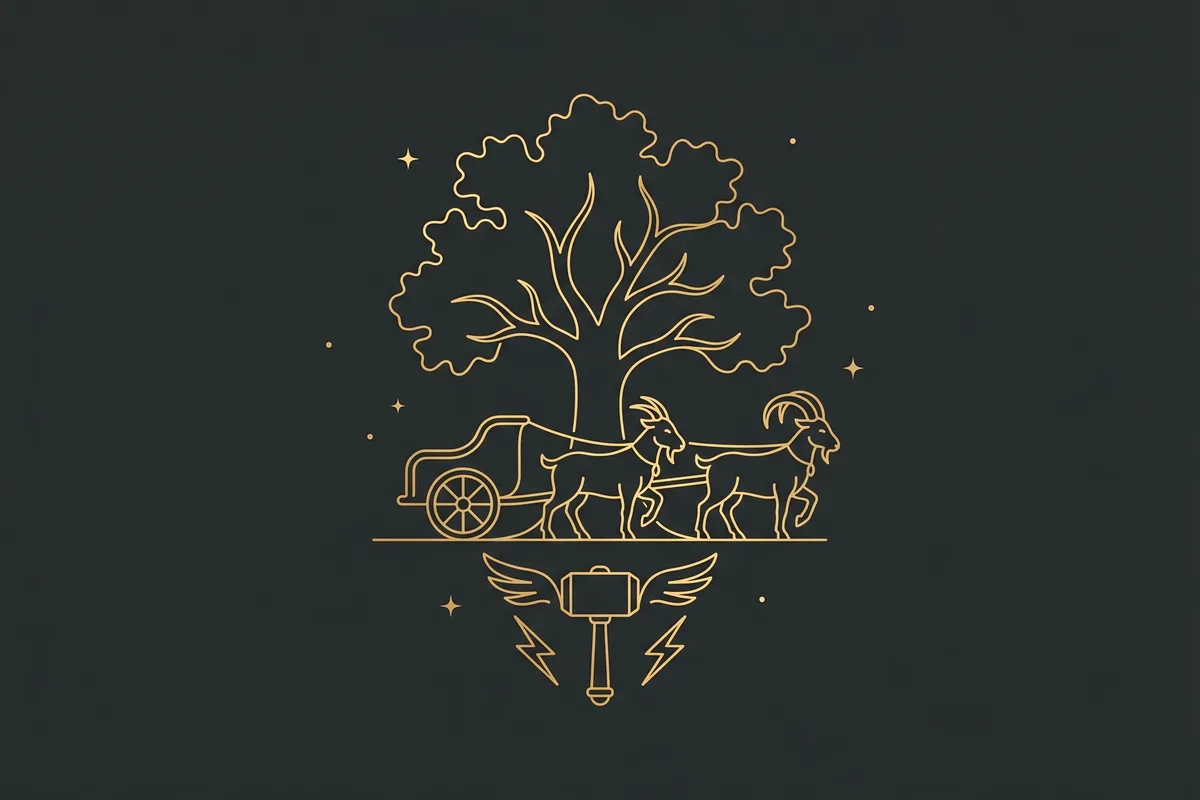
Mjölnir, the wedding at Þrymr's, Jörmungandr
Thor's best-known tool is Mjölnir, the hammer. In Skáldskaparmál 35 Snorri tells how it was forged. The dwarf brothers Brokkr and Eitri made it on a wager.
While they were casting it, Loki turned into a fly and bit Brokkr, so the hammer's handle came out short. Yet the weapon was still extraordinary: thrown at any target it would find its mark, return to its thrower's hand, and shrink to a small protective size. The name Mjölnir probably means "crusher," from an old root.
The hammer alone was not enough. Thor had a pair of iron gloves, Járngreipr, that he wore to hold it. With his belt Megingjörð buckled, his strength doubled. Three treasures, three practical tools. No ornament.
One of Thor's best-loved myths is told in Þrymskviða. The giant Þrymr has stolen the hammer and demands Freyja as his bride in return. The solution comes from Loki: Thor will dress as a bride, play the role of Freyja, and attend the giant's wedding.
The god is furious at the idea but agrees. " Finally, when they place the hammer in the bride's lap, Thor seizes it and turns the wedding into a funeral. The story is comic, but it shows how the folk saw their god.
Thor is venerable, yes, but he is not above himself, he can bear being laughed at, so long as the work gets done.
His most serious struggle is with Jörmungandr, the great serpent that circles the world. In Gylfaginning 47-48, Snorri tells of Thor's efforts to catch this serpent, together with the fisherman Hymir. They meet three times in the arc of the myth.
First, the giant Útgarða-Loki tricks Thor by making him try to lift a "cat" which is in fact the serpent; Thor manages to raise it only by one paw. Second, on the fishing trip, he sees the snake but Hymir cuts the line. Third, at Ragnarök, the final meeting comes: Völuspá says Thor will kill the serpent with the strength to walk nine paces, then fall from its venom.
Both will die. Not even a god escapes fate.
Hammer amulets, oak, and Thursday
Thor's most widespread symbol is the hammer-shaped silver amulet. Hundreds of these have been found in archaeological digs across Scandinavia, especially from the Viking age, and they multiplied in the period of the conversion to Christianity. Scholars read this as a counter-sign: against a neighbor who wore a cross, wearing the hammer was a quiet way of saying which god you stood with.
The oak was sacred to him. In the Germanic and Norse worlds the oak was Thor's tree; in the 8th century, when the missionary Boniface cut down the sacred oak of Donar (Thor's older Germanic name) in Germany, this act became a symbolic moment of Christianization. Adam of Bremen speaks of offerings made to Thor at the great blót festivals at Uppsala; in disasters such as famine, plague, or war, the people turned to him.
The day of the week carries his name. Old English Þunresdæg, Old Norse Þórsdagr, modern English Thursday, German Donnerstag, all of them the day of thunder and of Thor. The Roman week's day of Jupiter (Latin dies Iovis, French jeudi) was translated into Germanic languages as Thor's day, because the Romans and Germans saw Jupiter and Thor as carrying a similar function, both lords of thunder and of rain.
This translation shows Thor's tie to the sky, to rain, to weather.
Strength that refuses complication
What does Thor say to us today? In astrology he touches both the courage of Mars and the widening protectiveness of Jupiter. The direct movement of Aries and the earthbound endurance of Taurus carry his energy.
The Thor within us is plain strength that refuses to enter complication. The capacity that does what it knows to be right, acts without much calculation, stands in front of those it loves. He does not give an eye like Odin, he does not hang for nine nights to read a single rune.
His way is different. When danger comes he steps between, he shoulders the storm.
There is a grace to this plainness. In the myths, Thor is often outwitted, often tricked, in some scenes made to look comic. In the Útgarða-Loki episode the giants play games with him.
But the god is not ashamed of it. This is not the plainness of a mind that cannot bear complexity; it is the plainness of someone confident enough in his strength that being tricked does not unmake him.
He has a shadow too. Thor's anger is quick, and slow to release. " Read with modern eyes, this shows the limit of taking shelter in raw force.
The Thor within us, unripe, gets angry at complexity, answers a question with a wall. Ripe, he uses his strength in the right place at the right time. This is the side the myth loves.
Thor is unshowy, modest in a way, but when a real crisis comes he is there. People say this is why the folk loved him most, because in a hard moment a person does not want a complicated philosopher beside them, but someone solid they know. Thor is the divine form of that someone.
The voice within
Açık yürekli, sınırsız güçlü, ama gösterişsiz koruyucu arketip. Karmaşıklığa girmez, doğru bildiğini yapar. Modern okumada sadelik ve cesaretle koruma kapasitesinin sesidir.
"Çekici fırlatır, hedefi vurur, eline geri döner. Mjölnir, nereye gönderilirse oraya gider." Snorri, Skáldskaparmál 35.
Sources: Snorri Sturluson, Düzyazı Edda (Gylfaginning, Skáldskaparmál) · Þrymskviða, Şiirsel Edda · Hymiskviða, Şiirsel Edda · Völuspá, Şiirsel Edda · Lokasenna, Şiirsel Edda · Bremen'li Adam, Hamburg Kilisesi Tarihi · İskandinav run yazıtları ve çekiç muskaları (arkeolojik)
You can ask a question about this reading
Hypatia (Bilge Astrolog) answers your questions about Thor