
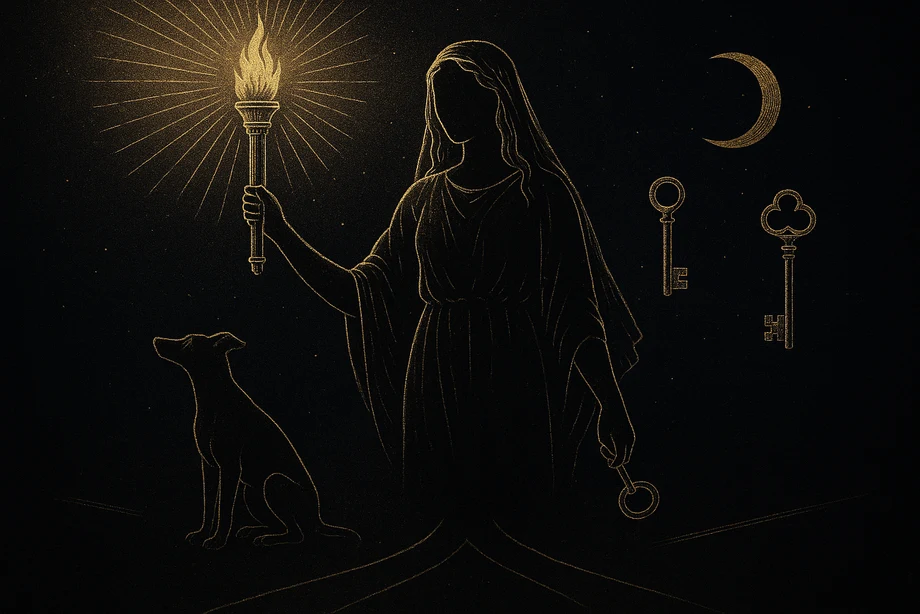
Eşik, kavşak, ay büyüsü, gece
Archetype: Eşiğin tanrıçası
Not from Olympus, but an older generation
Hekate is not one of the twelve great Olympians. Her origin reaches further back, into the generation of the Titans. Hesiod mentions her in the Theogony with extraordinary respect, and that passage is one of the most striking parts of all mythology.
According to Hesiod, Hekate is the daughter of the Titan Perses and Asteria. And here is the surprising thing: Zeus, who builds the new order, does not punish this goddess of the older generation. On the contrary, he gives her a great share.
Hekate holds authority in the sky, on the earth, and in the sea. Zeus did not take her privileges away; he even preserved them.
Hesiod describes at length how wide a domain she covers: she can grant the hunter game, the herdsman his flock, the warrior victory, the fisherman a great catch, the racer his speed, and she accompanies the growth of children. She is a goddess not confined to a single domain. Her power lies precisely in this fluidity, in her boundary-crossing nature.
The torchbearer who searched for Persephone
Hekate's best-known moment in myth appears in the Homeric Hymn to Demeter. When Persephone is drawn into the underworld, only two gods hear the girl's cry: Helios the Sun, and Hekate.
In the hymn, Hekate comes to Demeter with a torch in her hand. She tells her that she heard her daughter being taken. Then the two of them go together to Helios and learn the truth from him.
When Persephone returns to the surface of the earth, it is Hekate who welcomes her, who accompanies her, and the hymn says: from that day on, Hekate becomes the goddess who walks before and behind Persephone, her companion.
This small scene shows Hekate's true nature. She is the goddess who comes when something is lost in the dark, who carries light in her hand, who shows the way. She guides through that difficult passage between the underworld and the surface.
She should be remembered not as a frightening figure but as a companion who stands at the threshold and holds the light.
Three roads, a torch, and a key
Hekate's symbols tell exactly what she is. The best known is that she is the goddess of the crossroads, the place where three roads meet.
Why the crossroads? Because every crossroads is a point of choice. One road ends and another begins.
Hekate is the goddess of that moment, of that threshold. Her torch makes the way visible in the dark. Her key symbolizes the opening and closing of doors, the passage from one domain to another.
The dog was sacred to her, as an animal linked with night and with thresholds.
Hekate was often depicted with three bodies, three faces, because she looks in three directions at once, watching three realms. She was associated with the Moon, with night, with the invisible knowledge of transitions. Her being a goddess of night is not a praise of darkness. Night is the time for seeing what the day cannot.
The light held at the threshold
What does Hekate say to us today? In astrology she touches the domains of both the Moon and Pluto, which suits her nature as both intuitive and transformative.
The Hekate within us is the voice that comes online in moments of transition. The one who stands beside us when a door closes, when a road ends, at the crossroads where we cannot tell which way to turn. She does not hand us a ready answer. She only holds the torch, so that we can see our options.
Modern depth psychology reads her as the protective guide of transformation. When we pass through a threshold in life, in that uncertain gap between our old self and our new one, Hekate energy is at work. She teaches us to see darkness not as a threat but as a zone of passage.
Every choice is a small death and a small birth, and in those moments she reminds us that we are not alone. Hekate does not frighten. She simply stands at the threshold and holds the light.
The voice within
Geçişlerin, seçim noktalarının ve gece bilgisinin arketipi. Bir kapı kapandığında diğerini gösteren içsel meşale. Modern derinlik psikolojisinde dönüşümün koruyucu rehberi olarak okunur.
"Üç yolların kraliçesi, geceyi ve gündüzü gören." Hesiod, Theogonia, 411-415.
Sources: Hesiodos, Theogonia · Demeter'e Homerik İlahi · Orfik İlahiler · Pausanias, Hellas Tasviri
You can ask a question about this reading
Hypatia (Bilge Astrolog) answers your questions about Hekate