
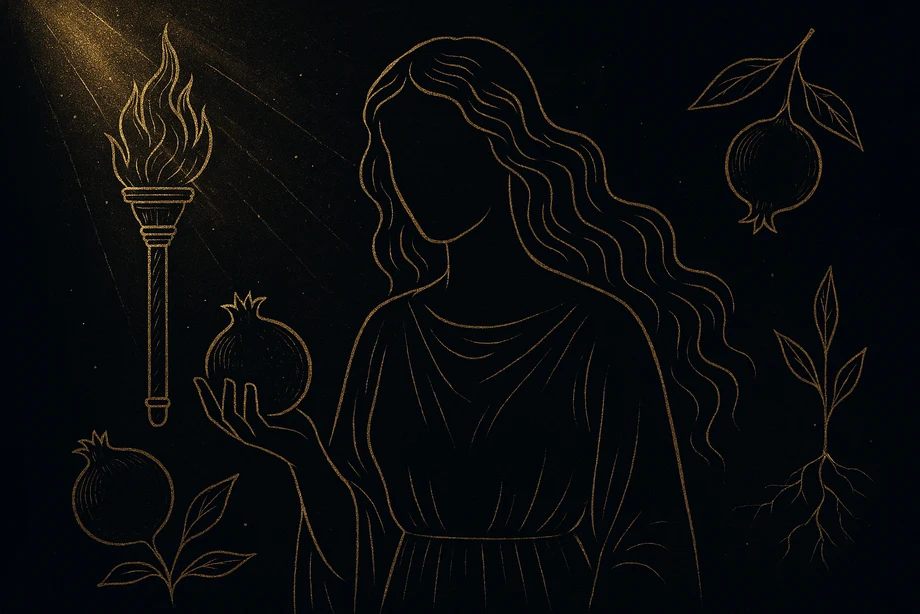
Yeraltı, mevsim, dönüşüm
Archetype: Kayıp ve dönüş
Kore, the one still a girl
Persephone's name in the beginning was Kore, and the word simply means "girl" or "young maiden." She was the daughter of Demeter, the goddess of harvest and abundance. Mother and daughter were an inseparable pair: one the yield of the earth, the other the fresh, young shoot of that yield.
The Homeric Hymn to Demeter tells her story in its most complete form. One day Kore was gathering flowers in a meadow with her companions, the daughters of Okeanos. While picking roses, crocuses, violets, and hyacinths, her eye fell on a narcissus of extraordinary beauty. The earth had grown this flower especially, as a snare.
The moment Kore reached for the flower, the ground split open. Hades, the god of the underworld, rose up in his golden chariot and, taking the young goddess with him, descended into the depths. The mountains and the deeps of the sea heard Kore's cry, but an armful of flowers scattered across the meadow, and that was all that remained behind.
A mother's grief and six seeds of the pomegranate
When Demeter heard of her daughter's loss, she searched the world for nine days, torches in her hands. At last Hekate and Helios told her the truth: Hades had taken Kore, and with the consent of Zeus. Demeter sank into such grief that she withdrew from among the gods and forbade the earth to bear fruit.
Seeds did not sprout, crops did not grow, famine threatened the world.
In the end Zeus had to intervene. He sent Hermes to the underworld; Persephone would return to her mother. But before she left, Hades offered her a pomegranate seed, in some accounts six. Persephone tasted the pomegranate. And whoever tastes the food of the underworld is from then on bound to it.
So a compromise was made: Persephone would spend part of the year with her mother on the surface, and part in the underworld beside Hades. This is how the seasons were born. While Persephone is in the underworld, Demeter mourns and the earth withdraws into winter.
When her daughter returns, the surface opens into spring. According to the hymn, when her daughter came back to her, Demeter gave humankind the knowledge of the harvest and the Eleusinian Mysteries.
The pomegranate, the torch, and the Eleusinian Mysteries
Persephone's symbols carry her dual nature. The pomegranate symbolizes both the bond she made with the underworld and abundance, with its countless seeds inside. The fresh shoot is the sign of spring, of return, of beginning again.
The torch recalls both the light her mother carried while searching for her, and the brightness that guides the way through the darkness of the underworld.
The heart of Persephone's worship was at Eleusis. In this town near Athens, the Eleusinian Mysteries, held in honor of Demeter and Persephone, were the most revered and most secret religious rites of ancient Greece. For centuries thousands of people took part in these mysteries.
The content of the rite was held so sacred that participants swore not to reveal it, and indeed it has largely remained a secret.
What is known is that the mysteries concerned death and rebirth, the fate of the soul. Persephone's descent into the underworld and her return gave participants a sense that death might be not an end but a passage. The goddess was known in Rome as Proserpina, and was always remembered with respect as the queen of the underworld.
The one who lives the descent and the return
What does Persephone say to us today? In astrology she touches both the transformative domain of Pluto and the inner world of the Moon.
The Persephone within us is the part of us that lives the cycle of loss and return. In life we all pass through a kind of descent: a grief, a separation, an illness, the end of a dream, a dark period in which we no longer recognize ourselves. Persephone's story says that this descent is not an end.
She was drawn downward, but she did not vanish below. There she was transformed into something else.
The most beautiful part of the story is this: the Persephone who rises is not the Kore who descended. Kore was her mother's daughter, a young goddess not yet given form. The one who returns is the queen of the underworld, someone with a kingdom of her own, someone who knows her own depth.
The myth asks us to remember her not as a victim but as the queen of transformation. The descent, if you return from it, is not a ruin but a ripening. After every winter a spring comes, but the one who returns is no longer the same person.
The voice within
İçsel inişin tanrıçası. Kayıp, yas, dönüşüm ve geri dönüş döngüsünü yaşayan herkesin sezgisel rehberi. Annenin kızı olmaktan kendi krallığının kraliçesi olmaya geçişin sesidir.
"Yeraltında nar yedim, artık yarı yılı orada geçirmem gerek." Homerik Demeter İlahisi, M.Ö. 7. yy.
Sources: Demeter'e Homerik İlahi · Hesiodos, Theogonia · Ovidius, Metamorphoses · Ovidius, Fasti · Apollodoros, Bibliotheke · Pausanias, Hellas Tasviri

You can ask a question about this reading
Hypatia (Bilge Astrolog) answers your questions about Persephone