
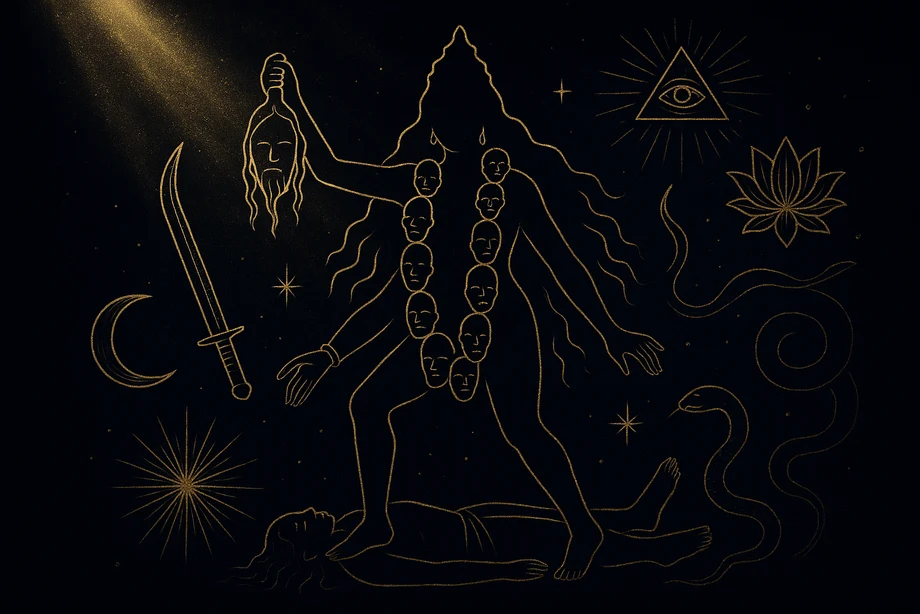
Zaman, döngünün kapanışı, kara ana
Archetype: Döngünün kapanışı
A name from the root of time
In Sanskrit, kala means two things at once: time and black. Kali carries both. Her name is the feminine form of time itself, and can be read as "she who consumes time" or "she who closes the cycle." To know her as a destroyer is to not know her at all, because no wind that closes a season is destroying it. It is making space.
Kali's Vedic roots are scattered but real. In the Rig Veda and the Mundaka Upanishad, the word "kali" appears as one of the names given to the seven tongues of fire, where it meant "the black one," the deepest, innermost tongue of the flame. Figures in the Atharva Veda and the late Vedic period can be read as forerunners of Durga and the other forms of the great Goddess.
Kali's true emergence, however, is found at the heart of the Markandeya Purana, in the text known as the Devi Mahatmya. This seven-hundred-verse text, dated to around the sixth century CE, is the most intense narrative in the Indian tradition devoted to the Goddess. In the Shakta tradition, the lineage that places Shakti (the cosmic feminine power) at the center, this text is read with the reverence of scripture.
And in it, Kali comes out from between Durga's brows.

Rakta-bija and the goddess who stands by her own tongue
The scene told in the seventh and eighth chapters of the Devi Mahatmya is Kali's real introduction. While the goddess Durga is fighting the asuras Shumbha and Nishumbha, their general Rakta-bija enters the battlefield. His name means "the blood seed," because every drop of his blood that falls to the ground rises again as a new copy of him.
Each strike against him is just a way of multiplying him.
Durga's brows draw together, and from that knotted brow comes a dark, slender, long figure. This is Kali. In her hand a wide bowl, in her mouth a long tongue.
She enters the battle and catches every drop of Rakta-bija's flowing blood with her tongue before it can fall to the earth. Until the asura runs dry, Kali drinks and drinks. In the end Rakta-bija falls.
The scene's ending gives birth to the most familiar image of the myth. Drunk on her victory, Kali takes up a cosmic dance whose tremor shakes the universe loose from itself. To stop her, Shiva lies down on the ground and stretches himself out beneath his wife's feet.
The moment Kali sees her husband under her foot, her tongue freezes outside her mouth. In much Indian art that long tongue is this surprise, not a threat. The myth says something subtle: even the most destructive-seeming force pauses in front of a witness and becomes conscious.
This is why Kali is neither an executioner nor a witch. She is the goddess who flows by the tongue of time itself. What she eats is the fuel of cruelty, the multiplying blood. What she consumes makes space for what is to come. The Shakta tradition knows her as Adi Shakti, the primordial cosmic feminine power.
From Kalighat to Dakshineshwar, the last nights of Navaratri
Kali's symbols are bare and ask to be read with care. Her nakedness is not a shame but the state of a cosmos that cannot be hidden by any cover; she is the goddess who sees reality as it is. Around her neck she wears a garland of fifty-two heads, and the number is the count of the letters of the Sanskrit alphabet, so Kali is the mistress of language, of sound, of mantra.
From her waist hang severed arms, the image of release from old karma, from old action. Of her four arms, two carry images of dissolution and two show the gestures of protection and blessing. The same goddess, in the same moment, closes and gives.
Her deepest temple is Kalighat in Kolkata. In the Sati story it is counted among the Shakti Pithas; it is remembered as the place where the toe of Sati's right foot fell. " In Ramakrishna's writings Kali is not a feared figure but a mother to whom he tells every night of his life.
Navaratri means "nine nights" and is dedicated to the Goddess twice a year. The festival's last three nights are given to Mahakali, Mahalakshmi, and Mahasarasvati, the three great forms of the feminine. Kali's night, Kalaratri, is the seventh night of Navaratri and marks the deepest point in the cycle.
Beyond that, the night before each new moon, called amavasya, is given to her. In Bengal, Kali Puja, celebrated at the same time as Diwali, is the goddess's most important annual rite, especially in the Shakta tradition.
The mother who knows how to close
What does Kali say to us today? Astrology has no single planetary equivalent for her, but her energy touches at once the transformative pull of Pluto, the time-keeping weight of Saturn, and the deep waters of the Moon.
The Kali within us is the voice that knows how to close. Inside the rhythm of life that constantly pushes us to keep going, to accumulate, to hold, Kali offers a strange gift: permission to let go. To allow a relationship whose time is up, a habit that no longer feeds us, an old definition of self, to come to a graceful end.
This is not destruction; it is a harvest. Like a field left unsown for one season.
To call Kali "Mother," as the Shakta tradition does, is its finest subtlety. Because a real mother is not only the one who gives. She is the one who knows what to cut.
The mother who raises a child also gives the child permission, one day, to leave. Kali represents that second half. If her outer face is fierce, the love inside is exceedingly tender.
" The songs of Ramprasad Sen, from the eighteenth century, are some of the purest forms of this love.
The myth whispers something deep: not to resist time but to flow with it. Knowing how to close is also a kind of love.
The voice within
İçsel olarak ölmesi gerekenin tertemiz bırakılması. Kelle dizisi öldürdüklerinin değil, geride bırakılmış kimliklerin simgesidir. Modern okumada radikal kabul ve egonun ötesine geçme süreçlerinin sesidir.
"O ki zamandır, zaman içinde dans eder, sonu vardır ama sonsuzdur." Mahanirvana Tantra, 6. Bölüm.
Sources: Markandeya Purana, Devi Mahatmya · Mundaka Upanişad · Atharva Veda · Bengal Şakta gelenek metinleri · Ramprasad Sen şarkıları · Mahanirvana Tantra

You can ask a question about this reading
Hypatia (Bilge Astrolog) answers your questions about Kali