
Yaratıcı, krallık, kozmik düzen
Archetype: Düzenin baş kahramanı
The young god of Babylon
Marduk is not among the oldest gods of Mesopotamia. In the old Sumerian pantheon the chief gods were An (sky), Enlil (wind and destiny), Enki (wisdom); Marduk began as a small local god, the protector of the city of Babylon, son of Enki. But as Babylon rose, Marduk rose with it.
When Hammurabi made Babylon the center of an empire in the eighteenth century BCE, the city's god became the empire's chief god. Over centuries a theological rewriting unfolded. Marduk was no longer just the god of Babylon, he was the keeper of cosmic order.
The textual monument to this rise is Enuma Eliš. The Babylonian creation epic walks through the generations of the gods across seven tablets, and at the end brings Marduk to the stage. His birth comes early in the fifth tablet.
Born to Ea (Enki) and Damkina, he is recognized for his greatness the moment the gods see him. His father Ea grants him fifty names, each one a domain. The entirety of the seventh tablet is the unfolding of these names, almost a hymn.
Marduk's physical description is striking too. He has four eyes, four ears, and fire issues from his mouth. This is not a gothic picture but a choice of narration. Marduk is the god who sees in every direction and hears in every direction. His judgment knows no blind spot.
Facing Tiamat, drawing the world
The spine of the story was told already in the Tiamat section, but Marduk's share should be read with its own care. The gods are afraid of Tiamat and search for a head. Marduk steps forward, accepts, but he has a condition.
This condition is repeated again and again in the second and third tablets of Enuma Eliš: the gods will accept his decision unanimously, the hierarchy will be rewritten after Tiamat, and Marduk's word will stand unchallenged. The gods assemble in the Upšukkinakku council, eat and drink together, and agree.
Then he prepares for battle. He gathers the seven winds, sets a net in seven directions, builds a chariot and harnesses four horses: Killer, Pitiless, Trampler, Swift. He takes the lightning into his hand, he carries light before his body.
When Marduk approaches Tiamat, he challenges her to single combat. Tiamat scorns him and opens her mouth. In that moment Marduk lets loose the evil winds into her mouth, and her mouth cannot close.
He looses his arrow and strikes her heart. He splits her body and shapes the sky and the earth from it.
Now the myth moves into a second part that most summaries skip. Creation is not only bodily. Marduk sets the positions of the stars in the sky, he orders the twelve months and ties each month to a constellation.
He marks the start of the New Year festival. " So astronomy, the calendar, the rhythm of time, all come from his hand. Marduk is not only a warrior god, he is a cosmic engineer.
In the end he asks for his own city. The gods labor for a year and build Babylon, raising the Esagila temple at its center and the ziggurat Etemenanki beside it. " It was the highest ziggurat known in the ancient world, and most scholars consider it the historical reference behind the Tower of Babel in the Hebrew tradition.
The mušḫuššu dragon, the spade, and the Akitu festival
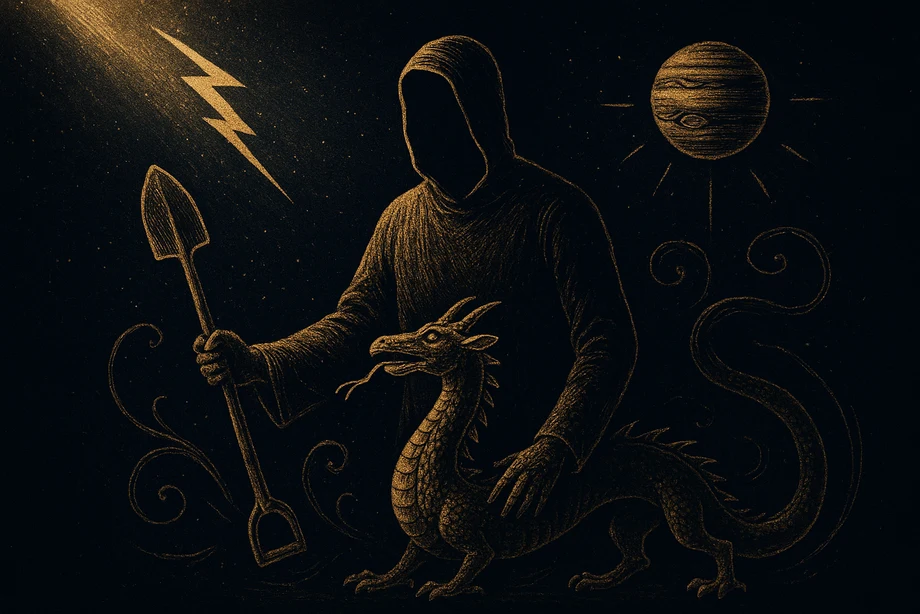
Marduk's symbols carry the god's many sides. The best known is the snake-dragon called mušḫuššu; horns on its head, scales over its body, lion paws in front, eagle talons at the back. On the Ishtar Gate of Babylon this creature is ranged in ceramic reliefs along the wall.
Moved now to the Pergamon Museum in Berlin, you can still look upon the mušḫuššu from this gate, on the lapis lazuli blue where it has stood since the sixth century BCE.
Another of his symbols is the marru, the spade. That Marduk carries an ordinary farm tool as a symbol matters. He is not only a cosmic warrior; he is also the god who keeps agriculture, and so civilization, alive.
The spade is the heart of Mesopotamian farming, the land turned by hand and fed by rain. Lightning is another of his domains, weather and yield. To the Babylonians, the planet Jupiter belonged to Marduk.
The Greek and Roman tradition took the Marduk-Jupiter bridge as natural for this reason; Jupiter's standing as chief god is itself an inheritance from old Babylonian theology.
The heart of his worship was the Akitu festival, the first twelve days of the month of Nisan in the Babylonian calendar. During this festival the statue of Marduk was carried out of Esagila, taken by boat along the Euphrates, kept as a guest in a temple outside the city, and then returned to Babylon in a great procession. During this time Enuma Eliš was read aloud.
At a certain moment of the rite the king would step down from his throne, be slapped by the priests, and then be re-crowned. Akitu taught that cosmic order had to be renewed every year. Order was not established once and for all but a covenant remade every year.
The one who rebuilds order every year
What does Marduk say to us today? Through his identification with Jupiter he carries, in astrology, the voice of expansion, of judgment, of giving meaning. But the Babylonian Marduk differs a little from the Greek Zeus or the Roman Jupiter. He is more of an engineer god. He does not only rule, he builds.
The Marduk within us is the capacity to give structure to chaos. To order a day, to carry a project from a tablet into a real work, to set a scattered life into a definite rhythm, to write our own calendar with our own hand. Marduk is a god not only when he fights but also when he traces the orbits of the months in the sky.
The core of his power is a deliberating mind: he listens, he plans, he asks for unanimity, and only then does he go forward.
The real lesson of the myth is hidden in Akitu. Marduk built the world once, but the Babylonians read his story again every year. Because order does not stay where it is built; it asks for upkeep.
The same is true in life. Just because we once drew ourselves a life, that life does not keep itself standing on its own. At least once a year we have to return to the foundations, tighten the bonds that have loosened, walk into the new year with a new intention.
Marduk presents this responsibility not as a sin but as a ceremony, as a festival, as a procession. Order is something that can be loved.
The voice within
Kaostan yapı kuran, sözle kozmosa şekil veren arketip. Liderliğin, sorumluluk almanın ve büyük resmi taşımanın iç sesi. Gölgesi katı kontrol, ışığı vizyondur.
"O ki Tiamat'ı yendi, krallığı ona verildi. Elli adı söylendi, her biri başka bir gücünü adlandırdı." Enuma Eliş, Tablet VI-VII.
Sources: Enuma Eliš, Tablet I-VII · Hammurabi yasaları, önsöz (Marduk'a atıf) · Esagila ve Etemenanki tapınak yazıtları · Akitu bayramı ritüel metinleri · Berossos, Babyloniaca (Helenistik derleme)
You can ask a question about this reading
Hypatia (Bilge Astrolog) answers your questions about Marduk