
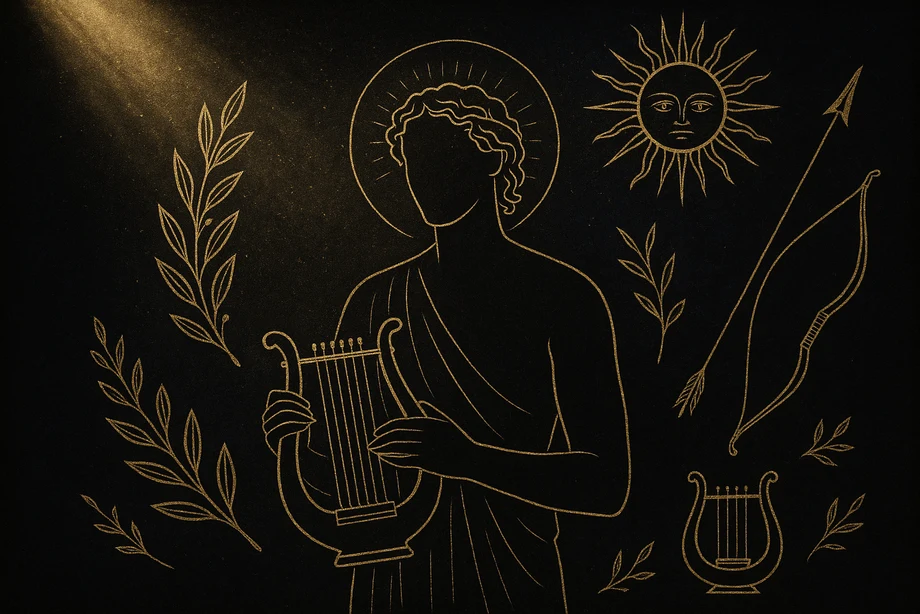
Güneş ışığı, müzik, kehanet, şifa
Archetype: Aydınlanmış sanatçı, kahin
The twin born on a floating island
Apollo's birth begins with a chase. Zeus had loved the Titan's daughter Leto, and Leto was pregnant with twins. But Hera's anger was so great that no piece of land dared to take on Leto's birth pangs, because every land feared Hera.
In the end Delos accepted. As the Homeric Hymn to Apollo tells it, Delos was a small, barren island, unanchored, floating on the sea. Precisely because it had nothing, it could risk something.
Holding onto a palm tree there, Leto gave birth first to Artemis, then to Apollo. The gods offered the newborn child nectar and ambrosia, and in that very moment Apollo filled the barren island with golden light. Delos floated no longer; it had become an anchor of the cosmos.
In this birth story the essence of Apollo is hidden: to give a center and a measure to what is uncertain, unanchored, and without form. The floating island became a place at his touch.
Python, Delphi, and the navel of the world
While still very young, Apollo set out to find a home for prophecy. The Homeric Hymn to Apollo describes his arrival at the foot of Mount Parnassus, beside a spring of water. There lived a great serpent named Python, an old, raw power of the earth. Apollo defeated it with his arrow.
That place became Delphi, and the most sacred oracle of ancient Greece rose there. The people of Delphi considered it the navel of the world, and a stone called the omphalos symbolized that center in the temple. The oracular woman called the Pythia, seated on a three-legged stool, delivered the words of Apollo.
Kings, cities, and ordinary people carried their questions about the future there.
Two phrases were inscribed at the temple entrance, both of them a summary of Apollo's spirit: "Know yourself" and "Nothing in excess." Apollo's prophecy was never crude fortune telling. It was more a mirror that reminded a person of their own limit, their own measure, their own place.
The lyre, the laurel, and music on the mountain
Apollo was the god not only of prophecy but of music, poetry, and healing. He played the lyre, and in one account his infant brother Hermes gave him this instrument, the first lyre, made from a tortoise shell. With the nine Muses, Apollo led music in the mountains and taught people the measure of poetry.
His symbols speak his nature. The lyre is sound turned into mathematics, into harmony. The laurel tree was sacred to him: in the story of Daphne told by Ovid, the nymph the god loved is transformed into a laurel tree, and from that day Apollo always carries a laurel branch, and victors are crowned with laurel.
The bow and arrow are his power to touch from a distance, with precision. The Sun came in time to be identified with him.
His role as a god of healing is meaningful too. His son Asklepios was considered the founder of medicine. Apollo could both send disease and take it back, because whoever knows measure can also restore balance. Beyond Delphi, ancient Greece honored him on Delos as well, with great festivals and the Pythian Games.
The voice of clarity and measure
What does Apollo say to us today? In astrology he is associated with the Sun, and this is a fitting match. He is the energy of clarity, of form, of knowledge that rises from within.
The Apollo within us is the desire to give a shape to chaos. To clarify a thought, to turn a feeling into a sentence, a melody, a work. That rare moment when intuition and reason speak the same language. Apollo tells us to "know yourself," to recognize your own limit and your own measure, neither scattering like a floating island nor falling into excess.
His shadow is perfectionism. When Apollo energy hardens, it wants everything to be flawless, measured, controlled, and cannot tolerate the messy, raw, formless side of life. Yet the real lesson of the myth is this: the gift of light is not burning but seeing. True clarity is not judging yourself harshly but being able to see yourself plainly.
The voice within
Form, ölçü, berraklık ve içe doğan bilginin arketipi. Sezgiyle aklın, müzikle matematiğin aynı dilde konuştuğu yer. Gölgesi aşırı mükemmeliyetçilik, ışığı ilham.
"Kendini bil." Delphi tapınağı girişinde yazılı buyruk, Apollo'ya atfedilir.
Sources: Apollo'ya Homerik İlahi · Hesiodos, Theogonia · Ovidius, Metamorphoses · Pausanias, Hellas Tasviri · Kallimakhos, Delos İlahisi
You can ask a question about this reading
Hypatia (Bilge Astrolog) answers your questions about Apollo