
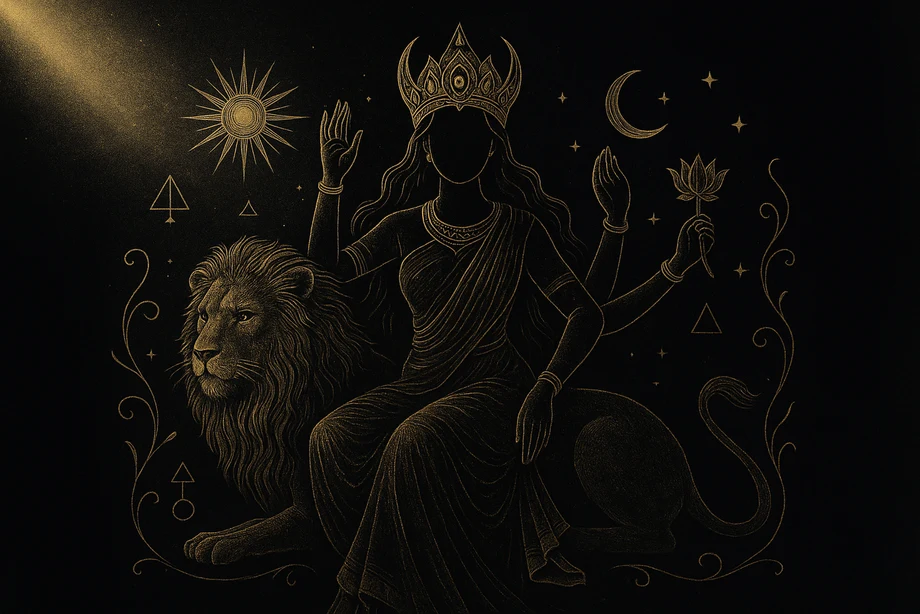
Ulu ana, tüm tanrıçaların özü, Şakti
Archetype: Bütün dişil ilkenin özü
From Vedic roots to the birth of the Devi Mahatmya
" But in the Indian tradition Devi is not an ordinary word; she is the common root of all feminine deities, the name of cosmic feminine energy. " Shiva's motionless consciousness and Shakti's active power are counted as the two poles of the cosmos. Without one, the other can neither stand nor move.
In the Vedic period, feminine deities appear scattered: Usha (the dawn), Prithvi (the earth), Sarasvati (the river and the word), Aditi (the mother of mothers). In the Atharva Veda there is a long hymn known as the Bhumi Sukta in which Mother Earth, Prithvi, is invoked; it could be read today as a great text of planetary ecology. The Vedic Aditi means "the unbounded one"; she is the mother of all the gods, and from her the gods were born.
But the gathering of feminine energy into a single goddess figure happens with the seven-hundred-verse text Devi Mahatmya, found in the Markandeya Purana. Dated to around the sixth century CE, this text recounts three cosmic crises, and in each it tells how the same goddess, in a different form, restores balance. A theological shift takes place here: there is now a single Supreme Goddess, and all other goddesses are her different faces.
The Shakta tradition is born this way, taking its place alongside the Shaiva and Vaishnava branches as the third great line of Indian religion.
Mahishasura and the birth of Durga
The second and third chapters of the Devi Mahatmya carry one of the most powerful scenes of Indian mythology. An asura named Mahishasura, whose name means "the buffalo demon," had defeated all the gods and had taken the sky, the earth, and the underworld. No one could face him, because a boon he had received said he could not be killed by any male god.
The gods gathered. Their three greatest, Brahma, Vishnu, and Shiva, fell into such anger that a light came out of their mouths, their foreheads, their hands. The lights of the other gods joined that light.
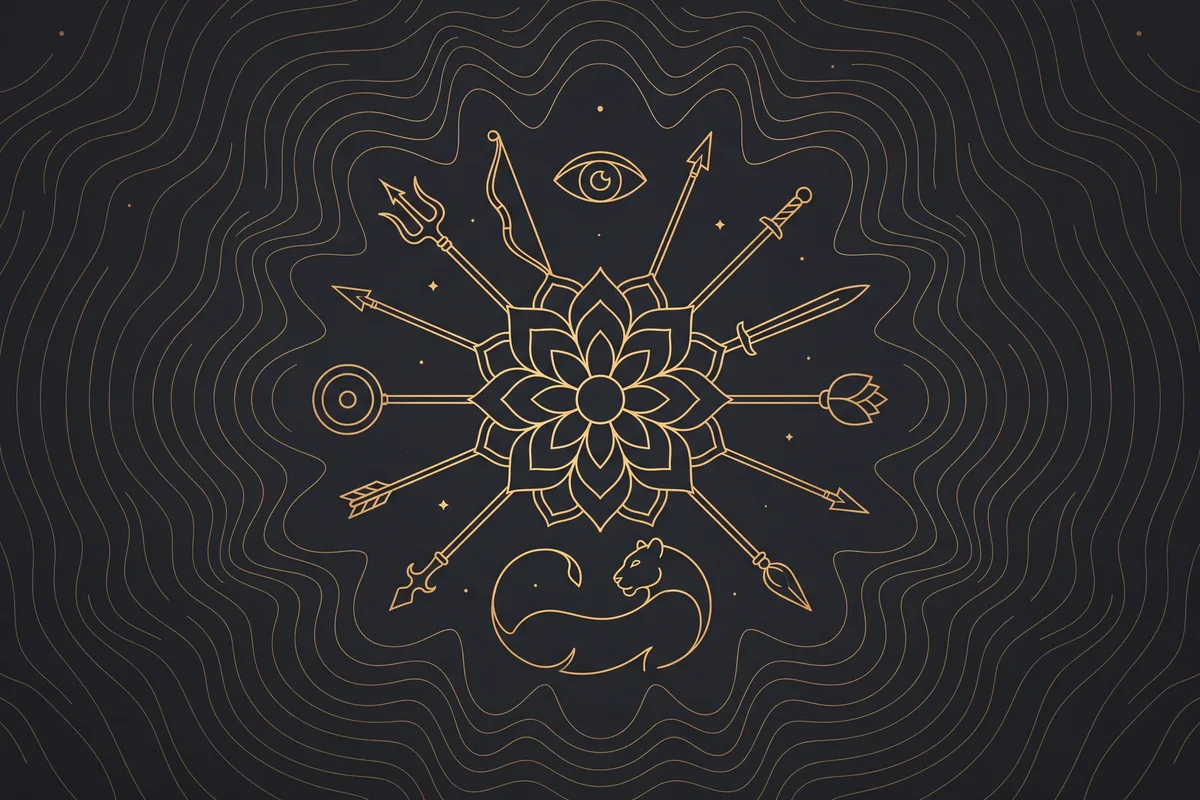
All these lights came together and, in the middle, took the form of a goddess. Her face came from Shiva, her shoulders from Vishnu, her arms from different gods; each of her organs was the grace of another god. Each god gave her his own weapon.
The trishula from Shiva, the chakra from Vishnu, the vajra from Indra, the bow and arrows from others. A lion, too, was offered to her as her mount.
This goddess was Durga. Her name means "she who is hard to reach"; it signals the firmness of a fortress. Her battle with Mahishasura lasted nine days and nine nights. Each day Mahishasura took a different form: a buffalo, a lion, an elephant-warrior. On the ninth day Durga drove the trishula into his heart, and balance was restored.
This story is the basis of Navaratri. Across the "nine nights" celebrated twice a year, the nine forms of Durga (Navadurga) are remembered: Shailaputri, Brahmacharini, Chandraghanta, Kushmanda, Skandamata, Katyayini, Kalaratri, Mahagauri, Siddhidatri. Each night belongs to one form.
The tenth day, Vijayadasami or Dussehra, is the day of celebrating the victory. What the myth says is important: cosmic balance could not be restored by any single god; only a feminine power born from the joining of every god's grace could do it. Devi is the name of the joining of the parts.
The Shakti Pithas, the Lalita Sahasranama, and three great paths
Devi does not fit into a single place of worship. Across India there are temples for her different forms, and fifty-two of them are known specifically as Shakti Pithas. As we told in the Sati story, when the burned pieces of Sati's body fell to the earth, wherever they fell became a temple.
Kalighat (Kolkata, Sati's toe), Kamakhya (Assam, Sati's yoni), Hingalaj (Pakistan, her head), Shankari Devi (Sri Lanka, her groin). This geography tells us that Devi is not a presence centered in one place; she is spread out over a continent.
" Lalita Tripura Sundari is the Supreme Goddess of the Shakta tradition, and this text invokes her with a thousand different names: sometimes she is the great mother, sometimes a tiny girl, sometimes the radiance of love, sometimes the threshold of death. The thousand names point to the impossibility of fitting a single being into one name.
The Shakta tradition divides into three great paths. The first is the Samaya path: the goddess is sought within, at the center of the heart, and external ritual is reduced. The second is the Dakshina or "right-hand" path: more traditional, centered on temple and mantra.
The third is the Vama or "left-hand" path: a more hidden tradition in which what is considered taboo is consciously transformed. All three call the same goddess, simply from different doors.
Her most powerful mantra is "Om Aim Hreem Kleem Chamundaye Vichche," the key mantra of the Devi Mahatmya. The Sri Yantra is her geometric form: a symbol made of nine interlocking triangles, five pointing downward (Shakti) and four pointing upward (Shiva); the whole cosmos is the dance of the feminine and masculine principles born from her.
Recognizing the Shakti within you
What does Devi say to us today? In astrology no single planet is her equivalent, because she is the living tissue behind the planets themselves. Just as you feel inward emotion in the Moon, value and beauty in Venus, active power in Mars, transformation in Pluto, Devi is the name of the single feminine principle behind all of these energies.
The Devi within us is the capacity to recognize our own inner power. Here "power" does not mean a social achievement or an outward dominance; it is the flow that has always been there inside, the one that moves and gives form. The same Shakti is at work in the full release of a breath, in a child coming into the world, in a sentence falling into its right place, in the turning of a season.
The Indian tradition says that this energy is specifically feminine but does not belong only to women. Devi is present in every body; in some openly, in others more veiled.
The Shakta tradition does something very valuable: it recognizes the goddess both outside and inside. You can stand before a lotus-borne goddess in a temple, and the tradition will at the same time tell you that this same goddess is also within you. One verse of the Lalita Sahasranama says it clearly: the goddess is not the object of the search, but the seeker herself.
What is Devi's shadow? Seeking her only outside, attributing her only to feminine bodies, or confusing Shakti with hardness. Real Shakti does not exclude softness, because the most flowing water passes through even the hardest stone.
The lesson of the myth is subtle: to recognize your own power is not to compete with anyone, but to allow what is already within you to flow. Devi does not give you something. She reminds you of what you have always carried.
The voice within
Tek bir tanrıçada toplanan tüm dişil arketiplerin kaynağı. Anne, savaşçı, bilge, sevgili, tek bedende. Modern okumada bütünleşmiş dişil bilincin sesidir.
"Ben her şeyim, ben yaratırım, korurum, dönüştürürüm. Tüm tanrıçalar benim tek bir yüzümdür." Devi Mahatmya, Bölüm 11.
Sources: Markandeya Purana, Devi Mahatmya · Atharva Veda, Bhumi Sukta · Rig Veda (Aditi ve Usha ilahileri) · Lalita Sahasranama · Devi Bhagavata Purana · Brahmanda Purana (Lalitopakhyana)

You can ask a question about this reading
Hypatia (Bilge Astrolog) answers your questions about Devi