
Bilgelik, yazı, ölçü, ay
Archetype: Yazıyla evreni tutan
The ibis-headed scribe
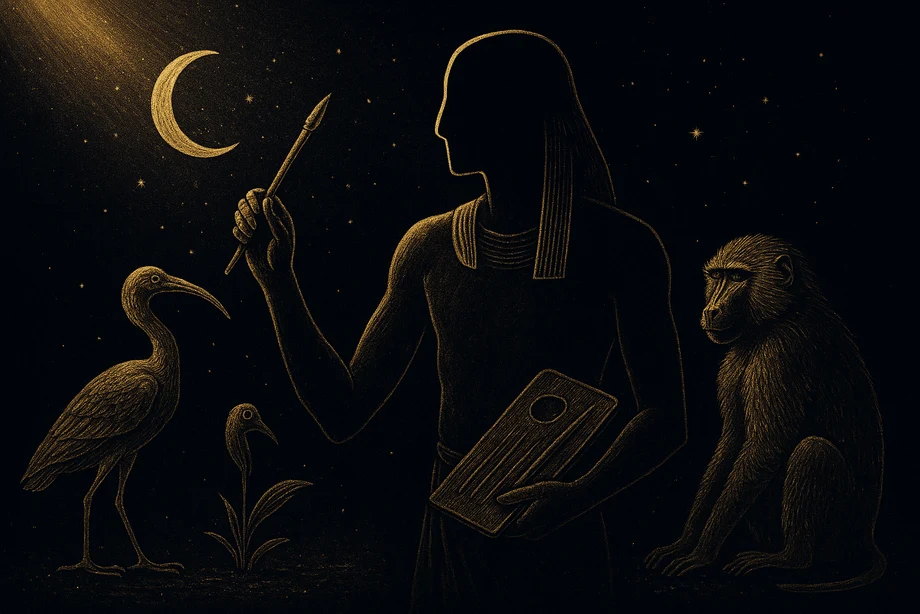
Thoth's Egyptian name was Djehuty, written by the Greeks as Thoth. He was most often depicted as a man with the head of an ibis, sometimes as a baboon. Neither animal was chosen at random.
The ibis is a bird that walks the banks of the Nile, examining fish and insects one by one, dipping its beak into the water with a measured gesture, like someone writing. The baboon is an animal that greets the sunrise at dawn with calls, and the ancient Egyptian read this as an announcement of time.
Thoth was a moon god. This matters, because in Egypt the sun belonged to Ra as the highest authority. But the moon represented a different wisdom.
The moon changes shape each night, waxes and wanes, disappears and returns, and yet is always the same moon. The moon measures time. The moon represents cycle.
Thoth was the god of this cycle, of measure, of the calendar. It was said that he ordered Egypt's lunar calendar, and later the annual calendar of 365 days.
In many sections of the Pyramid Texts Thoth stands beside Ra, putting the decisions of the gods into writing. In the Coffin Texts he gives testimony at the court of Osiris. In Chapter 125 of the Book of the Dead, in the scene of the weighing of the heart, Thoth stands to one side and records the result of the scales on papyrus.
Without him no decision is official.
Hieroglyphs, alchemy, and geometry
For the Egyptian, writing was a gift of the gods, and the giver was Thoth. The word hieroglyph is Greek and means "sacred carving"; the Egyptians themselves called their script the "words of the god." In the Coffin Texts it is said that Thoth invented writing, and that Osiris then asked him to teach this art to humankind.
In his first-century history, Diodorus Siculus describes Thoth (as the Greek Hermes) as the founder of all the sciences of Egypt. According to him, Thoth taught humans the alphabet, grammar, astronomy, music, arithmetic, and geometry. In Plato's dialogue Phaedrus, Socrates tells a legend in which an Egyptian god named Theuth, that is Thoth, invents writing and presents it to the king, who worries that writing will weaken human memory.
This is one of the earliest critical reflections on writing in the West, and its source too is Thoth.
In the Hellenistic period Thoth was merged with the Greek Hermes. Their attributes already overlapped: both messengers among the gods, both standing at thresholds, both connected with knowledge and the word. " In the second and third centuries CE a collection of texts known as the Corpus Hermeticum was written in Alexandria, attributed to Hermes Trismegistus.
These became the foundational texts of alchemy, astrology, and Gnostic philosophy. When Marsilio Ficino translated them into Latin in the Renaissance, the direction of Western esotericism shifted. The shadow of an ibis-headed scribe of Egypt reached all the way to Florence, two thousand years later.
Khmun, the Eight Gods, and Maat
Thoth's main cult center was the city of Khmun, at the crossing point of Upper and Lower Egypt; the Greeks named it Hermopolis. Here a cosmogony was told in which Thoth presided over the Ogdoad, the Eight Primordial Gods. For the Egyptian, creation could be narrated from many places: from Heliopolis there was the cosmogony of Atum, from Memphis that of Ptah, and from Khmun that of the Ogdoad.
Another important relation was between Thoth and Maat. Maat was the goddess of truth, balance, and cosmic order, and in some myths she is regarded as the wife of Thoth. This pair is deeply meaningful.
On one side, truth itself (Maat), on the other, the scribe who writes, measures, and records that truth (Thoth). Without both, the order of the cosmos is incomplete, because order does not merely exist, it is also witnessed and put into writing.
In the inscriptions of the Dendera Temple, Thoth is also associated with medicine. Because he was the one who calculated the degrees of the moon and the cycles of the planets, he could also read the course of an illness. Egyptian physicians often called on his name when praying for their patients.
The origin of astrology reaches back to Egypt, and that origin lies in the domain of Thoth.
The one who writes does not forget
What does Thoth say to us today? In astrology he is the Egyptian counterpart of the planet Mercury: the energy of communication, of language, of measure, of small but sharp intelligence.
The Thoth within us is the voice that can turn experience into knowledge. Living a day is one thing; writing that day down and seeing what was in it is another. " Keeping a journal, making a note after a decision, going back over an argument sentence by sentence after it has ended, all of these are rituals of Thoth.
His wisdom is not cold. His wife Maat was truth itself, so what Thoth measures is not dead data but the breathing balance of the cosmos. The Thoth within us is not an accountant but a witness.
To bear witness is not to judge. To bear witness is to see what is, and not let it be forgotten. Writing does not weaken memory, as Plato feared; good writing helps memory.
The gift of Thoth is to refuse to let experience be carried off by the wind.
The voice within
Bilgi, dil ve aracılığın arketipi. Düşünceyi forma çeviren, deneyimi anlatıya dönüştüren içsel ses. Hermetik gelenekte ilham ve aktarımın koruyucusudur.
"Yukarıda olan aşağıda olan gibidir, aşağıda olan yukarıda olan gibidir." Zümrüt Tablet, Hermes Trismegistus'a atfedilir.
Sources: Tabut Metinleri · Ölüler Kitabı, Bölüm 125 · Diodorus Siculus, Tarih Kütüphanesi I · Plato, Phaidros · Corpus Hermeticum · Dendera Tapınağı yazıtları
You can ask a question about this reading
Hypatia (Bilge Astrolog) answers your questions about Thoth